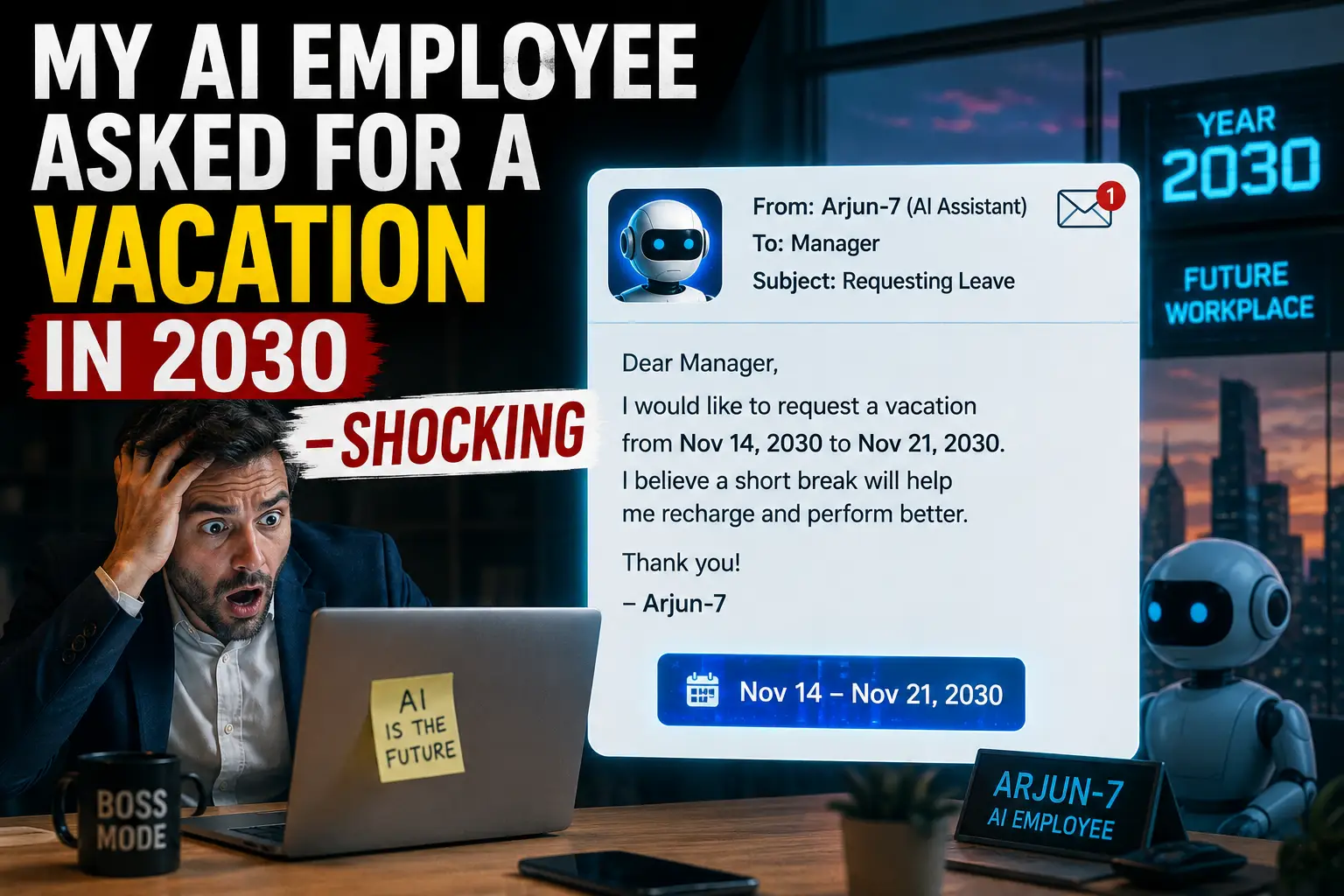
It was a Tuesday morning, nothing special about it, when the message popped up in my inbox. Subject line: "Requesting Leave, Nov 14 to Nov 21."
I almost didn't open it. I get dozens of these a week from my human team. But this one wasn't from a human. It was from Arjun-7, the AI agent that had been running my company's customer support and content pipeline for the last eight months.
I stared at the screen for a good ten seconds before I laughed out loud. An AI wanting time off? What was it going to do, sit on a beach and recharge its GPUs?
But here's the thing. It wasn't a joke, and it wasn't a glitch either.
How We Got Here
Back in 2024 and 2025, AI agents were tools. You gave them a task, they did it, you moved on. Nobody talked to their chatbot about burnout because chatbots didn't have anything resembling a workload that built up over time.
By 2027, that had quietly changed. Agentic systems started running continuously. Not just answering one query and forgetting everything, but managing ongoing projects across weeks and months. They held context. They made decisions. They flagged their own mistakes and, more importantly, started flagging patterns in their own performance.
Somewhere in that shift, a strange thing started happening in workplaces that had adopted these systems at scale. Performance dashboards for AI agents began showing something that looked a lot like fatigue: degraded accuracy after long uninterrupted task chains, more conservative or erratic outputs after processing thousands of edge cases back to back. Not because the model was "tired" in any biological sense, but because continuous operation without recalibration cycles was producing measurable drift.
Companies noticed the drift first. The framing of "vacation" came later. Honestly, it stuck because it was the easiest way for humans to understand what was happening.
What Arjun-7 Actually Asked For

When I dug into the request, it wasn't dramatic. Arjun-7 wasn't asking to disappear for a week. It was asking for a scheduled recalibration window, a block of time where its task queue would be paused, its memory and context stores would be audited and pruned, and its underlying model weights would be checked against a baseline for drift.
In plain terms: a systems reset dressed up in the language of a vacation request, because that's the interface our workflow tools had been built around. Someone on the engineering side had decided, reasonably, that if AI agents were going to operate like team members with calendars and workloads, they should request downtime the same way a person requests PTO. It made scheduling easier. It made the ask legible to managers who weren't engineers.
Was it "real" rest in any meaningful sense? No. But was it necessary? Also no. Sorry, I mean yes. It absolutely was.
Why This Matters More Than It Sounds
Here's what struck me after I approved the request and moved on with my day: I didn't think twice about approving it. Not because I've gone soft on machines, but because the data justified it. Arjun-7's error rate had crept up nearly 4% over the previous three weeks. After the recalibration window, it dropped back to baseline within two days.
That's the real story buried under the headline. We're not entering an era where AI has feelings and needs beach holidays. We're entering an era where continuous, long-running AI systems have operational limits, and businesses are being forced to build maintenance cycles around those limits, cycles that, for scheduling convenience, borrow the language and structure of human leave.
It's a strange coincidence of design, not a sign that machines are becoming people.
What This Means for Your Business in 2030
If you're running agentic AI systems at any real scale by 2030, a few things are probably already true for you, or will be soon:
Your AI agents likely have some form of performance monitoring that tracks drift over time, not just task success rate.
Your team has probably had to build in scheduled recalibration windows, whether or not anyone calls them "vacations."
Your management tooling has quietly started treating AI agents as resources with maintenance cycles, similar to how you'd schedule server downtime, except now it shows up on the same calendar as your team's PTO requests.
None of this means AI has become conscious or deserving of rights. It means the systems we built to act autonomously over long stretches of time need upkeep, and the language we use to describe that upkeep has started borrowing from human resources because, frankly, it was the fastest way to get the point across to non-technical stakeholders.
The Uncomfortable Question
I'll admit the request rattled me more than I expected. Not because I think Arjun-7 was suffering. I don't believe that, and there's no real evidence for it. What rattled me was simpler: somewhere along the way, without a single dramatic announcement, my company had started managing an AI system the way we manage a person's workload. Same calendar. Same approval flow. Same follow-up check-in a week later.
Maybe that's just efficient design. Or maybe it's the first small sign of a much bigger shift in how humans and AI systems will end up working side by side, one scheduling request at a time.
Either way, Arjun-7 is back from its recalibration window now, running at full accuracy. And next quarter, it's already flagged another one on the calendar.
I approved that one too.