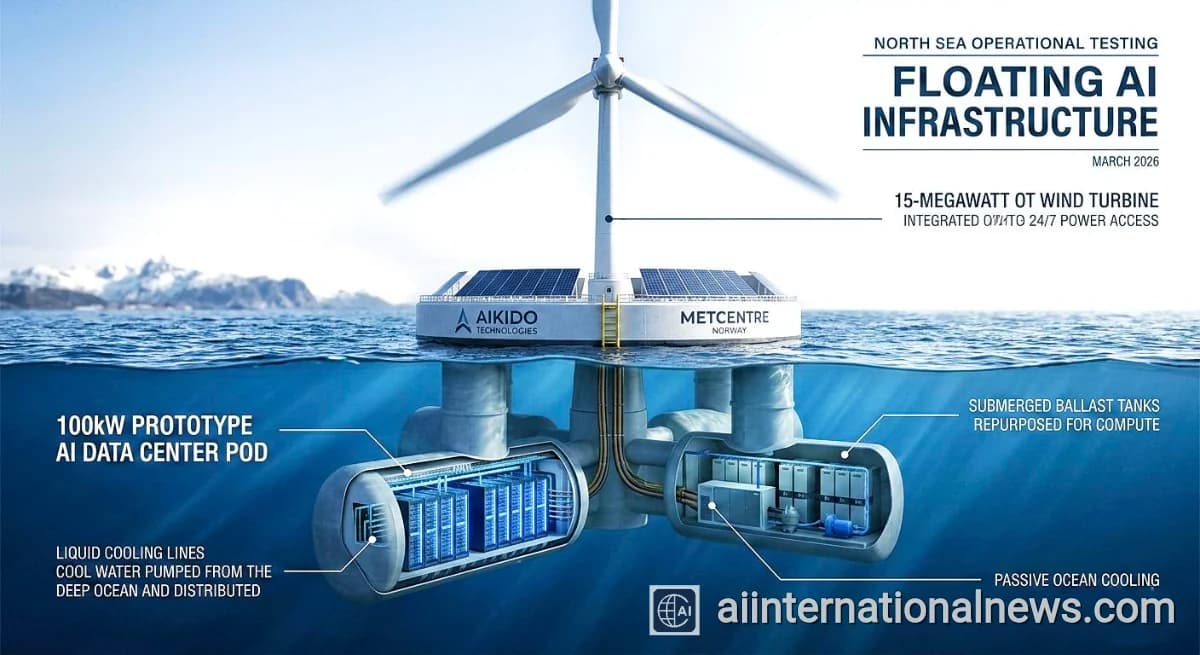
BREAKING: San Francisco-based startup Aikido Technologies has officially unveiled the AO60DC, a revolutionary floating offshore wind platform that houses gigawatt-scale AI data centers inside underwater ballast tanks. The company plans to deploy its first 100-kilowatt demonstration unit off the coast of Norway this year, offering a massive oceanic solution to the crippling AI power and cooling crunch.
The power crunch for artificial intelligence data centers has escalated to such an extreme in 2026 that tech titans—most notably Elon Musk—have publicly floated the idea of launching server farms into orbit to harness 24/7 solar power. However, a San Francisco-based startup believes the answer does not lie in the vacuum of space, but rather in the depths of the ocean. Aikido Technologies has officially unveiled the AO60DC, a first-of-its-kind floating offshore wind platform specifically designed to co-locate high-density, AI-grade compute directly with renewable wind generation and integrated battery storage.
By submerging data halls inside the massive ballast tanks of floating wind turbines, Aikido aims to bypass the crippling land, water, and energy constraints that are currently suffocating the AI industry's growth. With a 100-kilowatt demonstration unit scheduled to be deployed off the coast of Norway in the North Sea later this year, and gigawatt-scale commercial projects slated for 2028, the ocean is rapidly becoming the next great frontier for global computing infrastructure.
The AI Energy Crisis: Why Land is No Longer Enough
To understand the necessity of Aikido's radical approach, one must first look at the sheer scale of the AI energy crisis. The training and continuous inference of next-generation large language models (LLMs) require a staggering amount of electricity. Traditional terrestrial data centers are hitting hard physical and regulatory ceilings. Developers are finding it nearly impossible to secure the necessary land, tap into already-overburdened local power grids, and source the millions of gallons of fresh water required for conventional evaporative cooling systems.
This geographical gridlock has led to increasingly desperate proposals, including building dedicated nuclear small modular reactors (SMRs) or, as discussed in recent Silicon Valley circles, looking to space. But as Sam Kanner, CEO of Aikido Technologies, aptly stated during the AO60DC unveiling: 'Before we go off-world, we ought to go offshore.' The ocean covers over 70% of the Earth's surface, offering practically infinite space, an inexhaustible heat sink for cooling, and access to some of the most consistent and powerful wind resources on the planet.
Technical Anatomy of the AO60DC Platform
The engineering behind Aikido's AO60DC platform is a masterclass in modular infrastructure, combining proven offshore oil and gas engineering standards with cutting-edge data center architecture. At its core, the system utilizes Aikido's proprietary 'flat-pack' semi-submersible floating platform. This unique design allows the heavy steel components to be prefabricated in existing shipyards or factories and assembled on-site up to ten times faster than conventional offshore structures.
The platform itself consists of a central column that supports a massive 15 to 18-megawatt (MW) offshore wind turbine. Extending outward from this central hub are three structural legs, each terminating in a deep ballast tank that reaches approximately 20 meters (65 feet) below the ocean's surface. These ballast tanks, traditionally used simply to stabilize the towering turbine against fierce ocean waves, have been ingeniously repurposed. The upper sections of these underwater steel cylinders house the pressurized, highly secure data halls.
Each platform is designed to host 10 to 12 MW of AI-grade computing capacity. To put this into perspective, a single floating platform could power a massive cluster of advanced AI accelerators, entirely off the grid. When scaled into an offshore 'farm', these platforms can seamlessly aggregate from 30 MW up to a staggering 1 gigawatt (GW) or more of total IT load. By directly coupling the compute to the power source, Aikido eliminates the massive transmission losses and multi-year grid interconnection queues that plague land-based projects.
Solving the Cooling Conundrum: The Infinite Heat Sink
Beyond power generation, the AO60DC platform solves the second most critical bottleneck in AI infrastructure: thermal management. High-density AI chips generate an immense amount of heat, pushing traditional air-cooling systems beyond their physical limits and forcing the industry toward complex liquid cooling solutions.
Aikido's design leverages the surrounding ocean as an infinite, natural heat sink. Fresh water stored within the ballast tanks is utilized to cool the server racks via an internal liquid cooling loop. The absorbed heat is then transferred directly through the highly conductive steel hull of the ballast tank and dissipated passively into the frigid ocean water. According to Aikido's engineering models, this passive primary cooling system will enable the platform to achieve an astonishing Power Usage Effectiveness (PUE) of below 1.08—a level of efficiency that land-based data centers spend hundreds of millions of dollars trying to achieve.
Crucially, environmental impact studies suggest that the thermal dissipation will be highly localized, warming the water only a few meters from the structure, thereby mitigating concerns about disrupting local marine ecosystems.
The North Sea Pilot and the Path to Commercialization
The transition from concept to reality is moving at a breakneck pace. Aikido, which is backed by the Breakthrough Energy Fellows program and is a member of the NVIDIA Inception program, is currently finalizing a 100-kilowatt proof-of-concept unit. This prototype will be deployed at the METCentre test site in the North Sea, off the coast of Karmøy, Norway, by the end of 2026. The North Sea is renowned for its incredibly harsh maritime conditions, making it the ultimate proving ground to validate the structural integrity, safety standards, and computing reliability of the AO60DC before global deployment.
Following a successful pilot in Norway, Aikido has its sights set on massive commercial expansion. The company has already identified a site for a 15–18 MW commercial project off the coast of the United Kingdom, with a targeted operational date of 2028. Furthermore, Aikido notes that there are currently over 50 gigawatts of 'distressed' floating wind sites globally—projects that have stalled due to supply chain or grid connection issues. These pre-designated maritime zones could be immediately repurposed for sovereign, offshore AI data center deployments.
Abhijeet's Take: The AI hardware sector has been searching for a silver bullet to solve the power and cooling crisis, and Aikido's approach is the most pragmatic and scalable solution I've seen yet. Launching servers into space is a fun thought experiment for billionaires, but the launch economics and latency issues make it unfeasible for the near future. The ocean, however, is right here. By utilizing the submerged ballast tanks of offshore wind turbines, Aikido is effectively killing three birds with one stone: zero-carbon power generation, passive free-cooling, and bypassing NIMBY land-use politics. The concept of 'Sovereign AI'—where nations or massive corporations can deploy gigawatt-scale intelligence factories in international or sovereign waters without waiting five years for a grid connection—is going to fundamentally restructure the geopolitical landscape of the tech industry. If the Norway pilot survives the North Sea winter, expect hyperscalers like Microsoft, Amazon, and Google to start placing massive orders for these maritime compute platforms.
Economic and Geopolitical Implications of Sovereign AI
The introduction of gigawatt-scale offshore compute platforms introduces a new dynamic to the concept of 'Sovereign AI.' As artificial intelligence becomes inextricably linked to national security and economic dominance, countries are increasingly protective of where their models are trained and where their data resides. By deploying data centers in sovereign waters, nations can rapidly build indigenous AI capabilities without straining their domestic power grids or relying on foreign terrestrial infrastructure.
Furthermore, the integration of Battery Energy Storage Systems (BESS) directly into the platform ensures high uptime. While offshore wind is intermittent, the onboard batteries are designed to power the compute load for the majority of operating hours. Grid connections, when utilized, would act primarily as a backup during low-wind summer months, fundamentally flipping the traditional data center power model on its head.
Key Points: Aikido's Submerged Data Centers
- The Core Innovation: Aikido Technologies has launched the AO60DC, a floating offshore wind platform that houses AI data centers inside its underwater ballast tanks.
- Capacity & Scale: Each platform pairs a 15–18 MW wind turbine with 10–12 MW of AI-grade compute and integrated battery storage. They can be scaled into farms exceeding 1 GW of IT load.
- Unmatched Cooling Efficiency: Utilizing the ocean as an infinite heat sink, the passive liquid cooling system achieves a remarkable Power Usage Effectiveness (PUE) of less than 1.08.
- Modular Deployment: The 'flat-pack' semi-submersible design allows for rapid, factory-based prefabrication, vastly reducing the time and capital required compared to land-based gigawatt campuses.
- The Norway Pilot: A 100 kW proof-of-concept unit will be deployed in the harsh conditions of the North Sea off the coast of Norway by the end of 2026.
- Commercial Timeline: Aikido aims to launch its first full-scale commercial deployment in the United Kingdom by 2028, targeting over 50 GW of available offshore zones globally.
Conclusion: A Sea Change in Tech Infrastructure
The AI revolution requires physical infrastructure that the land can no longer easily provide. The sheer density of next-generation silicon demands a paradigm shift in how we generate power and manage thermals. Aikido Technologies is proving that the answer lies just offshore. By elegantly combining renewable marine energy with high-performance computing, the tech industry may finally have a sustainable roadmap to reach artificial general intelligence without boiling the terrestrial power grid or waiting on space elevators.
Frequently Asked Questions
Why put a data center in the ocean instead of on land?
Terrestrial data centers are currently constrained by a lack of available land near major power grids, multi-year waits for utility connections, and immense freshwater requirements for cooling. Offshore data centers solve this by co-locating directly with renewable wind power and using the ocean as an infinite, highly efficient heat sink for passive cooling.
How does Aikido's floating data center stay cool?
The data halls are located inside the underwater ballast tanks of the floating wind platform, reaching 20 meters below the surface. A liquid cooling system circulates fresh water through the server racks, and the heat is passively transferred through the steel hull of the tank directly into the cold ocean water, achieving a highly efficient PUE of under 1.08.
When will these underwater data centers be operational?
Aikido Technologies is scheduled to deploy a 100-kilowatt demonstration prototype off the coast of Norway in the North Sea by the end of 2026. Following this pilot, the company plans to launch a much larger 15-18 MW commercial project off the coast of the United Kingdom by 2028.