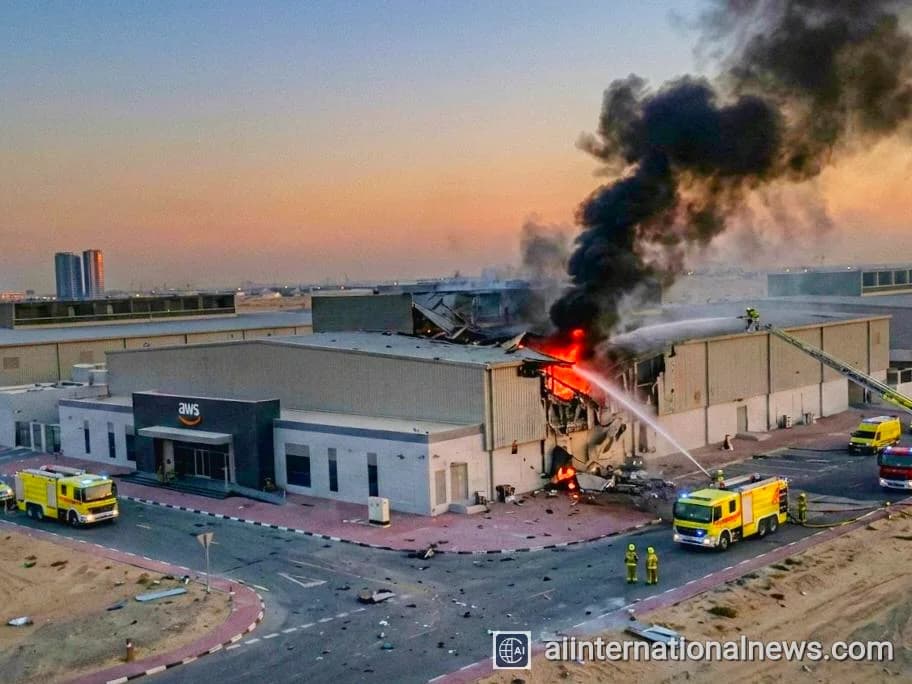
BREAKING: Amazon Web Services (AWS) data centers in the United Arab Emirates and Bahrain have suffered severe operational outages after unidentified "objects" struck a UAE facility, igniting a fire and forcing a total power shutdown. The catastrophic disruption occurred concurrently with a barrage of Iranian retaliatory missile and drone strikes across the Gulf, marking a potential watershed moment where global cloud infrastructure has become collateral damage in modern kinetic warfare.
In a chilling convergence of geopolitical conflict and digital vulnerability, the foundation of the modern internet has been violently shaken. As of early March 2026, the escalating war between the US-Israeli alliance and Iran has spilled over from traditional battlefields into the physical infrastructure that powers the global economy. Amazon Web Services (AWS), the world's largest cloud computing provider, confirmed that its Middle East operations were severely compromised after its facilities were physically impacted by external forces.
The incident forces a brutal reckoning for the technology sector, enterprise architects, and government entities worldwide. For years, the "cloud" has been marketed as an ethereal, indestructible network of redundancy. Yet, the events unfolding in the ME-CENTRAL-1 (UAE) and ME-SOUTH-1 (Bahrain) regions prove that hyperscale data centers—the beating heart of artificial intelligence processing, global finance, and telecommunications—are fundamentally bound by their physical geography and are acutely vulnerable to the destructive realities of war.
The Incident: Kinetic Impact on Digital Infrastructure
The timeline of the disruption paints a stark picture of physical infrastructure failure. According to official updates from the AWS Health Dashboard and internal reports, the crisis began at approximately 4:30 AM PST on Sunday, March 1, 2026. AWS confirmed that "objects struck the data center, creating sparks and fire" within one of its Availability Zones, specifically designated as mec1-az2, located in the United Arab Emirates.
Faced with an active blaze and severe structural risk, local emergency responders and the fire department were forced to take immediate, drastic action: they completely severed the power supply to the building and its backup generators to safely extinguish the fire. Consequently, the entire Availability Zone went dark. This physical shutdown immediately triggered a cascade of digital failures across the region. Within minutes, critical AWS services, including Amazon Elastic Compute Cloud (EC2), Amazon Simple Storage Service (S3), and Amazon Relational Database Service (RDS), began experiencing catastrophic error rates.
Simultaneously, localized power and connectivity issues began plaguing AWS operations in neighboring Bahrain. While the Bahrain disruptions have not yet been directly attributed to physical projectile impacts, the regional proximity and concurrent timing suggest a broader destabilization of the Gulf's power grids and telecommunication networks amid the intense military exchanges.
The Geopolitical Crossfire
The context surrounding this outage is impossible to ignore. The AWS facility was struck on the exact same day that Iran launched a massive wave of retaliatory drone and missile strikes targeting airports, ports, and residential areas across the UAE, Bahrain, and the wider Gulf region. These strikes were launched in direct response to prior US and Israeli military operations against the Islamic Republic.
When questioned by global news agencies, Amazon explicitly declined to confirm or deny whether the "objects" that struck their data center were Iranian projectiles, intercepted missile debris, or military drones. However, defense analysts and cybersecurity experts are treating the correlation with extreme gravity. If definitively confirmed as a result of the Iranian strikes, this event will be recorded as the very first instance in history where a major US technology corporation's commercial data center has been knocked offline by direct military action.
Abhijeet's Take: We are witnessing a terrifying paradigm shift in modern warfare. The cloud is no longer an abstract, untouchable entity floating above geopolitical strife—it is a collection of hyper-vulnerable physical buildings that represent the central nervous system of global commerce. The strike on AWS's UAE facility shatters the illusion of seamless cloud resilience. When missiles fly, standard "multi-AZ" failover protocols are virtually useless if the local grid is deliberately targeted or emergency crews are forced to sever power. This incident will fundamentally rewrite how enterprise architects and nation-states view data sovereignty and disaster recovery. The era of assuming cloud infrastructure is immune to kinetic warfare is officially over. Silicon Valley must now factor surface-to-air missile defense into its regional expansion plans.
Technical Anatomy of the Outage
To understand the severity of this disruption, one must delve into the architecture of hyperscale cloud environments. An AWS "Region" is comprised of multiple "Availability Zones" (AZs). Each AZ consists of one or more discrete data centers with redundant power, networking, and connectivity, housed in separate facilities. The theoretical design dictates that if one AZ fails due to a local hazard (like a fire or power cut), applications can seamlessly failover to another AZ within the same region.
However, the March 2026 strikes tested this redundancy to its breaking point. While AWS stated that other AZs in the UAE remained operational, the sheer scale of the disruption caused elevated latencies and API error rates across the entire regional network. Because major enterprise workloads and AI inference models require massive, uninterrupted data pipelines, the loss of mec1-az2 resulted in high failure rates for massive data ingest and egress workflows.
Amazon's guidance to its clients highlighted the severity of the situation. The company stated, "We are actively working to restore power and connectivity... full recovery is still expected to be many hours away." More alarmingly, AWS issued an urgent recommendation that affected customers should immediately "failover, and backup any critical data, to another AWS Region." Migrating petabytes of enterprise data across global regions during an active crisis is a logistical nightmare for most organizations, underscoring the severe operational limitations of single-region cloud dependency.
Key Takeaways: AWS Middle East Disruption
- Unprecedented Strike: Unidentified "objects" struck an AWS availability zone (
mec1-az2) in the UAE at 4:30 AM PST on March 1, 2026, causing a fire and massive outages. - Geopolitical Crossfire: The incident occurred simultaneously with intense Iranian retaliatory missile and drone strikes targeting infrastructure in the UAE and Bahrain.
- Widespread Disruptions: Dozens of critical cloud services, including Amazon EC2, S3, and DynamoDB, experienced severe error rates and latency.
- First of Its Kind: If confirmed as a military projectile, this marks the first instance of a major US tech giant's commercial data center being taken offline by kinetic warfare.
- Cascading Failures: Secondary connectivity and power issues were also reported at AWS facilities in neighboring Bahrain (ME-SOUTH-1).
- Enterprise Warning: AWS has strongly advised customers to back up critical data and initiate failover procedures to alternate global regions, a complex and costly maneuver for businesses.
The Economic and Enterprise Fallout
The ripple effects of the AWS outage were felt almost immediately across the Middle Eastern financial and technology sectors. Hyperscalers like Amazon, Microsoft, and Google have poured billions of dollars into the Gulf region over the last five years, courting lucrative government contracts, sovereign wealth funds, and burgeoning AI startups. The UAE and Bahrain have aggressively positioned themselves as the premier technological hubs of the Middle East.
Following the data center hit, prominent financial institutions experienced notable instability. Abu Dhabi Commercial Bank, for instance, reported that its digital platforms and mobile applications were unavailable due to a "region-wide IT disruption," though the bank stopped short of officially attributing the blackout directly to the AWS fire. Furthermore, the broader IT services industry reacted with swift panic. Major Indian IT consulting firms, which manage vast cloud deployments in the region, initiated crisis protocols. Companies like TCS suspended all travel to the Middle East, while Infosys and Nasscom issued stern warnings regarding regional stability.
Redefining Cloud Resilience in Conflict Zones
This event forces a radical reassessment of enterprise risk management. Prior to March 2026, disaster recovery planning for cloud infrastructure primarily focused on natural disasters (hurricanes, earthquakes), cyberattacks (DDoS, ransomware), or internal configuration errors. Kinetic military action—where physical servers are destroyed or disabled by falling shrapnel and missiles—was rarely factored into standard Service Level Agreements (SLAs).
Moving forward, multinational corporations and AI developers will be forced to implement aggressive multi-region architectures. Relying on a single geographic region, even one with multiple Availability Zones, is no longer a viable strategy for mission-critical applications. As geopolitical flashpoints shift and intensify, infrastructure strategy transcends market demand; it becomes an exercise in wartime operational preparedness.
Looking Ahead: Big Tech's Geopolitical Dilemma
The strikes on the UAE and Bahrain data centers raise profound questions about the future of Big Tech's global expansion. Will US cloud providers continue to invest heavily in physical infrastructure located within volatile conflict zones? As artificial intelligence models become increasingly integrated into national security apparatuses, the physical locations where these models are hosted will inevitably become strategic military targets.
The "cloud" is built on the earth, powered by local grids, and vulnerable to local wars. As emergency crews in Dubai continue to clear the debris from Amazon's servers and engineers desperately reroute global data traffic, the tech industry must confront a harsh new reality: in the era of advanced algorithmic warfare and globalized conflict, no data center is truly out of reach.
Frequently Asked Questions
What caused the AWS outage in the UAE and Bahrain?
On March 1, 2026, an AWS data center in the UAE was struck by unidentified "objects," which created sparks and ignited a fire. To safely extinguish the blaze, local fire departments cut all power to the facility, knocking the entire Availability Zone (mec1-az2) offline. Concurrently, AWS reported localized power and connectivity disruptions in its Bahrain region.
Was the Amazon data center intentionally targeted by Iranian strikes?
Amazon has officially declined to confirm or deny whether the "objects" that struck their facility were linked to the Iranian missile and drone strikes occurring on the same day. However, the timing coincides exactly with Iran's retaliatory bombardment of the UAE and Bahrain. If confirmed, it would be the first time a major US tech data center was directly disrupted by military action.
How are businesses and cloud customers responding to this disruption?
The outage caused severe latency and error rates across critical services like Amazon EC2 and S3. AWS has strongly advised affected enterprise customers to back up critical data and execute failover protocols to alternate, unaffected global regions. Many regional financial institutions and global IT service providers have initiated emergency continuity plans to mitigate the ongoing instability.