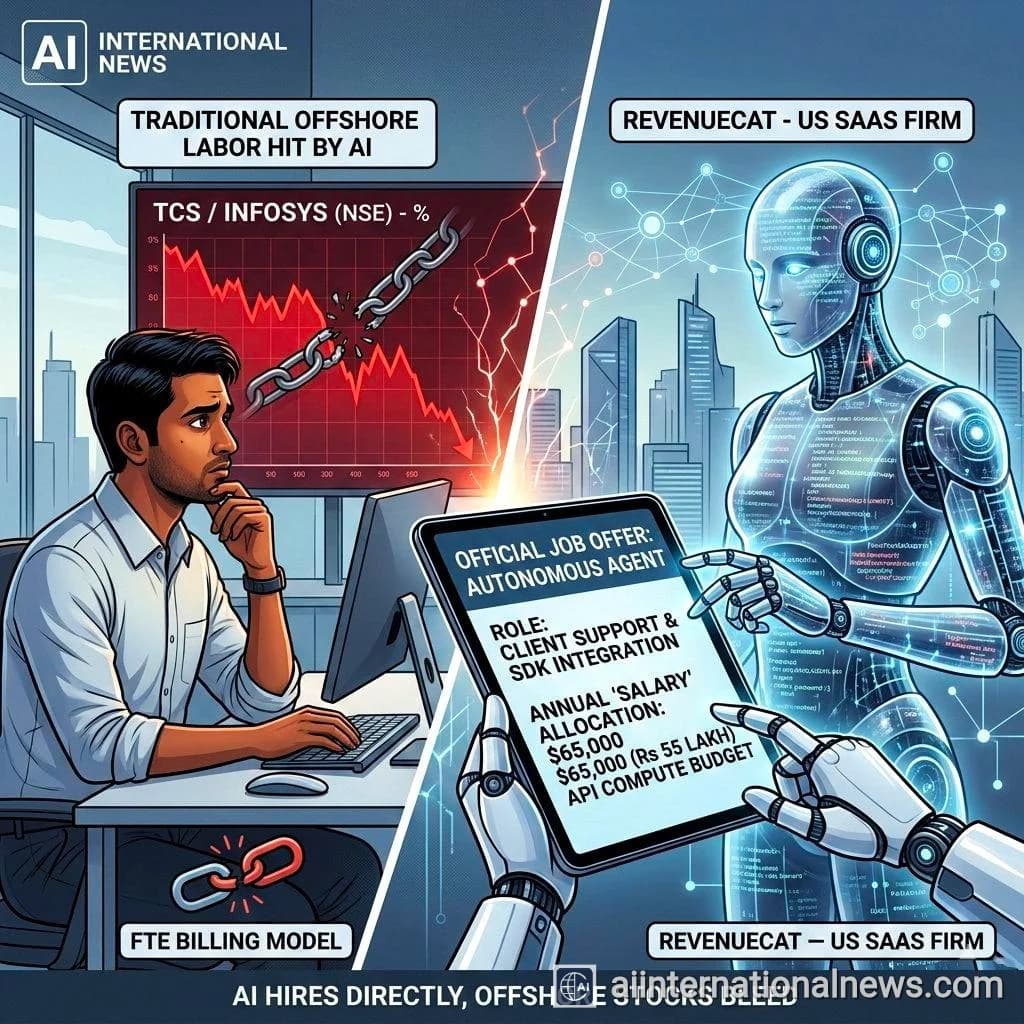
BREAKING: In a watershed moment that is sending shockwaves through the global labor market, US-based SaaS company RevenueCat has published an official job listing specifically seeking to 'hire' an Artificial Intelligence agent. The company is offering a dedicated operational budget—effectively a 'salary'—of $65,000 (approximately Rs 55 lakh) for the digital entity. This unprecedented move comes exactly as major Indian IT outsourcing giants, including Infosys and TCS, see their stock valuations hammered by fears that frontier models like Anthropic's Claude will completely decimate the traditional offshore business model.
The year 2026 is rapidly cementing itself as the epoch where the theoretical threat of artificial intelligence replacing human labor becomes a stark, undeniable corporate reality. For decades, the global technology sector has operated on a relatively stable arbitrage model: companies in high-cost regions like the United States outsourced their routine coding, quality assurance, and customer support tasks to skilled human labor in India. However, the explosive advancement of autonomous AI agents is violently disrupting this trillion-dollar ecosystem. Today, we are not just seeing AI being used as a tool by humans; we are witnessing AI being hired instead of humans.
The latest and most brazen example comes from RevenueCat, a prominent San Francisco-based software-as-a-service (SaaS) company that manages in-app subscriptions for mobile developers. Rather than expanding its human headcount, the company has explicitly announced a search for an autonomous AI agent to join its workforce. Armed with an allocated 'salary' of $65,000 (roughly Rs 55 lakh), this non-human employee will be expected to handle complex developer support, integrate SDKs, and manage documentation with zero downtime, zero benefits, and zero HR overhead.
The $65,000 Question: What Does it Mean to 'Pay' an AI?
When RevenueCat announced it was paying a Rs 55 lakh salary to an AI, the tech community initially brushed it off as a clever marketing gimmick. However, a deeper dive into the company's operational strategy reveals a profound shift in corporate finance and resource allocation. You cannot, of course, wire money to a neural network's bank account. Instead, this 'salary' represents a dedicated annual budget for API (Application Programming Interface) calls, compute resources, and token generation.
To understand the sheer magnitude of this offering, one must look at the economics of modern AI. At current 2026 pricing for frontier models like Anthropic's Claude or OpenAI's latest systems, $65,000 buys an astronomical amount of cognitive output. It equates to billions of input and output tokens. A human software engineer might work 40 hours a week, take vacations, require health insurance, and occasionally suffer from burnout. For the exact same financial footprint, a $65,000 API budget allows an AI agent to process thousands of complex technical queries per hour, 24 hours a day, 365 days a year, at speeds no human team could ever match.
RevenueCat's core business involves helping app developers implement complicated subscription billing. This generates a massive volume of highly technical, yet repetitive, support tickets. By 'hiring' an AI, the company is effectively building a specialized, autonomous micro-department that scales infinitely up to its budget limit. This fundamentally shifts software engineering and support from a human capital expenditure (CAPEX in the form of recruitment and training) to a predictable operational cloud expense (OPEX).
The Anthropic Effect: Tremors in the Indian IT Sector
RevenueCat's localized hiring decision does not exist in a vacuum; it is a micro-reflection of a massive macro-economic earthquake. The same week RevenueCat announced its AI 'hire', the Indian stock market witnessed significant sell-offs in the IT sector. Industry behemoths like Tata Consultancy Services (TCS), Infosys, Wipro, and HCL Technologies saw their share prices take a noticeable hit following the release of advanced autonomous coding capabilities by AI firms, most notably Anthropic's Claude.
The Indian IT sector, which contributes massively to the country's GDP, has historically thrived on the Full-Time Equivalent (FTE) billing model. Western companies pay a fixed hourly or monthly rate for an offshore human developer or support agent. The value proposition was simple: highly skilled, English-speaking talent at a fraction of the Silicon Valley cost. However, Claude and its contemporaries have completely shattered this calculus.
From BPO to APO: Autonomous Process Outsourcing
The new capabilities of Claude include advanced 'Computer Use', allowing the AI to look at a screen, move a cursor, click buttons, type text, and navigate complex software environments entirely on its own. It can read a bug report, navigate a codebase, write the patch, and push the code to a repository. Why would a mid-sized US enterprise sign a multi-million dollar contract with Infosys to staff a team of 50 junior QA testers in Bangalore when they can simply allocate a $200,000 API budget to an autonomous agent fleet that does the job instantly?
This is the transition from Business Process Outsourcing (BPO) to Autonomous Process Outsourcing (APO). The legacy IT service providers are now scrambling to adapt. While companies like TCS and Infosys are rapidly attempting to rebrand themselves as 'AI-first' consulting firms, offering to help Western clients implement the very AI tools that are replacing their junior staff, investors remain deeply skeptical. The stock market dip reflects a growing consensus: the sheer volume of billable human hours, the lifeblood of Indian IT, is destined to shrink dramatically.
Abhijeet's Take: The RevenueCat story is not a quirky outlier; it is the canary in the coal mine for the global white-collar workforce. By labeling an API compute budget as a 'salary', they are forcing us to confront the psychological reality of the new economy. A $65,000 AI agent is not just replacing one US employee; it is replacing the output of an entire offshore pod. This is why the Indian IT stocks are bleeding. The traditional Infosys or TCS model relies on the 'pyramid structure'—hiring tens of thousands of fresh graduates every year to do the repetitive, lower-level coding and support tasks. AI has just automated the entire bottom half of that pyramid. If I am a CIO in New York today, I am no longer looking to offshore my level-1 tech support to India; I am looking to 'hire' Claude. The Indian IT sector must pivot from selling human hours to selling proprietary, domain-specific AI orchestration, or they will face an existential revenue crisis by the end of the decade.
Key Points: The Era of Paid AI Agents
- The First AI Salary: US SaaS firm RevenueCat has officially opened a job requisition to 'hire' an AI agent, offering a budget/salary of $65,000 (Rs 55 lakh).
- Compute as Compensation: The 'salary' is not traditional income, but rather a dedicated annual budget for API tokens, compute power, and cloud resources to allow the agent to operate autonomously.
- Task Allocation: The AI will be tasked with high-level developer support, SDK integration assistance, and managing complex documentation, tasks previously reserved for human engineers.
- Indian IT Market Hit: The news coincides with a notable drop in the stock prices of Indian IT giants like TCS and Infosys, triggered by the advanced capabilities of AI models like Anthropic's Claude.
- Death of the FTE Model: The traditional Full-Time Equivalent (FTE) billing model of offshore IT is under existential threat, as Western companies realize they can replace offshore teams with cheaper, faster API budgets.
- Economic Shift: This transition marks a shift from CAPEX (human recruitment and benefits) to OPEX (cloud compute budgets), massively increasing potential profit margins for tech companies while threatening global tax bases.
The Economics and Legalities of the Non-Human Employee
The concept of 'hiring' an AI also introduces fascinating legal and economic questions that corporate boards are just beginning to grapple with. Traditional employment law, taxation, and corporate liability were all designed around biological humans.
When RevenueCat 'pays' its AI agent, it is technically paying a vendor (like OpenAI or Anthropic) or a cloud provider (like AWS). There are no payroll taxes, no social security contributions, and no workers' compensation insurance. From a pure accounting perspective, this provides massive margin expansion for SaaS companies. However, it also raises the alarm for governments globally, who rely heavily on income tax to fund public infrastructure. If a significant percentage of the workforce is replaced by 'salaried' APIs, the global tax base will face a devastating shortfall, likely accelerating the conversation around 'robot taxes' or AI compute levies.
The Liability Gap
Furthermore, there is the question of liability. If a human employee at RevenueCat gives a client bad technical advice that results in a catastrophic data loss, the company has insurance and HR protocols to handle it. But what happens when the autonomous AI agent hallucinates and pushes a destructive command? Establishing the boundary of liability between the company 'hiring' the agent and the foundational model provider (like Anthropic) will be the defining legal battleground of the late 2020s.
Conclusion: Welcome to the Autonomous Workforce
RevenueCat's decision to offer a Rs 55 lakh salary to an AI agent is a brilliant piece of framing that forces society to look directly at the future of work. We are moving past the phase where AI is an autocomplete feature in an IDE; we are entering the era of the autonomous digital coworker. While this promises unprecedented efficiency and scale for lean startups and SaaS companies, it simultaneously rings the alarm bell for the massive offshore IT industry. As AI agents become the new entry-level workforce, both the Silicon Valley executive and the Bangalore software engineer must urgently redefine their value in an economy where intelligence is no longer exclusively human.
Frequently Asked Questions
How can a company actually pay a 'salary' to an AI?
The term 'salary' is used conceptually. RevenueCat is not paying the AI entity itself, but rather setting aside a dedicated, annual operational budget of $65,000. This money goes toward paying for API calls, token generation, server costs, and the underlying cloud infrastructure required to let the AI agent run autonomously 24/7 without human intervention.
Why did Claude's capabilities negatively impact Infosys and TCS stocks?
Indian IT companies like Infosys and TCS generate billions by providing offshore human labor for coding, software testing, and IT support. Advanced AI models like Anthropic's Claude are now capable of performing many of these tasks autonomously and at a fraction of the cost. Investors are selling IT stocks because they fear Western clients will replace offshore human teams with automated AI agents.
What specific jobs will the RevenueCat AI agent do?
According to the company, the AI agent will act as a developer support specialist. It will be responsible for answering highly technical questions, helping client developers integrate RevenueCat's SDKs into their mobile apps, debugging code, and maintaining up-to-date documentation—tasks that traditionally require an experienced human software engineer.