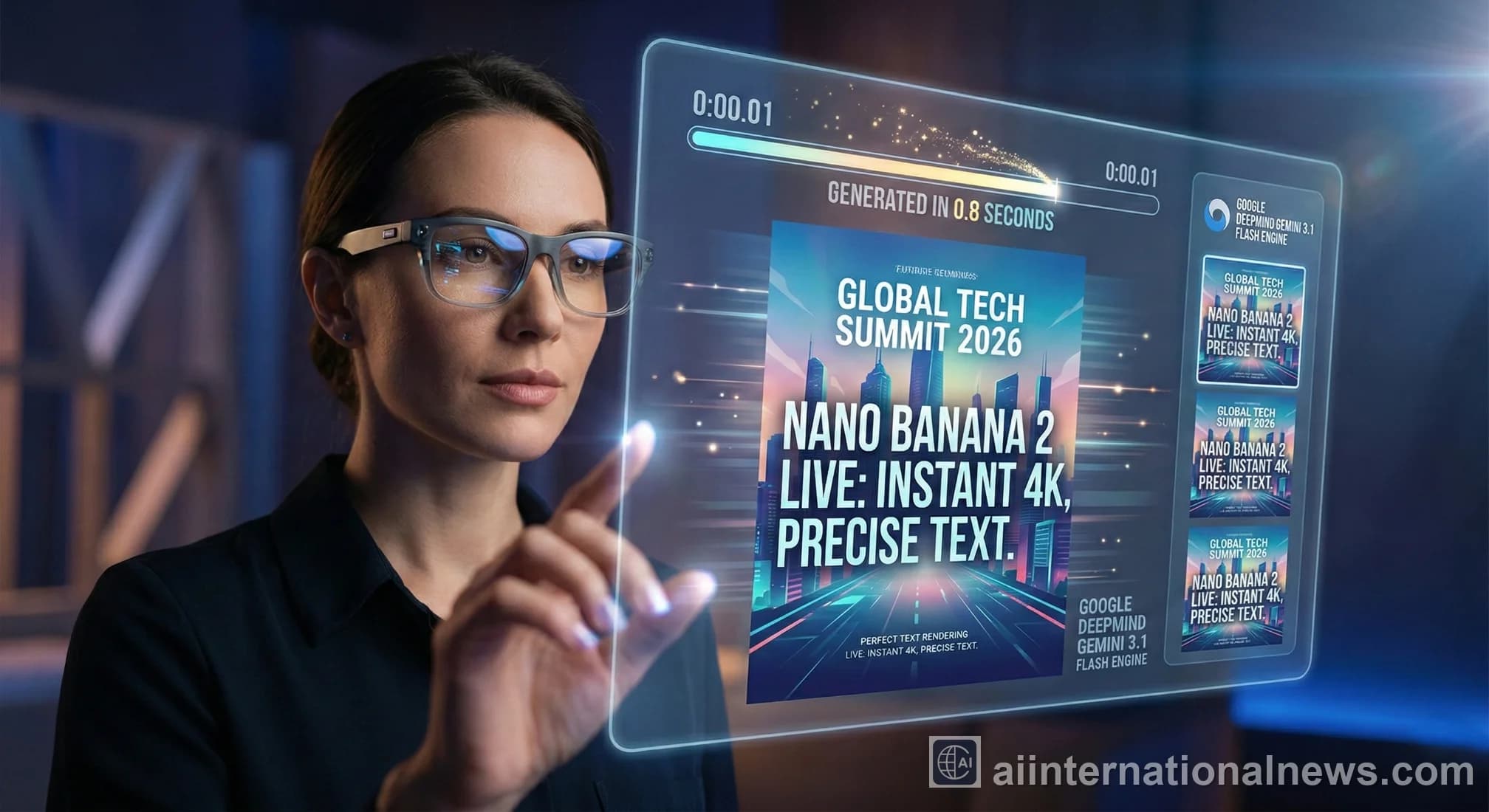
BREAKING: Google has fundamentally disrupted the generative AI landscape today with the official rollout of Nano Banana 2, carrying the official technical designation of Gemini 3 Flash Image. This monumental release brings unprecedented speed, hyper-accurate text rendering, and advanced multi-image composition capabilities to the mainstream, officially replacing the legacy Nano Banana and Nano Banana Pro models as the default engine within the core Gemini App experience.
The 2026 AI Image Generation Landscape: A Paradigm Shift
For the past few years, the artificial intelligence community has been locked in a seemingly endless battle between generation speed and visual fidelity. Creators, enterprise designers, and everyday users have historically been forced to choose: wait thirty to sixty seconds for a studio-quality render, or accept lower-resolution, artifact-heavy outputs in exchange for real-time speed. As we progress deeper into 2026, Google has effectively shattered this dichotomy with the release of Nano Banana 2.
By leveraging the heavily optimized "Flash" architecture of the Gemini 3 ecosystem, Google has achieved a state-of-the-art model capable of delivering highly complex, photorealistic, and stylized images in mere seconds. This isn't just a minor iteration or a simple software patch; it is a ground-up rebuild of how the Gemini ecosystem processes visual and textual prompt data. The official retirement of the original Nano Banana and Nano Banana Pro models from the default interface signals Google's absolute confidence in this new, streamlined architecture.
Under the Hood: Gemini 3 Flash Image Architecture
At its core, Nano Banana 2 is powered by the Gemini 3 Flash Image model. This architecture moves beyond traditional diffusion techniques by integrating a highly efficient latent space processor that reduces computational overhead by nearly 40% compared to last year's models. What this means for the end-user is not just faster generation, but significantly higher adherence to complex prompts.
One of the most profound upgrades lies in the model's multimodal processing capabilities. Nano Banana 2 is no longer just a text-to-image generator. It is natively built for image+text-to-image (editing) and sophisticated multi-image-to-image (composition and style transfer) workflows. Users can now upload multiple reference images—for instance, a picture of a specific product and a picture of a desired background style—and the Gemini 3 Flash Image engine will intelligently composite them while harmonizing lighting, shadows, and perspective without requiring complex masking or manual Photoshop intervention.
The Typography Revolution: Enhanced Text Rendering
Perhaps the most celebrated feature of this massive update is the complete overhaul of how the AI handles text. Historically, AI image generators have struggled to render legible text, often producing surreal, alien-looking gibberish instead of proper letters. This has been a massive pain point for digital marketers, graphic designers, and meme creators alike.
Nano Banana 2 features a dedicated typography semantic layer. This allows the model to understand text not just as a visual pattern to be mimicked, but as explicit characters that must be constructed with orthographic precision. Whether you are prompting for a glowing neon sign in a cyberpunk cityscape, an elegant wedding invitation with cursive calligraphy, or a bold billboard advertisement, Nano Banana 2 renders the requested text flawlessly. It even understands context-aware text placement, ensuring that the words wrap correctly around 3D objects and interact naturally with environmental lighting.
Abhijeet's Take: This is the "iPhone moment" for AI graphic design. For years, the inability to reliably generate text within an image has relegated AI tools to the "concept art" phase of the workflow. Designers always had to take the AI output into a traditional editor to add typography. By solving the text rendering problem and integrating multi-image composition natively into the Gemini App, Google has transformed Nano Banana 2 from a fun conceptual tool into an end-to-end production powerhouse. The speed of the Gemini 3 Flash Image architecture means rapid A/B testing of ad creatives is now something anyone can do in seconds, effectively democratizing high-end graphic design on a global scale.
The New Workflow: Accessing Pro-Level Tools
With Nano Banana 2 becoming the default engine, Google has completely revamped the user interface and the backend quota economy. The goal is to provide everyone with blistering fast, high-quality images while reserving the most computationally heavy, hyper-specialized rendering for those who truly need it.
Here is how the new generation economy breaks down across the user base:
- Basic Tier: Free users are granted a combined total of 20 image generation uses per day.
- AI Plus Subscribers: Enjoy an upgraded limit of 50 uses per day.
- Pro Subscribers: Receive a generous 100 uses per day.
- Ultra Subscribers: Gain a massive enterprise-grade limit of 1000 uses per day.
The "Redo with Pro" Paradigm
While Nano Banana 2 replaces the older Pro model in the default view, Google hasn't abandoned users who need absolute maximum fidelity, ultra-high resolution, or complex scientific rendering. A new workflow has been introduced for paid subscribers (AI Plus, Pro, and Ultra tiers). Once an image is generated using the lightning-fast Nano Banana 2 engine, users can click on the three-dot menu associated with that specific generation and select "Redo with Pro".
This action seamlessly routes the prompt and the current visual seed to the heavy-duty Nano Banana Pro model. This ingenious two-step workflow saves massive amounts of compute. Users can rapidly iterate their ideas using the high-speed Flash model until they get the exact composition and text layout they desire, and then "upscale" that specific concept using the Pro model, rather than wasting Pro compute on trial-and-error prompting.
Ethical AI and the Future of Content Provenance
As the line between reality and AI generation blurs into non-existence, Google continues to double down on ethical AI deployment. Every single image generated, edited, or composited by Nano Banana 2 and the "Redo with Pro" feature is automatically embedded with Google's proprietary SynthID technology.
SynthID places a robust, imperceptible digital watermark directly into the pixels of the image. Unlike traditional metadata, which can be easily stripped out by bad actors or lost during social media compression, SynthID survives cropping, filtering, and color adjustments. This ensures that as Nano Banana 2 floods the internet with photorealistic, text-perfect imagery, platforms, news organizations, and everyday users will always have the technical means to verify the AI origins of the content, maintaining a crucial layer of digital trust in 2026.
Key Points to Remember
- Model Overhaul: Nano Banana 2 (Gemini 3 Flash Image) is now the default image engine in the Gemini App, replacing earlier versions.
- Text Perfection: Groundbreaking typography layers allow for flawless, context-aware text generation within images.
- Advanced Workflows: Native support for image+text editing and multi-image style transfer/composition.
- Smart Quotas: Daily limits range from 20 for Basic users up to 1000 for Ultra subscribers.
- Redo with Pro: Paid users can rapidly iterate with the Flash model, then use the 3-dot menu to "Redo with Pro" for maximum fidelity.
Conclusion: A New Standard for Digital Creation
The release of Nano Banana 2 marks a definitive turning point. Google has successfully combined the speed required for modern internet culture with the precision required for professional design work. The Gemini 3 Flash Image architecture proves that we no longer have to compromise. By solving the text rendering issue, introducing intuitive multi-image composition, and creating a brilliant "Redo with Pro" workflow, Google has not just released a new feature; they have built the definitive creative suite for the AI era.
FAQ: What is the official name of Nano Banana 2?
While commonly referred to as Nano Banana 2 in the consumer interface, the official underlying model architecture is named Gemini 3 Flash Image. This highlights its integration into Google's high-speed "Flash" tier of multimodal AI models.
FAQ: How do I access the Nano Banana Pro model now?
Nano Banana Pro is no longer a standalone starting point in the app. Instead, users on paid tiers (AI Plus, Pro, and Ultra) first generate their image using the high-speed Nano Banana 2. Once they have a satisfactory composition, they can click the three-dot menu on the image and select "Redo with Pro" to process the image through the heavier, maximum-fidelity model.
FAQ: Are there generation limits for the new image tools?
Yes. To manage the immense computational power required, Google has implemented daily usage quotas. Basic (free) tier users receive 20 uses per day. This scales up based on subscriptions: AI Plus gets 50, Pro gets 100, and Ultra users receive 1000 daily uses.