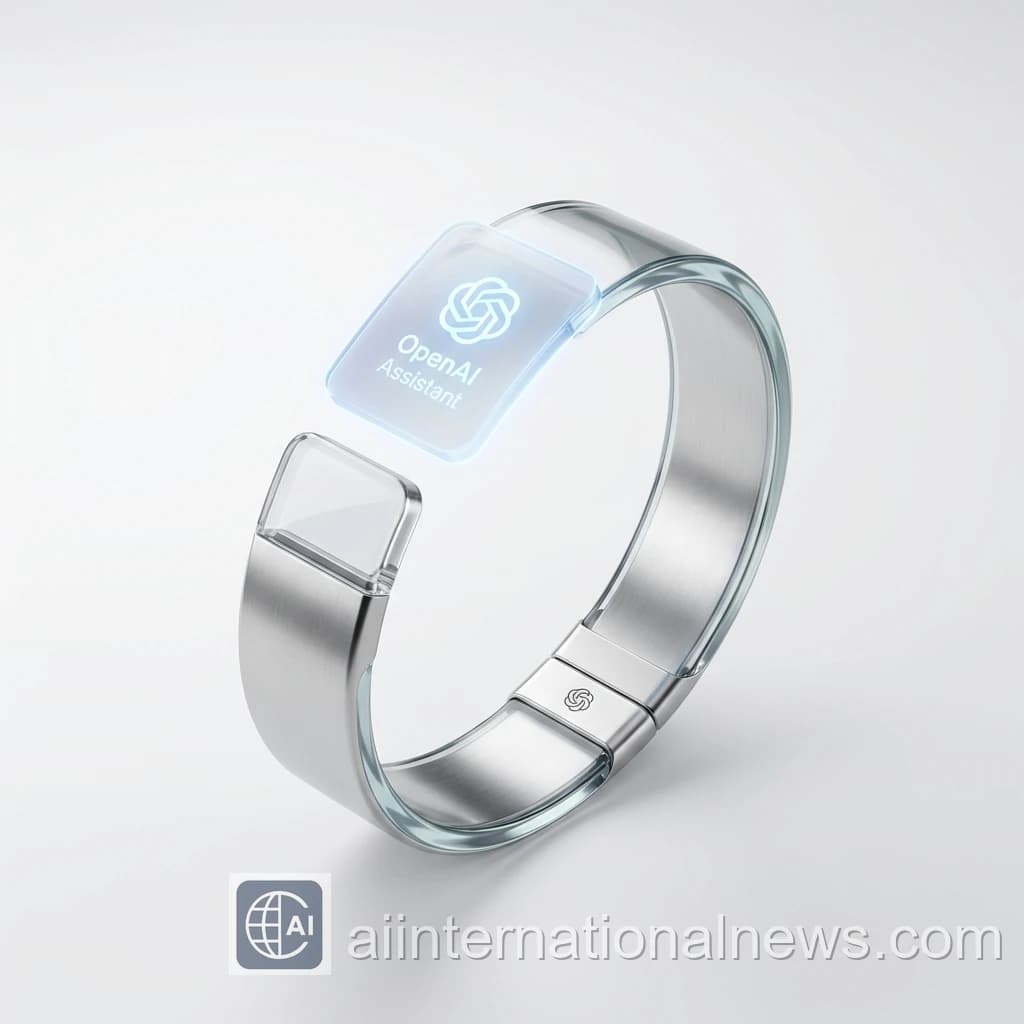
After ChatGPT revolutionized software AI, OpenAI is now betting big on hardware. In partnership with Jony Ive—the design genius behind the iPhone, iPad, and Apple Watch—OpenAI is building its first AI wearable device, set to launch in late 2026.
Abhijeet's Take: This is huge. OpenAI has been a software-first company since day one. Their decision to enter the hardware game—with Jony Ive, no less—signals a massive strategic shift. They're not just building an AI assistant; they're building an entirely new category of consumer device. If anyone can pull off an "iPhone moment" for AI, it's this duo.
The Announcement That Shocked Silicon Valley
On January 15, 2026, OpenAI CFO Sarah Friar confirmed that OpenAI is working on its first AI wearable device in partnership with Jony Ive's design firm, LoveFrom. The device is expected to launch in the second half of 2026.
This isn't just another gadget announcement. This is OpenAI—the company behind ChatGPT, which amassed over 100 million users in just two months—teaming up with the designer who created the most iconic products of the 21st century.
Key details confirmed:
- Partnership between Open AI and Jony Ive's LoveFrom
- Launch window: H2 2026 (July-December)
- Designed to be AI-first, not phone-dependent
- Focus on seamless, natural AI interaction
- Expected to integrate deeply with ChatGPT ecosystem
Why Jony Ive? The Design Philosophy Behind It
Jony Ive isn't just a designer—he's a visionary who redefined consumer technology. His work at Apple resulted in:
| Product | Impact |
|---|---|
| iMac (1998) | Saved Apple from bankruptcy |
| iPod (2001) | Revolutionized music industry |
| iPhone (2007) | Created smartphone category |
| iPad (2010) | Defined modern tablets |
| Apple Watch (2015) | Made wearables mainstream |
OpenAI chose Ive because they need more than an engineer—they need someone who can make AI feel human, approachable, and essential. Ive's design language prioritizes simplicity, elegance, and intuitive interaction—exactly what AI wearables desperately need.
What We Know About the Device (So Far)
While OpenAI has been tight-lipped about specifics, industry insiders and leaked details suggest the following:
Form Factor
The device is not a smartwatch or traditional glasses. Sources suggest it's an entirely new form factor—possibly a small, minimalist clip-on device or a subtle wrist-worn band with a holographic interface.
Core Features (Predicted)
- Always-on voice assistant: ChatGPT at your command, anywhere
- Visual AI: Analyzes what you're looking at in real-time
- Phone-free operation: Works independently via LTE/5G
- Context-aware AI: Learns your habits and anticipates needs
- Privacy-first: On-device processing for sensitive data
- Multi-day battery: Unlike current smart glasses (2-4 hours)
Technical Specs (Rumored)
- Processor: Custom AI-optimized chip (possibly Qualcomm or Apple Silicon-based)
- Connectivity: Wi-Fi 7, Bluetooth 5.4, LTE/5G
- Battery: 48-72 hours (vs 3-4 hours for Ray-Ban Meta)
- Weight: Under 50 grams (lighter than AirPods Max)
- Display: Micro-OLED or AR projection (if glasses form factor)
- Voice: Advanced far-field mics + neural noise cancellation
How It Compares to Existing AI Wearables
The AI wearable market is heating up. Here's how the OpenAI device stacks up against competitors:
| Device | Price | Battery | AI Model |
|---|---|---|---|
| OpenAI Wearable | $599-$699 (est.) | 48-72 hours (est.) | GPT-4+ |
| Ray-Ban Meta | $299 | 4 hours | Llama 3 |
| Humane AI Pin | $699 + $24/mo | ~4 hours | GPT-4 |
| Plaud NotePin | $169 | 20 hours | GPT-4 (transcription only) |
Key advantages:
- Native ChatGPT integration (no third-party AI)
- Jony Ive design (guaranteed to look and feel premium)
- OpenAI's resources ($90B valuation means serious R&D budget)
- Brand trust (ChatGPT name recognition is unmatched)
The $50 Billion AI Wearables Market
Timing is everything. OpenAI is entering the market at the perfect moment:
- AI wearables market projected to hit $50 billion by 2027
- Smart glasses shipments expected to grow 300% in 2026
- Over 200 million people now use AI assistants daily
- Smartphone sales declining as users seek new form factors
Market Reality Check: The Humane AI Pin flopped hard (sold ~10,000 units vs 100,000 target). Ray-Ban Meta glasses are doing better (~400,000 sold), but still niche. OpenAI has the brand power and AI chops to go mainstream—if they nail the user experience. That's where Jony Ive comes in.
Why This Matters for Your Productivity
Forget the hype. Here's what an OpenAI wearable could actually do for you:
1. Instant Knowledge Access
Imagine asking ChatGPT questions without pulling out your phone. Cooking? "What's 350°F in Celsius?" Shopping? "Is this a good deal?" Meeting someone? "What's their LinkedIn profile?"
2. Real-Time Translation
Travel to Japan and have conversations in real-time. The AI listens, translates, and speaks through your device. No awkward pauses. No language barriers.
3. AI Note-Taking
Meetings, lectures, conversations—automatically transcribed, summarized, and actionable. No more "let me write that down."
4. Health and Wellness
Stress detection, posture alerts, activity tracking—but powered by AI that actually understands context. Not just "you walked 10,000 steps" but "you've been sitting for 3 hours; time to move."
The Challenges Ahead
Let's be real: AI wearables have failed before. Here's what OpenAI must get right:
Battery Life
Current AI wearables die in hours. If OpenAI can't deliver all-day battery, it's DOA.
Privacy Concerns
An always-on, always-listening device? People are skeptical. OpenAI must prove that user data stays private and secure.
Price Point
Humane AI Pin's $699 price killed it. If OpenAI can hit $399-$499, they'd dominate. At $699+, it's a luxury item.
Ecosystem Lock-in
Will it work seamlessly with iPhone AND Android? Or will it be ChatGPT-only? Openness wins markets.
When Can You Buy It?
Official launch window: H2 2026 (July-December).
Based on typical Apple-style product cycles (which Jony Ive knows intimately), expect:
- June-July 2026: Official unveiling event
- August-September 2026: Pre-orders open
- October-November 2026: General availability
Early adoption will likely be limited (think iPhone 1 scarcity), with wider availability in Q1 2027.
My Prediction: Will It Succeed?
Abhijeet's Prediction: This has a 70% chance of success—IF they nail three things: (1) All-day battery life, (2) Price under $500, (3) Cross-platform compatibility. If they fail on any of these, it'll be another Humane AI Pin. But OpenAI has something competitors don't: ChatGPT's mindshare. People ALREADY use ChatGPT daily. Making it wearable is a natural evolution, not a forced gadget.
FAQs: OpenAI AI Wearable
When will the OpenAI wearable device launch?
OpenAI confirmed the wearable will launch in the second half of 2026 (H2 2026), likely between July and December. No specific date has been announced yet.
How much will the OpenAI wearable cost?
Expected pricing is between $299-$699 based on industry analysis. Jony Ive's involvement suggests a premium price point, likely closer to $599-$699 for the base model.
Will it work with iPhone and Android?
While official compatibility hasn't been announced, OpenAI's platform-agnostic approach suggests it will support both iOS and Android devices via the ChatGPT app.
The Bottom Line
OpenAI's AI wearable, designed by Jony Ive, represents the company's boldest bet yet. It's not just about creating another gadget—it's about defining the next computing paradigm. If they execute well, this could be the "iPhone moment" for AI wearables.
The stakes are high. The competition is fierce. But with ChatGPT's 100 million+ users and Jony Ive's design genius, OpenAI has a real shot at making AI wearables mainstream.
What do you think? Would you buy an OpenAI wearable for $599? Let me know in the comments below!