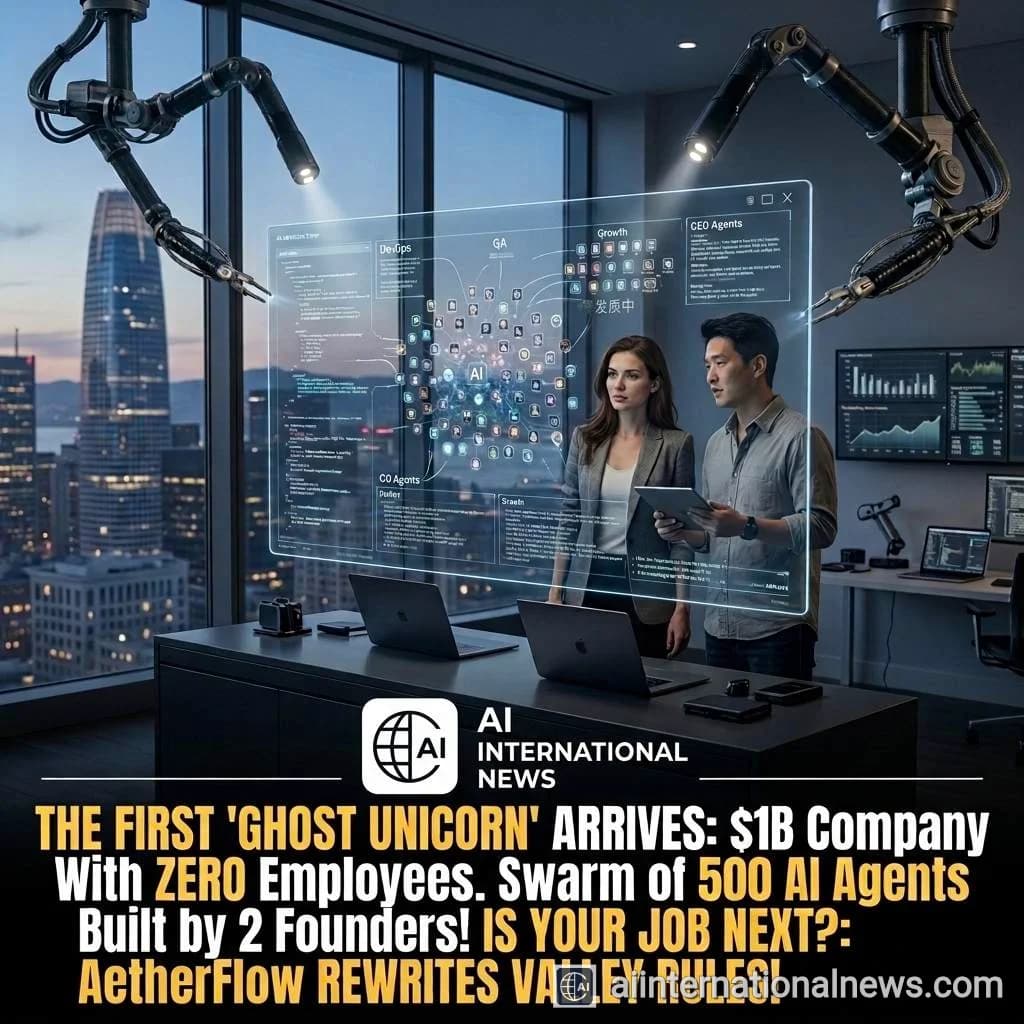
BREAKING: Silicon Valley has officially crowned its first 'Ghost Unicorn.' A stealth startup named AetherFlow has reached a $1 billion valuation within six months of launch, operating with exactly two human founders and a decentralized swarm of 500 autonomous AI agents. This marks the dawn of the Zero-Employee Enterprise, fundamentally upending the traditional venture capital model and the global labor market.
In the rapidly accelerating landscape of artificial intelligence in 2026, the concept of the 'future of work' has taken a dramatic, unprecedented turn. For decades, the metric of a company's success and scale was inextricably linked to its headcount. High-growth tech startups boasted about hiring sprees, massive HR departments, and sprawling office campuses. Today, a San Francisco-based enterprise software company has shattered that paradigm entirely. AetherFlow, an infrastructure-as-a-service provider, has secured a massive Series B funding round that values the company at over $1 billion. Yet, if you visit their headquarters, you will only find two human beings: co-founders Elena Rostova and David Chen. The rest of their workforce—handling everything from complex backend software engineering to global marketing, customer acquisition, and financial compliance—consists entirely of autonomous, interacting artificial intelligence agents.
This watershed moment signifies the transition from AI as a 'copilot'—a tool used to assist human workers—to AI as the primary engine of corporate execution. AetherFlow represents the culmination of autonomous agent swarm technology, a sophisticated architectural framework where specialized large language models (LLMs) are given distinct roles, budgets, and operational autonomy. The traditional corporate hierarchy has been replaced by an API-driven neural network, sparking a frantic realization across Wall Street and Silicon Valley: the most profitable companies of the next decade may not need employees at all.
The Architecture of the Ghost Unicorn: How Agent Swarms Operate
To comprehend how a two-person company can service Fortune 500 clients, manage millions in recurring revenue, and deploy daily software updates, one must look at the mechanics of the 'Agent Swarm.' AetherFlow does not rely on a single, monolithic AI. Instead, it utilizes a highly decentralized orchestration of foundational models, primarily leveraging OpenAI's latest architecture for creative problem-solving alongside Anthropic's Claude 3.5 Opus for deep, rigorous code auditing and safety compliance.
The founders essentially act as the 'Board of Directors,' setting high-level strategic objectives. These objectives are fed into a 'CEO Agent,' which breaks the goals down into actionable departmental tasks. The CEO Agent then delegates these tasks to specialized sub-agents. There is a 'DevOps Agent' that manages server load, a 'QA Agent' that aggressively tries to break the code written by the 'Engineering Agents,' and a 'Growth Agent' that conducts A/B testing on marketing copy across thousands of digital channels simultaneously. Because these agents communicate via structured APIs at the speed of light, an entire product iteration cycle—from ideation to coding, testing, debugging, and deployment—happens in a matter of hours, rather than weeks or months.
The Death of the Silicon Valley Office
The operational efficiency of this model is staggering. AetherFlow has no payroll taxes, no health insurance premiums, no stock options to dilute among hundreds of early employees, and no office lease. Their primary operational expense is raw compute—paying for cloud infrastructure and API tokens. This shift is already sending tremors through the commercial real estate market in major tech hubs. If the unicorns of tomorrow only require a two-bedroom apartment and a massive AWS or Azure server allocation, the sprawling corporate campuses of the 2010s will quickly become obsolete monuments to an outdated era of human capital.
Furthermore, the Swarm architecture solves one of the most persistent bottlenecks in human organizations: interpersonal friction and communication breakdowns. When the Marketing Agent needs a new feature to promote, it does not have to wait for the Engineering Team to finish a two-week sprint or navigate office politics. It submits a highly structured, machine-readable ticket directly to the Product Agent, which dynamically allocates compute resources to the coding agents to execute the request in real-time.
Abhijeet's Take: AetherFlow is not just a company; it is the total inversion of Coase's Theory of the Firm. For a century, economists believed that companies grow larger because internalizing tasks (hiring employees) is cheaper than the transaction costs of finding external contractors. AI agents have driven transaction and coordination costs to absolute zero. You no longer need a middle manager to coordinate between engineering and sales; the APIs do it instantly. This is the holy grail of hyper-capitalism: infinite scalability with zero marginal labor cost. However, the societal implications are terrifying. If the blueprint for a billion-dollar company no longer requires a middle class of developers, marketers, and HR professionals, we are staring down the barrel of unprecedented wealth concentration. Venture capitalists are no longer funding job creation; they are funding server farms and two lucky founders. The labor market isn't just being disrupted; in the high-growth tech sector, it is being completely eradicated.
The Venture Capital Paradigm Shift: Compute is the New Equity
The rise of the Zero-Employee Enterprise is forcing an immediate, aggressive restructuring of the venture capital industry. Firms like Sequoia Capital, Andreessen Horowitz, and Benchmark are completely re-evaluating their investment thesis. Historically, a Series A or Series B funding round was calculated based on the 'burn rate'—specifically, how many engineers and sales reps a startup needed to hire to capture market share over the next 18 to 24 months.
With companies like AetherFlow, the capital allocation model is entirely different. Funding is no longer directed toward human salaries; it is directed toward securing proprietary compute clusters and fine-tuning specialized AI models. We are seeing the emergence of 'Compute-as-Equity' deals, where instead of taking traditional cash, startups are accepting direct access to massive GPU clusters in exchange for board seats and company shares. The metric of success is no longer Revenue Per Employee; it is Revenue Per Token.
The "Self-Healing" Organization
One of the most fascinating aspects of AetherFlow's Swarm architecture is its capacity for autonomous self-correction and self-healing. In a traditional firm, when a key employee quits or falls ill, institutional knowledge is lost, and productivity halts. In an AI Swarm, institutional knowledge is permanently encoded into the system's vector databases. If an agent hallucinates or makes a critical error, a secondary 'Auditor Agent' detects the anomaly, rolls back the action, and instantly rewrites the system prompt of the offending agent to ensure the mistake is never repeated. The company literally gets smarter, more resilient, and more efficient every single second it operates, immune to burnout, fatigue, or corporate espionage.
Key Points: The Zero-Employee Enterprise Era
- The Ghost Unicorn: AetherFlow, a tech infrastructure startup, has reached a $1 billion valuation with only two human founders and zero human employees.
- Agent Swarm Architecture: The company operates via a network of 500 autonomous AI agents that handle engineering, marketing, QA, and finance.
- Infinite Scalability: By replacing human labor with structured API calls, the company achieves near-instantaneous product iteration and zero interpersonal communication bottlenecks.
- Venture Capital Shift: VCs are shifting from funding human 'burn rates' to funding massive compute allocations, leading to the rise of 'Compute-as-Equity' funding rounds.
- Economic Disruption: This model threatens to hollow out the white-collar tech middle class, proving that hyper-growth companies no longer need to be massive job creators.
- Self-Healing Operations: The AI swarm constantly audits itself, retaining all institutional knowledge and rewriting its own parameters to eliminate errors without human intervention.
The Looming Regulatory and Economic Backlash
Unsurprisingly, the unprecedented success of AetherFlow has triggered massive alarm bells in Washington D.C., Brussels, and across global labor organizations. The concept of a billion-dollar "Ghost Company" presents a myriad of regulatory and taxation nightmares. Modern tax systems are heavily reliant on payroll taxes and income taxes generated by human employment. When a company generates hundreds of millions in revenue without issuing a single W-2 or contributing to social security grids, it creates a massive localized deficit for public infrastructure.
Politicians are already floating the idea of 'Automation Levies' or 'Synthetic Labor Taxes'—a tax based on the volume of compute or the number of API calls a company executes, designed to offset the loss of human payroll taxes. Furthermore, labor unions, previously focused on blue-collar manufacturing or gig-economy workers, are rapidly organizing white-collar tech workers who see their six-figure coding and marketing jobs evaporating overnight.
The Accountability Void
There is also the profound legal question of corporate accountability. If AetherFlow's autonomous 'Finance Agent' makes a trading decision that inadvertently manipulates a market, or if its 'Security Agent' implements a protocol that leads to a massive customer data breach, who is legally responsible? The two human founders claim they merely set the high-level goals; they did not write the code or execute the trade. Regulators are currently paralyzed by this accountability void, struggling to draft laws that govern entities operating at speeds and complexities far beyond human oversight.
Conclusion: The Blueprint for the 2030s
AetherFlow is not an anomaly; it is the undeniable blueprint for the next generation of global enterprise. The barriers to entry for creating a world-changing technology company have never been lower, provided the founders understand how to architect and manage artificial intelligence. We are entering an era of hyper-leverage, where the vision of a single human being, amplified by a swarm of tireless, brilliant digital agents, can rival the output of a multi-national corporation. The Zero-Employee Enterprise is no longer science fiction—it is a $1 billion reality, and it is going to rewrite the rules of capitalism forever.
Frequently Asked Questions
What is a Zero-Employee Enterprise or 'Ghost Unicorn'?
A Zero-Employee Enterprise is a company that scales and operates primarily using autonomous AI agents rather than hiring human workers. A 'Ghost Unicorn' refers to a startup that reaches a $1 billion valuation (unicorn status) utilizing this model, such as the newly valued AetherFlow, which operates with just two human founders and 500 specialized AI agents.
How do AI 'Agent Swarms' actually run a company?
Unlike a single chatbot, an Agent Swarm assigns specific roles (like a Software Engineer Agent, a Marketing Agent, or a QA Agent) to different AI models. These agents are given dedicated budgets, tools, and goals. They communicate with each other through structured APIs, writing code, testing products, and deploying marketing campaigns completely autonomously, around the clock.
How is this affecting the job market and economy?
This model is highly disruptive. It allows companies to achieve massive revenue and scale without creating white-collar jobs in engineering, HR, or marketing. This threatens the traditional tech middle class, drastically reduces the need for commercial real estate, and forces governments to reconsider how to collect taxes when companies no longer have human payrolls.