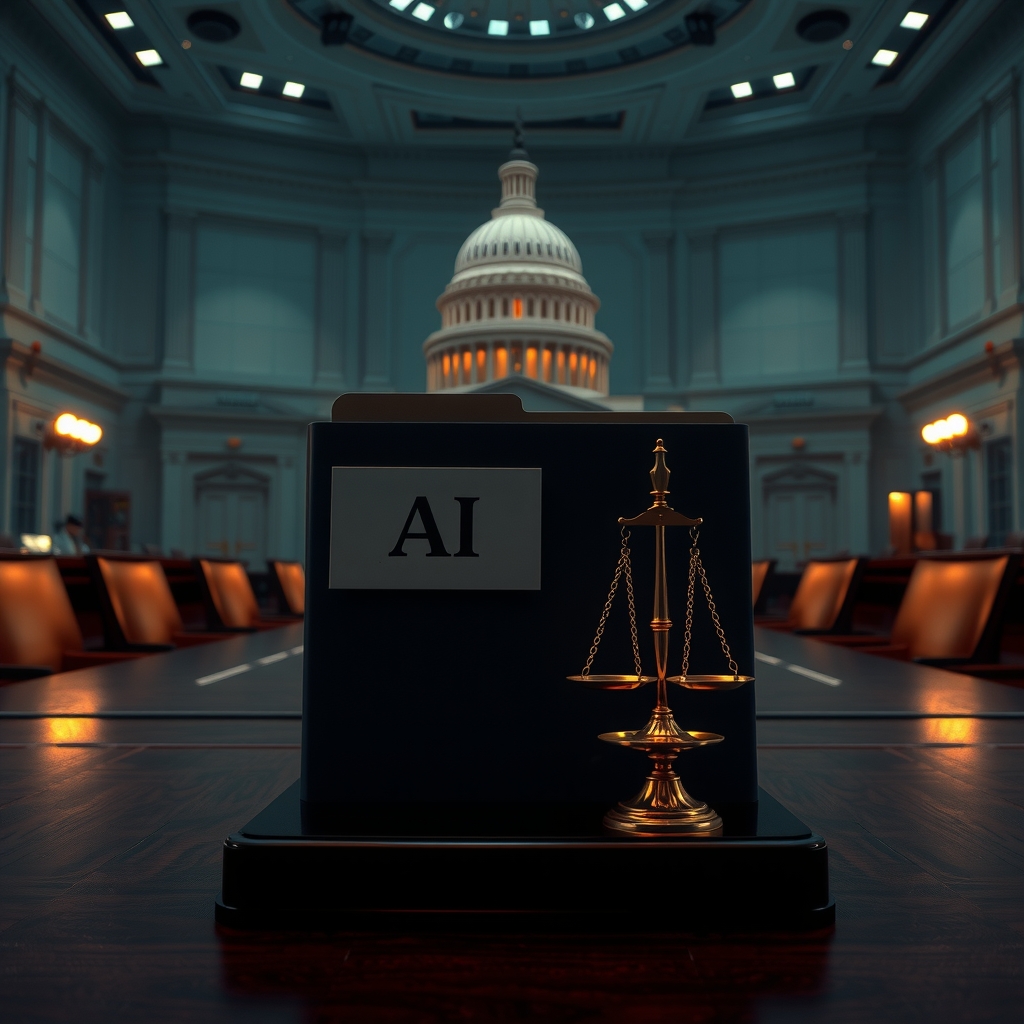
Anthropic is pitching lawmakers on a draft federal AI-safety bill that would make government intervention an exceptional remedy rather than a routine review tool, according to Politico’s report. The proposal is not introduced legislation or enacted law: it is a confidential draft described by three anonymous people familiar with private deliberations.
Anthropic’s draft AI-safety bill puts a high bar on federal intervention
What Politico reported
Politico says Anthropic representatives have quietly presented Capitol Hill lawmakers with a draft aimed at regulating the safety and security of frontier AI models. The outlet says it obtained the confidential draft and spoke with three people granted anonymity to discuss private deliberations. The draft itself is linked through PoliticoPro and was not publicly accessible in the reporting reviewed for this article. That matters: provisions attributed to the draft should not be treated as independently inspectable statutory text.
Anthropic confirmed the advocacy, but not by publishing the draft. A spokesperson told Politico that the bill represents proposals in the company’s Advanced AI Framework, which Anthropic says it has advocated to federal and state lawmakers since June. Reuters separately covered the episode, but its account also attributes the reported provisions to Politico rather than presenting an independently obtained copy of the bill. The distinction is central to understanding what is known and what remains reported rather than verified from the underlying text.
On the account provided by Politico, the proposal would allow the government to block a model’s release or use only where there is a foreseeable, imminent risk of more than $1 billion in damage, or the death or serious injury of more than 50 people. The reported risk categories are the creation or release of a biological weapon, a model evading its developer’s controls, or a cyberattack. These are details of the confidential draft as reported by Politico, not a description of a bill that Congress has formally introduced.
Why the intervention bar matters
The proposed threshold would place federal action at the far end of the risk spectrum. It is designed around catastrophic outcomes, not ordinary model errors, biased outputs, consumer complaints or every instance in which a system might be misused. In practical terms, the government would have to connect a covered model to a near-term and serious threat that clears a large harm threshold before seeking to stop its release or use.
Anthropic’s stated rationale is to preserve a meaningful backstop against dangerous deployments while constraining discretionary intervention. The company’s spokesperson told Reuters that the bill would give the government the ability to block or deter dangerous deployments of the most powerful models, while requiring testing, transparency and independent evaluation. That is a company characterization of the proposal, not an assessment that the safeguards would be sufficient.
The high bar also reflects a policy argument about institutional risk. A model can be technically capable without producing measurable harm, and many safety concerns are probabilistic or difficult to quantify before deployment. A rule that waits for a foreseeable, imminent catastrophe could reduce arbitrary shutdowns, but it could also make preventive action harder when evidence is incomplete. The draft’s reported numbers therefore represent more than legal drafting: they define how much uncertainty officials must tolerate before intervening.
How the proposed enforcement system would work
Politico reports that independent evaluators would register with the Commerce Department and periodically assess frontier labs and their models. Labs could pay for evaluations, provided payment was not contingent on the result. This arrangement attempts to combine technical independence with a funding model that does not require a new public evaluator workforce, although the draft’s practical safeguards against conflicts of interest are not publicly reviewable here.
If an evaluator found an “imminent enumerated risk,” Politico says it would have to report the finding to Commerce within 72 hours of completing the assessment. Commerce could then ask a federal judge to halt a model’s release. The reported language would reserve that suspension route for a judge in the U.S. District Court for the District of Columbia and would expressly bar other departments, agencies or officers from suspending a model’s development, deployment or internal use.
That allocation of authority is a notable design choice. It would put technical findings in the hands of evaluators, a government request in Commerce, and the ultimate halt decision in court. Supporters could view the chain as a check on unilateral executive action. Critics could ask whether a judicial process can move quickly enough for a fast-developing cyber or biological threat, and whether the Commerce Department would have the expertise and resources to challenge a well-funded lab. The reported draft does not settle those operational questions.
The June framework is context, not identical bill text
Anthropic’s public June framework provides the official policy context. It proposes obligations for frontier developers to test capable models for catastrophic risks, engage external evaluators, disclose results and incidents, and be accountable to a government agency. It names biological weapons, offensive cyber operations, loss of control and automated research and development as priority risk areas. Those are published company recommendations, not proof that every provision appears word-for-word in the confidential draft.
The framework also proposes a scope based on training compute and AI-related revenue or research spending: more than 1025 training FLOP plus either more than $500 million in annual AI-derived revenue or more than $1 billion in annual AI research and development spending. Anthropic says capability-based thresholds may eventually be preferable as the cost of producing dangerous capabilities changes. Because Politico’s account focuses on intervention, evaluation and reporting, readers should not assume the draft uses these exact coverage tests without seeing the text.
On transparency, the public framework calls for safety frameworks, system cards, recurring risk reports, annual certification and critical-incident reporting. It also says developers should answer to a government agency while retaining procedural, judicial and structural safeguards against overbroad discretion. This helps explain the architecture reported by Politico: mandatory preparation and disclosure are paired with a deliberately narrow power to stop a deployment.
Preemption is the political fault line
Politico reports that the draft would preempt some state laws involving public disclosure of risk, third-party evaluation and critical-incident reporting. A national standard could reduce compliance conflicts for labs operating across the country. Industry groups have made that uniformity argument, and the reported draft appears to tie federal authority to a single regime.
But Anthropic’s own June framework is more qualified than a blanket displacement of state regulation. It says Congress should preempt state law only if a rigorous federal regime meets or exceeds the framework’s strongest measures, and then only for specific frontier-governance functions. It says state statutory and common-law claims outside those functions should remain intact, and that compliance with federal rules should not automatically create immunity from state liability.
That limitation is politically consequential. Politico describes preemption as contested on Capitol Hill, with Democrats warning that some proposals could weaken state rules adopted in places such as California, Illinois and New York. The draft’s reported approach may appeal to companies seeking one compliance baseline, while drawing opposition from lawmakers and advocates who view state experimentation as a necessary safety backstop.
What happens next
Nothing in the available reporting shows that Congress has introduced the proposal, that lawmakers have agreed to it, or that it has become law. The next meaningful test would be whether Anthropic releases a public version, whether lawmakers convert parts of it into legislative language, and whether Commerce authority, judicial review and state preemption survive negotiation.
The proposal also arrives amid competing ideas about the federal role. Politico points to other congressional efforts that would address catastrophic AI risk, alongside lawmakers who want broader government review or, at the other extreme, a pause on advanced AI development. Anthropic’s draft is therefore best read as a company-backed opening position: concrete enough to shape debate, but still subject to scrutiny, amendment and rejection.
FAQs
Has Anthropic introduced an AI-safety bill?
No. Politico reported on a confidential draft pitched to lawmakers. The available sources do not show an introduced bill, a committee vote, enactment or presidential signature.
What would trigger federal intervention under the reported draft?
Politico reports that intervention would be limited to a foreseeable, imminent risk involving more than $1 billion in damage or the death or serious injury of more than 50 people, tied to specified biological, cyber or control-evasion scenarios. These details are reported provisions, not publicly verified draft text.
Who would decide whether a model must be halted?
According to Politico, registered independent evaluators would report qualifying risk to Commerce within 72 hours, Commerce could ask a federal judge to act, and a judge in the District Court for the District of Columbia could order a halt. The reported language would restrict other federal officials from suspending development, deployment or internal use.
Is the June Advanced AI Framework the bill?
No. Anthropic says the draft represents proposals in that framework, but the framework is a public policy document and the draft is confidential. The framework is useful primary-source context, not a substitute for the unpublished bill.
Would the proposal eliminate state AI-safety laws?
Politico reports that it would preempt some state disclosure, evaluation and incident-reporting laws. Anthropic’s public framework calls for narrower preemption only after a strong federal regime is enacted and says state authority should remain outside expressly occupied functions. The eventual scope, if any, is unresolved.