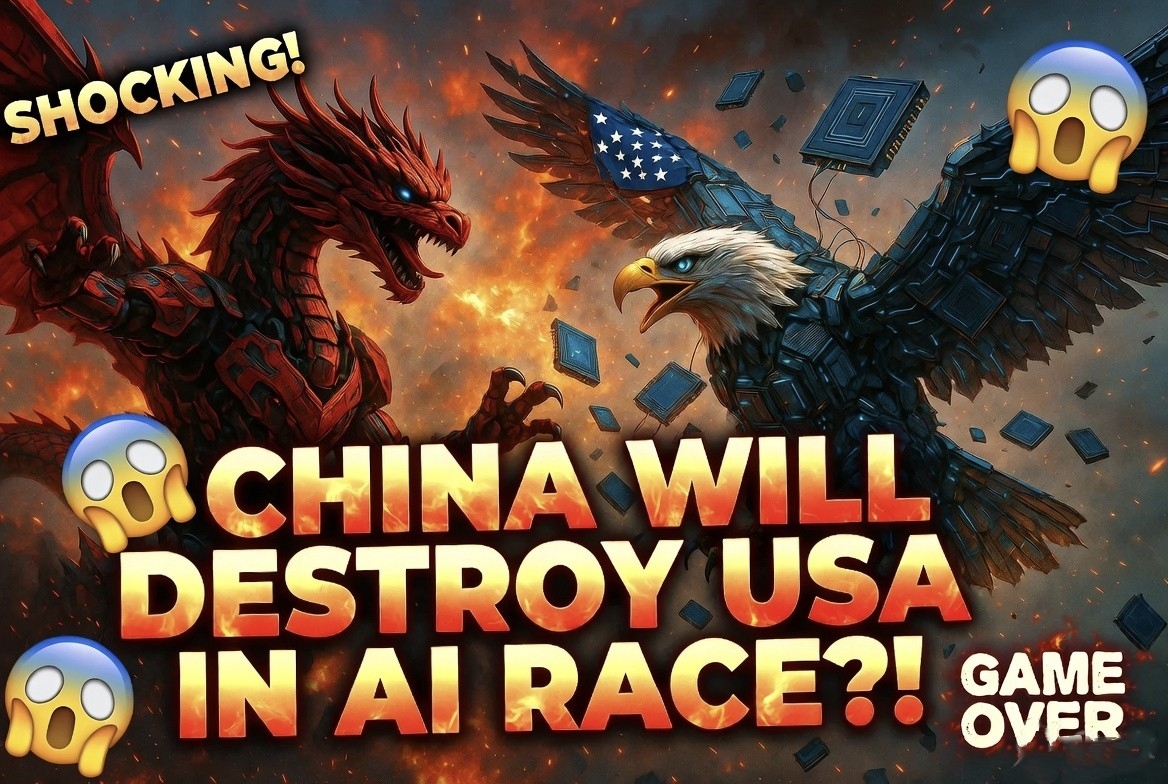
Every week there's some new headline yelling that China's about to overtake America in AI, or that it's already game over and the US has won. Both versions get clicks. Neither one actually tells you what's happening. And honestly, almost nobody's asking the question that matters most here: what happens to everyone else while these two fight it out for the crown.
The race everyone's covering wrong
Most coverage just boils this down to chip counts and benchmark scores. Who's got more GPUs this quarter, whose model topped some leaderboard. That's the easy story to write, so that's the one you keep seeing.
The real story is quieter than that. It's about who controls the layers underneath the models — the power grids keeping data centers alive, the rare earth supply chains that make the chips possible in the first place, and the talent pipelines deciding who's even building this stuff five years from now. China's genuinely ahead on the first two. The US still leads on the third, though that lead is shrinking faster than most people in Silicon Valley want to say out loud.
Where China's actually pulling ahead
Scale is where the numbers really do favor Beijing. China can throw up new data centers and power infrastructure at a pace the US permitting and regulatory system just can't touch right now. If this whole race comes down to raw compute and raw energy, that's a game built for China to win.
Chinese open-source models have also closed the gap way faster than anyone expected a couple years back. Back then the assumption was China sat three to five years behind the frontier. Now, on a bunch of benchmarks, that gap looks more like a few months, even though the actual bleeding edge (the most capable closed models) is still held by a small handful of US labs.
Where the US still has the edge
Frontier research talent is still heavily concentrated in the US, even if a lot of that talent was originally trained in China. The advanced chip fabrication bottleneck, the truly cutting edge nodes and not the workaround chips, is also still a real chokepoint. Export controls made routing around it harder, not impossible, but harder counts for something.
There's also a structural advantage that doesn't get talked about enough. American labs are racing each other just as hard as they're racing China, and that internal competition creates a weird kind of speed that a more centralized system doesn't naturally produce. OpenAI, Anthropic, Google DeepMind going at each other is probably doing more for US capability than any single government initiative could.
Two angles nobody's really talking about
This next part is speculation, and I want to be upfront about that. It's not reporting, it's a theory worth sitting with.
First, the stockpiling angle. Chip export controls have tightened in waves over the past few years. What almost nobody talks about is what happened to all the chips that made it into China before each new round of restrictions kicked in. There's a decent theory going around policy circles that a real compute reserve got quietly built up in those windows before each control took effect, chips sitting in reserve instead of getting deployed immediately. If that's true, China's actual usable compute could be higher than what public estimates show, because those estimates are almost entirely built on tracked exports, not on stuff that got banked earlier and never shows up in a new shipment number.
Second, the talent circulation angle. A lot of researchers behind China's fastest open-source labs trained or worked in the US at some point. The usual framing is "brain drain, one direction." But there's a less discussed possibility, that this movement is actually bidirectional now, researchers going back and forth for specific projects instead of making one permanent choice of country. If that's happening at any real scale, it would mean the two ecosystems are quietly mixing even while the politics on both sides describe a clean split. Nobody's published solid data on this, mostly because it's genuinely hard to track and nobody really wants to be the one to confirm it.
So who actually wins?
Probably neither, at least not in the dramatic way the headlines want you to believe. What's more likely is a split world, two AI ecosystems that don't really talk to each other, each dominant in the regions and industries they already control. The US ecosystem wins in advanced enterprise, defense-adjacent work, and frontier research. The Chinese ecosystem wins in cost-sensitive, high-volume deployment, manufacturing, logistics, government use cases, especially across Asia, Africa, and parts of Latin America where price beats raw capability.
That's a far less dramatic story than "Game Over." But it's probably the one that actually plays out, and it's the one almost nobody's writing about because it doesn't fit on a thumbnail.
This piece is analysis and informed speculation based on public trends, not confirmed reporting. Treat the stockpiling and talent circulation sections as theories worth watching, not established facts.