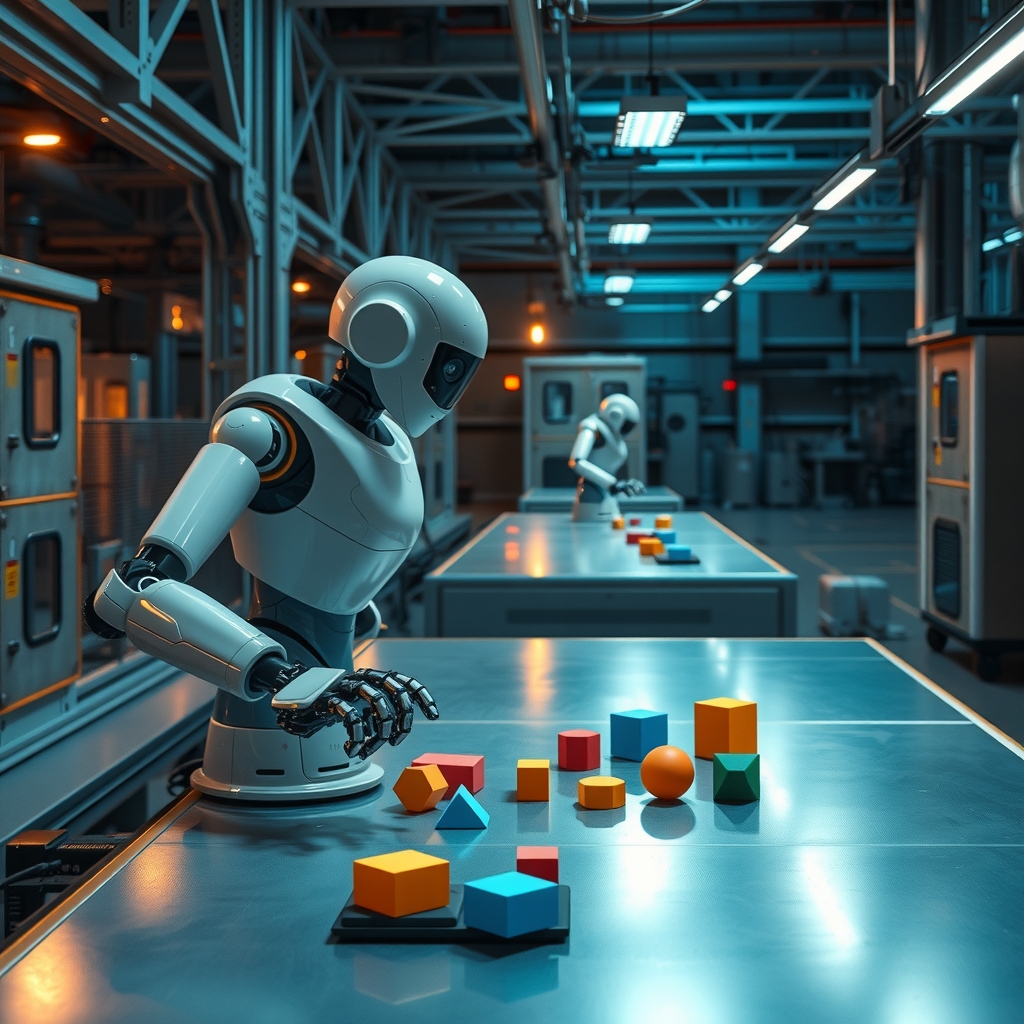
DexForce is building a robot-training proposition around simulated workplaces rather than relying only on people repeatedly demonstrating tasks in the physical world. The Shenzhen startup creates virtual scenes, varies objects and conditions, and uses the resulting synthetic data to train models before transferring them to real machines. The approach could reduce the burden of collecting demonstrations, but the public evidence currently mixes a Reuters-observed demonstration with the company’s own, largely undated marketing claims. It does not establish that synthetic data alone produces better robots, a particular cost saving, or a verified accuracy level.
What happened in Shenzhen
Fact: Reuters published its report on October 15, 2026, after a visit and demonstration on October 14 at DexForce’s headquarters in Shenzhen. Keeping those dates separate matters: the demonstration was observed on October 14, while the article describing it was dated October 15. The Reuters report showed a screen displaying a virtual robot putting objects on a table. The task was repeated while the arm angle, table color and objects changed. That small scene illustrates the central proposition: generate controlled variation in software instead of asking a human worker to perform every possible version of a movement.
Reuters also photographed and identified DexForce W1 Pro humanoid robots demonstrating object sorting at an industrial-deployment testing facility. The report describes the project as a sim-to-real process: a workplace or task is represented digitally, a robot is trained in the simulation, and the learned behavior is transferred to a physical machine. The observation is evidence that DexForce can present this workflow; it is not, by itself, a measurement of reliability across factories, offices or homes. Read the Reuters report.
Company position: Chief Executive Jia Kui told Reuters that simulated training could help the industry teach humanoids a wider range of useful tasks. That is a strategic argument, not a finding that every task transfers successfully. A robot that sorts objects in a prepared test area still has to cope with occlusion, slippery or deformable items, unexpected human movement, sensor noise and the safety constraints of a working site.
How the simulated-workplace pipeline works
Build scenes, objects and sensor views
DexForce’s official DexVerse page describes an in-house embodied-intelligence engine that combines environmental assets, robot assets and sensing paradigms. The page lists vision, force/torque and tactile sensors, along with an online parallel data stream. In practical terms, a training scene can contain a table, objects, a robot body and sensor inputs; the simulator can then produce examples of what the robot should see or feel as it acts.
The company says its system can create physics-accurate three-dimensional scenes from multimodal inputs. Its description specifically mentions detailed lighting, friction, and rigid, soft and fluid dynamics. Those details are important because a useful simulator has to represent more than a clean image. Contact forces, grasp stability and an object’s response to a push can determine whether a policy works outside the virtual environment. The page is an official product description, however, so these capabilities should be read as company claims unless an independent benchmark is supplied. See DexForce’s DexVerse page.
Generate, train and assess
The same page labels three parts of the workflow DexGen, DexSim and DexAI. DexGen is described as generating three-dimensional assets from descriptions of physical-aware objects or scenes; DexSim generates data; and DexAI trains models. DexForce also describes high-concurrency simulation and automated data generation that can stream training examples continuously. Domain randomization and differentiable simulation are presented as methods for helping models adapt and for reducing the sim-to-real gap.
Fact versus interpretation: These labels explain the architecture DexForce advertises. They do not show how many examples a given task requires, how often a simulated policy fails on hardware, or whether the system is cheaper for a particular customer. Those questions require task-level logs and reproducible tests rather than a product-page description.
Why synthetic data is attractive
Robot learning is data hungry because a machine must connect perception to action under variation. A person placing one cup on a shelf demonstrates one trajectory; a production robot may face different cup positions, lighting, surfaces, loads, grasp points and obstacles. Real-world collection can also be slow, expensive and risky. Reuters reported that DexForce says human trainers may need to repeat a movement more than 100 times to produce precise examples. It also reported that dozens of humanoid-robot data-training centers are being built in China, often at substantial cost and with heavy reliance on government subsidies.
Simulation offers three operational advantages in principle. First, the same task can be varied systematically: colors, geometry, camera position, friction and object placement can be changed in batches. Second, failures can be recorded without damaging a production line or putting a person near a moving machine. Third, a training run can be parallelized in software, allowing many virtual scenes to proceed at once. These are reasons to test simulation, not proof that it will outperform real demonstrations for every task.
Company claim: DexForce says its approach is faster and cheaper than gathering data from human trainers. The supplied reporting does not provide a measured dollar-per-successful-task comparison, a standard collection cost, or a controlled study. Accordingly, “cheaper” and “faster” should be treated as an asserted business advantage, not a verified saving. The likely result will vary with simulator development, robot hardware, task complexity, validation time and the cost of correcting sim-to-real failures.
Claims, limits and open questions
The 99.9 percent figure
Marketing claim: DexForce’s official page says rich datasets, training paradigms and model architectures can enable robust, generalizable models achieving up to 99.9% accuracy. The page does not define the benchmark, task population, sample size, failure taxonomy, confidence interval or comparison baseline. It should therefore not be reported as an independently established performance result. “Up to” also describes a ceiling, not an average across deployed tasks.
A serious evaluation would state whether accuracy means successful grasps, correct sorting, completion of a multi-step task, perception classification or something else. It would report performance on unseen objects and environments, not only randomized variants close to the training distribution. It would also include collision rates, recovery behavior, latency, human interventions and performance degradation after deployment. Without those details, the figure cannot tell a customer how a W1 Pro or another robot will behave in a specific workplace.
The physical-AGI estimate
Estimate and opinion: Jia told Reuters that reaching what he called physical artificial general intelligence through purely real-world collection could require 10 trillion samples. His definition concerns a humanoid completing new tasks in unfamiliar environments on command. This is a forward-looking estimate, not a measured industry requirement or a demonstrated threshold. It is useful for explaining why DexForce favors scalable virtual data, but it should not be treated as a forecast with a validated methodology.
The same distinction applies to the phrase “physical AGI.” A robot that performs selected tasks in a simulation and transfers some of them to hardware is not thereby shown to possess general intelligence. The relevant test would involve broad, independently specified tasks, unfamiliar conditions, safe adaptation and repeatable results.
DexForce’s company context
Reported fact: Reuters described DexForce as a roughly 500-employee startup founded in 2021 by Jia Kui, a machine-learning professor at the Chinese University of Hong Kong, Shenzhen. Reuters said the company is backed by Lenovo Capital, Lens Technology and state-owned funds, and had raised 1 billion yuan in a Series B round, which Reuters converted to about $147 million. The reported valuation was above 10 billion yuan.
Reuters also reported that the firm’s software is used in industrial settings by Chinese and foreign manufacturers including Toyota, Samsung, Panasonic, Foxconn, Haier and Hisense. It said the company’s humanoid robots make coffee and serve customers at malls and tourist sites in more than 15 Chinese cities. These are reported customer and deployment descriptions, not an independent assessment of the robots’ performance or the scale of each engagement.
Reported plan, not confirmed: Bloomberg reportedly said DexForce was considering a Hong Kong initial public offering. Jia declined to comment to Reuters. The IPO possibility should therefore be described as unconfirmed and not as a committed plan, timetable or filing.
What customers and researchers should watch
Recommendation: Buyers evaluating a simulated-data system should ask for a task-specific evaluation that separates simulation results from physical-robot results. The test should include held-out objects, lighting and surfaces; a clear success definition; the number of trials; human interventions; safety stops; and the time needed to recover from failure. If a vendor cites an accuracy percentage, request the benchmark protocol and the denominator behind it.
Recommendation: Compare the full cost of ownership, not only the price of synthetic data. Include scene and asset authoring, simulator licensing or infrastructure, sensor calibration, real-world validation, hardware wear, engineering labor and the cost of failures after deployment. A virtual pipeline may reduce repetitive demonstrations while shifting work into modeling, quality assurance and physical testing.
Researchers should also test whether synthetic examples add value beyond real examples, rather than assuming that more generated data is automatically better. A useful ablation could compare real-only, synthetic-only and mixed-data training under the same compute budget and held-out physical tasks. Reporting these comparisons would clarify whether improvements come from synthetic data, from the training method, from more compute, or from a carefully chosen benchmark.
The near-term story is therefore more measured than a promise of instant general-purpose robots. DexForce has shown a plausible workflow and a business case for investing in it. The remaining question is how reliably the workflow survives contact with the unpredictable, safety-critical environments where customers need robots to work.
FAQs
What is DexForce training?
DexForce is training robot models in simulated physical environments and then transferring the learned behavior to physical machines. The official page describes synthetic-data generation, streaming training and example tasks such as serving fruit, organizing a desktop, stacking cups and serving dishes. Those examples describe the platform’s task menu, not proof that every task is production-ready.
What did Reuters observe?
During a Shenzhen visit on October 14, 2026, ahead of its October 15 report, Reuters observed a virtual robot sorting or placing objects while arm angle, table color and objects changed. Reuters also reported on W1 Pro humanoid robots demonstrating object sorting at an industrial testing facility.
Does the company have verified 99.9% accuracy?
Not on the evidence supplied. DexForce’s undated official page makes an “up to 99.9% accuracy” claim, but does not define the benchmark or provide an independent validation in the cited material. It should be labeled a marketing claim until the measurement is specified and reproduced.
How much money does simulation save?
No measured saving is provided in the cited material. DexForce says simulated training is faster and cheaper than repeated human demonstrations, while Reuters reports the company’s explanation of why human collection can be costly. The actual saving would depend on the task, engineering effort, hardware and validation burden.
Is DexForce pursuing a Hong Kong IPO?
A possible Hong Kong IPO was reported by Bloomberg and mentioned by Reuters, but Jia declined to comment. It is an unconfirmed reported consideration, not a disclosed filing or a confirmed timetable.
References
- Reuters, “Chinese startup DexForce trains humanoid robots using virtual data to slash costs,” October 15, 2026. The report covers the October 14 Shenzhen visit and demonstration, W1 Pro, sim-to-real description, company statements, funding, valuation, staffing, customers and unconfirmed IPO report.
- DexForce, “Fully In-House Designed Embodied Intelligence Engine DexVerse,” undated official marketing page. The page describes physics-accurate scenes, synthetic data, online streaming training, domain randomization, differentiable simulation, listed sensing paradigms, example tasks and the up-to-99.9% accuracy claim.
Editorial note: This article distinguishes observed events, reported company information, estimates, recommendations and marketing claims. It does not independently verify DexForce’s performance, customer deployments, savings, valuation or future financing plans.