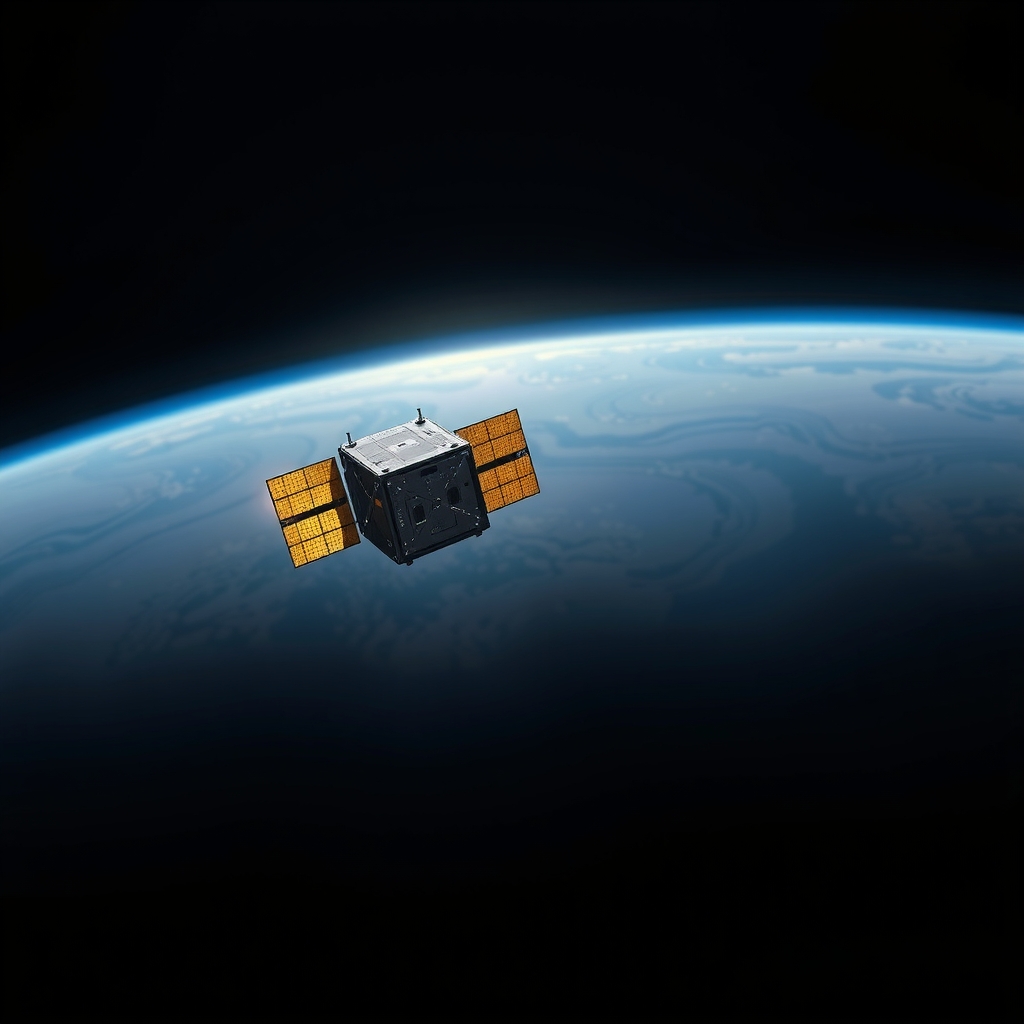
Google put four of its AI chips into orbit on October 1. A refrigerator-sized prototype satellite for Project Suncatcher launched on a SpaceX Falcon 9 from Vandenberg Space Force Base in California, and Google says it has confirmed contact and started in-orbit tests. The satellite carries four Trillium TPUs and about a kilowatt of solar power. That is a small amount of compute. The point of the flight is to learn whether Google's chips survive launch, radiation and heat in space, before the company tries anything bigger.
Table of contents
- What launched
- What Google is testing
- Cooling is the hard part
- What comes next
- Why do this at all
- FAQ
What launched
The satellite, called MVP, was built with Planet, the satellite company, and flew as one of about 130 payloads on SpaceX's Transporter-18 rideshare mission. RuntimeWire reports SpaceX's deployment list shows it as Project Suncatcher M1, released roughly 61 minutes after liftoff. Tech Times puts the orbit at a dawn-dusk sun-synchronous path about 650 kilometers up, where the solar panels stay in near-constant sunlight.
The chips are four Trillium TPUs, equal to a Google Cloud TPU v6e-4 slice, according to Alpha Signal. Tech Times offers a comparison: four TPUs and one kilowatt is about the compute of a single data center server. Google announced the mission on September 24, and the launch date held.
What Google is testing
Google's own framing, quoted by Gizmodo, is modest. The first launch is about seeing what works and finding points of failure so the findings can shape later missions. Three things are on the list.
First, the ride up. Gizmodo says the roughly 10-minute climb to orbit subjects a spacecraft to forces up to 10 times Earth's gravity, and individual parts, including the chips, can briefly feel 50 to 100 times gravity. Second, radiation. Google had already tested Trillium chips on the ground, and the flight adds real orbital data. Third, power and temperature. Alpha Signal says the satellite will run short Gemini inference workloads while engineers measure radiation-induced errors, power draw and heat rejection. That detail comes from a single outlet, so treat it as reported, not confirmed by Google.
Google plans to collect data over the coming weeks, per RuntimeWire. Technology.org reports the plan is to operate the craft for about a year, and that it could stay in orbit for up to six years.
Cooling is the hard part
The satellite cannot use the cooling systems common in data centers, because space has no air to carry heat away. Google told Gizmodo it is working on several approaches, including a combination of heat pipes and radiators. Tech Times goes further and argues in its headline that cooling, not radiation, now defines the mission. That is the outlet's analysis, though it fits Google's own emphasis on heat rejection.
It is a good reminder of why the numbers are so small. Power is not a problem in the right orbit, since solar panels get far more sunlight than they do on the ground. Getting rid of the heat that chips produce is harder, and it gets harder as you add chips.
What comes next
Google already plans to launch two satellites in 2027, according to Gizmodo, and to test the high-bandwidth lasers it hopes will connect satellites into clusters. No laser links are on this flight. A second launch or a commercial date has not been announced, per Tech Insider's summary.
The longer vision, as Aroged describes it, is a group of satellites that work together as an orbiting data center, each carrying dozens of TPUs and talking to each other and to Earth by laser. That is a research goal, not a product.
Why do this at all
The motivation is the strain on data centers on the ground. Alpha Signal lists limited grid connections, long power contracts, water constraints and local permitting as the pressures. Orbit sidesteps most of them, at the price of launch costs, hard repairs, hardware replacement, debris management and reliance on ground networks.
Whether the economics ever work is unproven. Technology.org says Google's own research paper estimated space compute could reach rough cost parity with ground data centers around the mid-2030s, if launch prices keep falling. A four-chip prototype will not settle that math. It will only show whether the chips survive the trip.
The demand side is real, though. As we reported in our look at Anthropic's $518 billion in compute commitments, AI labs are locking in capacity years ahead because they expect demand to outrun supply. Anything that adds capacity, on the ground or off it, gets attention. But the gap between four chips in a rideshare slot and a working orbital data center is very large, and Google has not claimed otherwise.
FAQ
What is Project Suncatcher?
It is a Google research program, announced in November 2025, exploring whether AI computing could run on solar-powered satellites in low Earth orbit instead of ground data centers.
What launched on October 1?
A refrigerator-sized prototype satellite built with Planet, carrying four Trillium TPUs and about 1 kW of solar power, launched on SpaceX's Transporter-18 rideshare mission from California.
Will it run real AI workloads?
Mostly it is a hardware test. One outlet reports it will run short Gemini inference tasks while engineers measure errors, power and heat.
When will Google launch more satellites?
Google plans two satellites in 2027 to test laser links between them. No commercial date has been announced.