📝 Abhijeet's Note: I started learning agentic AI in early 2023 when it was still called "autonomous agents." Back then, there was no clear roadmap. I spent months figuring out what to learn and in what order. This guide is the roadmap I wish I had - a structured path from complete beginner to building production AI agents.
What is Agentic AI?
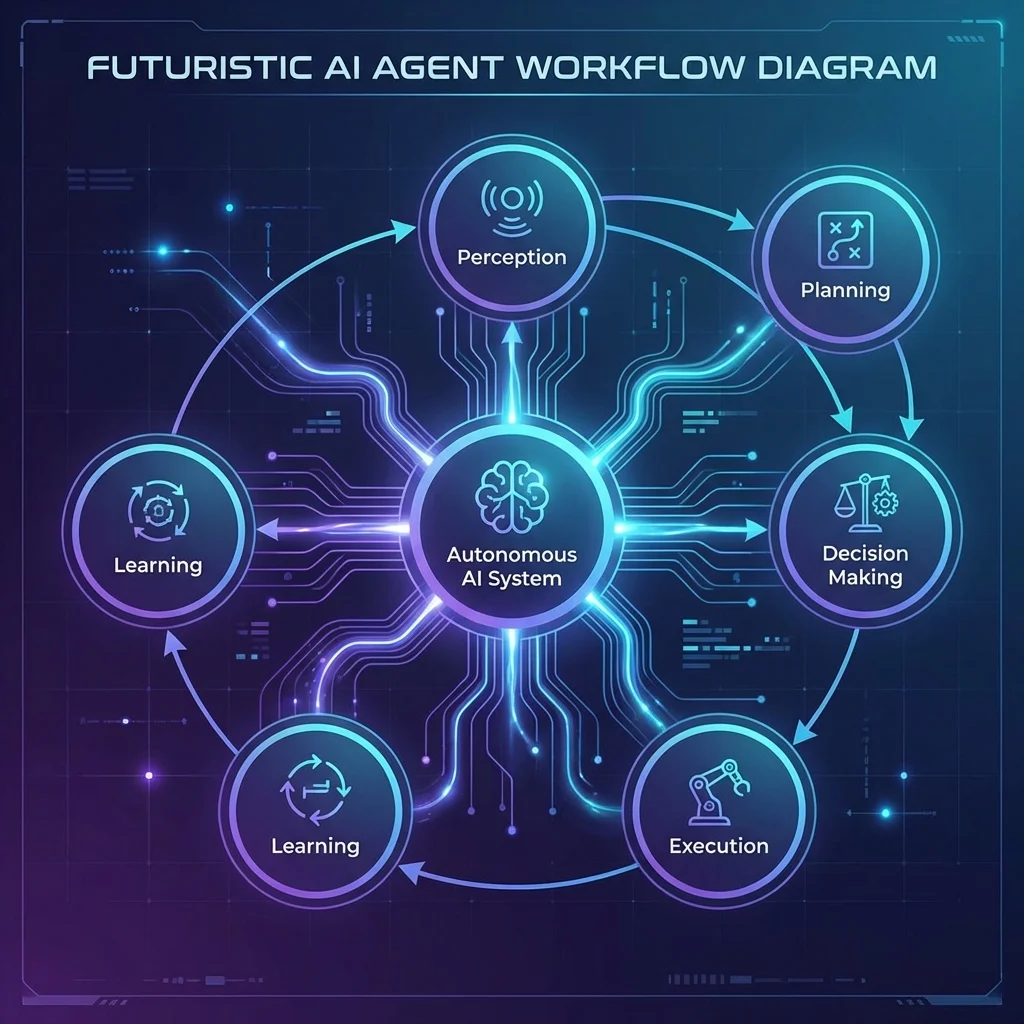
Agentic AI represents the next evolution of artificial intelligence - systems that can act autonomously to achieve goals without constant human intervention.
Key Characteristics:
- ✅ Autonomy: Makes decisions independently
- ✅ Goal-Directed: Works toward specific objectives
- ✅ Planning: Creates multi-step strategies
- ✅ Tool Use: Leverages external APIs and databases
- ✅ Learning: Improves from feedback and experience
Why Learn Agentic AI in 2026?
According to Gartner, 40% of enterprise applications will incorporate AI agents by end of 2026, up from less than 5% in 2025.
Market Demand:
- Job Growth: 300% increase in "AI Agent Engineer" roles
- Salary: $120K-$200K average for agentic AI developers
- Startups: $2.5B+ invested in agent-focused companies
- Use Cases: Customer service, coding assistants, research automation
💭 My Take: I've seen the shift firsthand. In 2023, I was building simple chatbots. By 2024, I was creating agents that could research, plan, and execute complex tasks. The demand is real - I get 3-4 recruiter messages weekly specifically for agentic AI roles.
Prerequisites: What You Need to Know
Essential Skills:
- Python Programming: Intermediate level (functions, classes, async)
- Basic ML Concepts: Understanding of training, inference, embeddings
- API Knowledge: REST APIs, JSON, HTTP requests
- Git/GitHub: Version control basics
Nice to Have:
- Linear algebra fundamentals
- Experience with LLMs (ChatGPT, Claude)
- Cloud platforms (AWS, Azure, GCP)
The 36-Week Learning Roadmap
Phase 1: Foundations (Weeks 1-8)
Week 1-2: Mathematics Refresher
- Linear Algebra: Vectors, matrices, operations
- Probability: Distributions, Bayes theorem
- Graph Theory: Nodes, edges, traversal (for agent reasoning)
Resources: 3Blue1Brown (YouTube), Khan Academy
Week 3-5: Python for AI
- Async Programming: asyncio, await, concurrent execution
- Type Hints: Better code quality for agents
- Error Handling: Try/except, custom exceptions
- API Development: FastAPI basics
Project: Build a simple async web scraper
Week 6-8: Machine Learning Fundamentals
- Supervised Learning: Classification, regression
- Neural Networks: Backpropagation, activation functions
- Embeddings: Vector representations of text
- Fine-tuning: Transfer learning basics
Project: Train a simple text classifier
Phase 2: LLMs & Prompt Engineering (Weeks 9-14)
Week 9-10: LLM Fundamentals
- Transformer Architecture: Attention mechanism
- Tokenization: How text becomes numbers
- Context Windows: Memory limitations
- Temperature & Sampling: Controlling randomness
Week 11-14: Advanced Prompt Engineering
- Zero/Few-Shot: Learning from examples
- Chain of Thought: Step-by-step reasoning
- ReAct: Reasoning + Acting pattern
- Self-Consistency: Multiple reasoning paths
- Tree of Thought: Exploring multiple solutions
Project: Build a ReAct agent from scratch
📝 Abhijeet's Note: Prompt engineering is THE most important skill for agentic AI. I spent 3 months just mastering different prompting techniques. Don't rush this phase - the quality of your prompts directly determines agent performance.
Phase 3: Core Agentic Concepts (Weeks 15-24)
Week 15-17: Memory & Knowledge
- Vector Databases: Pinecone, Weaviate, ChromaDB
- RAG (Retrieval-Augmented Generation): Connecting LLMs to data
- Semantic Search: Finding relevant information
- Memory Types: Short-term, long-term, episodic
Project: Build a RAG chatbot with memory
Week 18-20: Tool Use & API Integration
- Function Calling: LLM-driven API calls
- Tool Schemas: Describing tools to agents
- Error Handling: Graceful failures
- Tool Chaining: Multi-step workflows
Project: Agent that uses 5+ external APIs
Week 21-24: Planning & Reasoning
- Task Decomposition: Breaking complex goals
- Planning Algorithms: BFS, DFS for agent paths
- Reflection: Self-critique and improvement
- Decision Trees: Structured decision-making
Project: Planning agent for travel itineraries
Phase 4: Frameworks & Production (Weeks 25-32)
Week 25-28: LangChain/LangGraph
- LangChain Basics: Chains, agents, tools
- LangGraph: State machines for agents
- Custom Agents: Building from scratch
- Streaming: Real-time responses
Project: Customer service agent with LangGraph
Week 29-32: Multi-Agent Systems
- Agent Communication: Message passing
- Coordination: Task distribution
- AutoGen: Microsoft's multi-agent framework
- CrewAI: Role-based agents
Project: Research team with 3+ specialized agents
Phase 5: Advanced Topics (Weeks 33-36)
Week 33-34: Deployment & Monitoring
- Docker: Containerization
- FastAPI: Production APIs
- Monitoring: LangSmith, Weights & Biases
- Cost Optimization: Caching, batching
Week 35-36: Ethics & Safety
- Alignment: Ensuring agents follow instructions
- Safety Guardrails: Preventing harmful actions
- Bias Mitigation: Fair decision-making
- Responsible AI: Best practices
Essential Tools & Resources
| Category | Tools |
|---|---|
| Frameworks | LangChain, LangGraph, AutoGen, CrewAI |
| LLM APIs | OpenAI, Anthropic, Google Gemini |
| Vector DBs | Pinecone, Weaviate, ChromaDB |
| Monitoring | LangSmith, Weights & Biases |
| Deployment | Docker, FastAPI, AWS/Azure/GCP |
Common Mistakes to Avoid
❌ Don't Do This:
- Jumping straight to frameworks without understanding fundamentals
- Ignoring prompt engineering (it's 80% of the work!)
- Not testing with real-world data
- Skipping error handling and edge cases
- Building without monitoring/logging
💭 My Biggest Mistake: I spent 2 months building complex multi-agent systems before mastering single-agent basics. Result? Buggy, unreliable agents. Start simple, master the fundamentals, then scale up.
Career Paths in Agentic AI
Job Roles:
- AI Agent Engineer: $120K-$180K
- LLM Application Developer: $100K-$150K
- Multi-Agent Systems Architect: $150K-$200K
- Prompt Engineer: $80K-$130K
- AI Safety Researcher: $140K-$220K
Key Takeaways
🎯 Summary
- ✅ 36-week structured roadmap from beginner to expert
- ✅ Focus on fundamentals before frameworks
- ✅ Master prompt engineering (80% of success)
- ✅ Build real projects at each phase
- ✅ High demand: 300% job growth in 2026
- ✅ Salary range: $120K-$200K for experienced developers