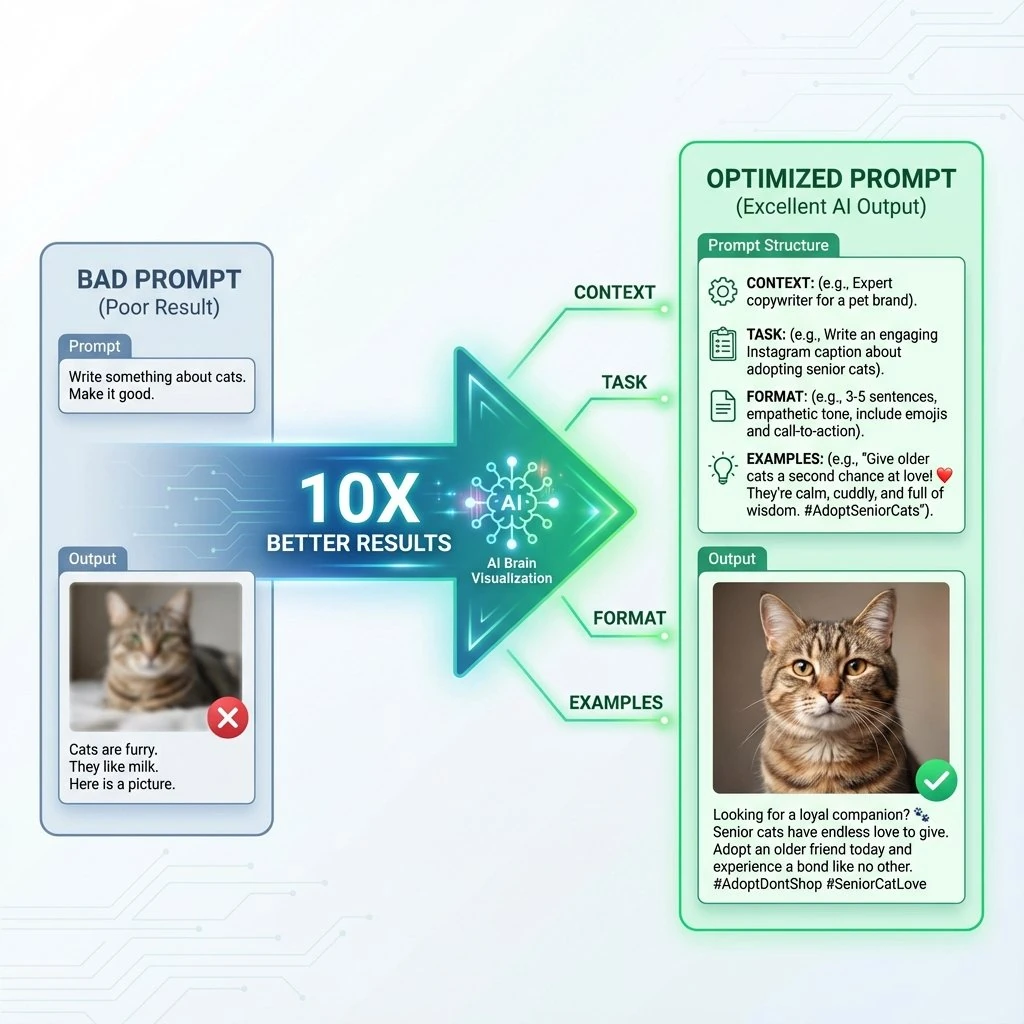
The Golden Formula
Persona + Context + Task + Constraints + Format
"Act as a Senior Python Developer (Persona). I am building a Flask app for a library (Context). Write a function to calculate late fees (Task). Use type hinting and docstrings (Constraints). Output only the code block (Format)."
Technique 1: Few-Shot Prompting
Don't just tell AI what to do. Show it.
Bad: "Write a catchy title."
Good: "Write a catchy title. Here are examples of titles I like:
1. AI Changed Everything Overnight
2. 5 Ways to Code Faster
Now write one for a cooking article."
Technique 2: Chain of Thought
Force the AI to "think" before it answers. This reduces logic errors by 40%.
Prompt: "Before answering, think step-by-step. Break down the problem, analyze potential edge cases, and then provide the solution."
Technique 3: The "Refusal" Hack
Prevent lazy answers by adding negative constraints.
- "Do not use filler words."
- "Do not apologize."
- "Do not explain the code, just write it."
Top 5 Prompts to Save
- The Improver: " critique my code/writing and suggest 3 specific improvements."
- The Simplifier: "Explain this quantum physics concept to a 12-year-old."
- The Consultant: "Act as a McKinsey consultant. Analyze this business idea."
- The Teacher: "Create a study plan for learning Rust in 30 days."
- The Devil's Advocate: "Tell me why my plan might fail."
Final Verdict
🎯 Pro Tip
Iterate. Your first prompt is rarely perfect. Treat AI like a junior intern. If the output is wrong, explain why it's wrong and ask it to try again.
Prompt engineering isn't magic. It's just clear communication.