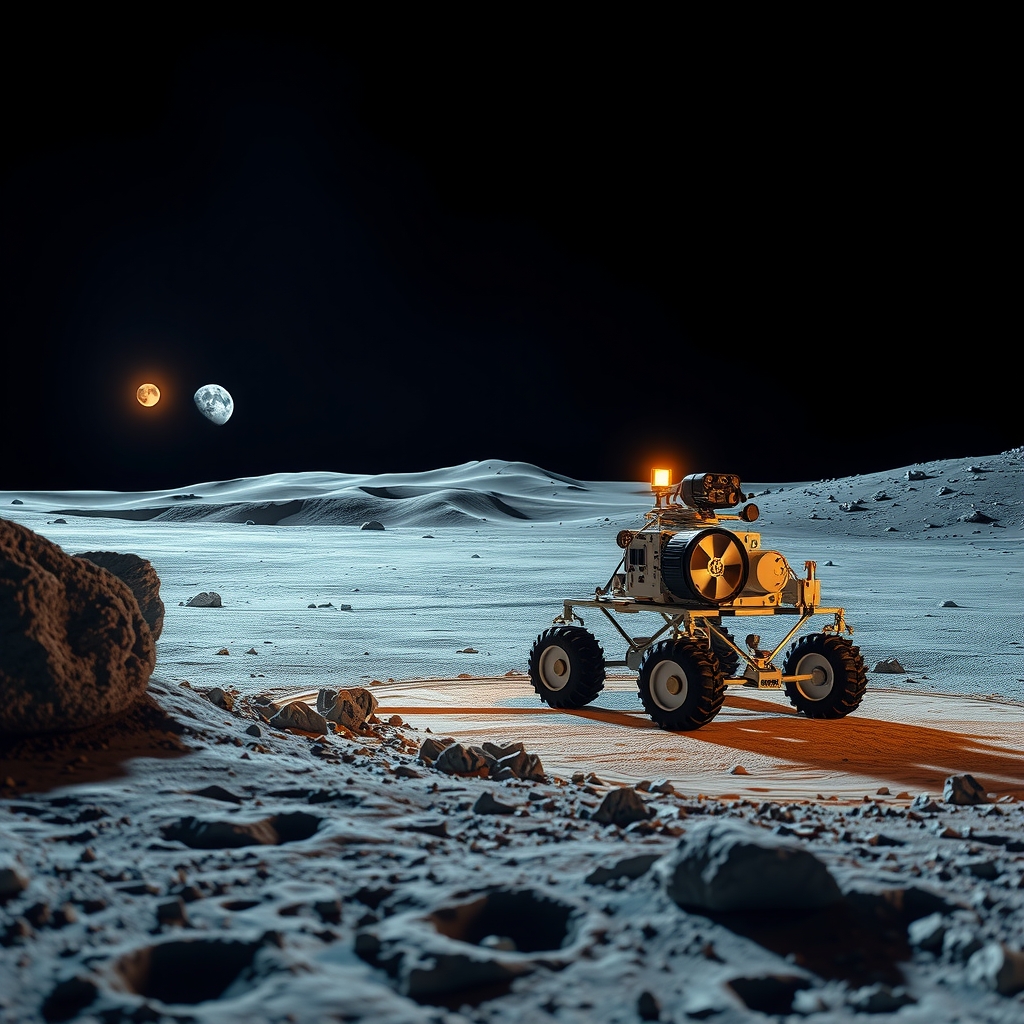
HPE’s Spaceborne Computer-4 is planned as a compact lunar AI and high-performance-computing payload, designed to process rover data near the Moon’s south pole instead of sending every task back to Earth. The mission remains a preview: hardware specifications, qualification details, launch, landing and benchmark results have not been disclosed.
Mission and lunar setting
HPE announced Spaceborne Computer-4 on October 20 as a planned addition to Astrolab’s FLIP rover, which is intended to travel on an uncrewed lunar-south-pole mission under NASA’s Commercial Lunar Payload Services program. NASA’s event page describes the planned Griffin-1 mission as carrying FLIP and other cargo to Nobile Crater in late 2026. That wording matters: the packet supports a mission plan, not a completed launch or a result in space. NASA’s mission page is the reference for the destination and planned timing.
The payload is framed as an experiment in putting computing beside the instruments that generate data. A rover could process imagery, ranging data and mission documents locally rather than waiting for every intermediate file to cross the lunar link. That is the proposed operating logic, not evidence of reduced latency or higher productivity.
The south-pole setting gives the preview a practical focus: a semi-autonomous rover must reason about terrain while managing solar and battery availability, according to a Space.com interview and report. That reporting says the design contemplated multiple lunar nights and a full year of design work. These are goals, not a demonstrated survival record.
What is known about the hardware
HPE describes Spaceborne Computer-4 as a lightweight, self-contained, fanless, low-power computer combining a CPU and GPU. The company also identifies Kioxia solid-state drives as part of the payload. That gives a useful outline of the architecture: general-purpose processing, accelerated workloads and local storage in a package intended for a rover rather than a conventional terrestrial data center.
Beyond that outline, the public description is restrained. The packet does not give processor or accelerator models, core counts, memory or storage capacity, mass, power draw, thermal limits, interfaces or throughput. It also does not state radiation qualification, shielding, redundancy, fault tolerance or enclosure dimensions. Fanless describes the cooling approach, but not how heat will be rejected on the Moon.
Compact does not mean fully specified
HPE’s announcement is a product description, not a flight-hardware data sheet. A CPU and GPU do not establish an AI model size, inference rate or benchmark score, and naming Kioxia SSDs does not reveal storage capacity or fault protection.
The same caution applies to the word “supercomputer.” HPE’s release positions the payload within its Spaceborne Computer line and discusses high-performance computing, but the packet does not establish a conventional data-center ranking or a final sustained performance figure. The useful fact for this preview is narrower: the payload is planned to bring CPU/GPU computing and storage to a lunar rover, with tests intended to include recognized HPC benchmarks.
In other words, the announcement establishes a direction of travel rather than a finished specification. Readers can assess why local computing is being attempted and what categories of work are proposed, while leaving room for the flight manifest, qualification report and post-mission measurements to determine how closely the eventual system matches the concept.
Planned AI and HPC workloads
The announced workload list spans benchmark science, mission assistance and security. HPE plans HPL and HPCG benchmark tests. They are planned checks of HPC performance in this concept, not published results: the packet gives no implementation details or scores, and HPE’s “first” language is limited to public information as of October 20.
Search, vision and mapping
For document work, the payload is planned to support retrieval-augmented generation (RAG): an onboard language model would search mission documents and ground an answer in retrieved material. That could help when a round trip to Earth is undesirable, but it does not prove accuracy or autonomy. The model, corpus, retrieval method and evaluation results are undisclosed.
Other services address direct rover sensing. Vision inference could analyze camera imagery, while LiDAR workloads could support mapping, navigation and terrain analysis. The announcement does not specify the models, sensors, duty cycle or whether a person will approve outputs.
Model coordination and cyber monitoring
The payload is also described as hosting an AI services container. NASA’s FLUID effort is identified as coordinating models trained across Earth, the Moon and the International Space Station. No acronym expansion, topology or synchronization method is supplied, so it should be treated as a named effort, not a demonstrated lunar federation.
Deloitte’s Silent Shield is listed for cyber anomaly detection. This is a vendor-associated planned service, not an independently verified detection rate: no threat model, alerting workflow, false-positive rate or test outcome is provided. The preview supports inclusion intent, not a claim that a rover has been secured.
Why compute at the lunar edge
Spaceborne Computer-4 is best understood through the edge-computing problem it is meant to explore. Lunar distance, contact opportunities and limited bandwidth can make sending raw camera or LiDAR streams inefficient. Local processing could reduce a sensor stream to a map, alert, selected image or other compact result before transmission.
That approach does not eliminate Earth support. Ground teams would still handle planning, oversight, model development, science analysis and recovery. Edge computing changes where intermediate work occurs; it does not make the rover an independent mission authority or authorize unsupervised safety-critical decisions.
The trade-off is resource management. Finite power, storage and thermal headroom are shared with sensing, mobility and communications. A fanless, low-power package suits that goal, but does not prove simultaneous operation. No duty cycle, battery budget or latency comparison is supplied.
Timing and the Griffin-1 source discrepancy
The declared schedule is late 2026, but it remains planned. NASA’s page identifies Astrobotic’s FLIP rover and Nobile Crater, while Space.com also identifies Astrobotic. HPE’s press release, however, calls Griffin-1 a lander from Voyager Technologies. Those sources differ, so this preview preserves the discrepancy.
Readers should not infer a launch change from the labels. NASA and Space.com identify Astrobotic as Griffin-1 operator or developer in the packet, while HPE uses Voyager Technologies. The source set does not explain the difference, so roles and schedule should retain source-specific attribution.
There is no launch, landing, benchmark or operational result to report. “Planned for late 2026” is not “on the Moon in late 2026”; later primary documentation would be needed to update this preview.
What remains unknown
Several unanswered questions will determine the demonstration’s value. The packet does not say how the CPU, GPU, SSDs and enclosure were tested for radiation, vibration, vacuum, thermal cycling or lunar-night conditions. Flight redundancy and recovery modes are also undisclosed.
There are no HPL or HPCG scores, RAG accuracy study, vision or LiDAR evaluation, Silent Shield statistics or FLUID results. No model card, dataset description or human-approval policy is public. Without them, readers cannot compare the payload with a terrestrial server or call the services autonomous.
The division of responsibility is also open. The payload is associated with HPE, the rover with Astrolab, named services with NASA and Deloitte, and Griffin-1 attribution differs. A final manifest, interface specification and post-mission report would need to identify operators, data flows, Earth-side decisions and benchmark execution.
FAQs
What is Spaceborne Computer-4?
It is HPE’s planned lightweight, self-contained, fanless, low-power CPU/GPU payload with Kioxia SSDs, intended for Astrolab’s FLIP lunar rover. It is described as a platform for HPC benchmarks and AI services, not as a completed lunar deployment.
When is the lunar mission expected?
The packet gives a planned late-2026 timeframe. NASA’s mission page says Griffin-1 is planned to carry FLIP and cargo to Nobile Crater under CLPS. The date is not a launch or landing confirmation, and no result is available in the declared sources.
What will the computer do on the Moon?
Planned uses include HPL and HPCG testing, RAG-based onboard-document search, vision inference, LiDAR mapping and navigation analysis, an AI services container, NASA FLUID model coordination and Deloitte Silent Shield cyber anomaly detection. Exact models, operating procedures and outcomes are undisclosed.
Who is associated with Griffin-1?
The sources differ. NASA and Space.com identify Astrobotic, while HPE’s release says Voyager Technologies. The packet does not resolve the discrepancy, so it should be reported rather than silently corrected.
References
- HPE: Spaceborne Computer-4 announcement — primary company description and planned workloads.
- NASA: CLPS Flight—Astrobotic’s Griffin Mission One — planned mission, FLIP and Nobile Crater details.
- Space.com: report on the planned lunar computer and FLIP — interview-based context on design and rover operations.
- The Register: Spaceborne Computer-4 coverage — additional independent reporting listed in the research packet.