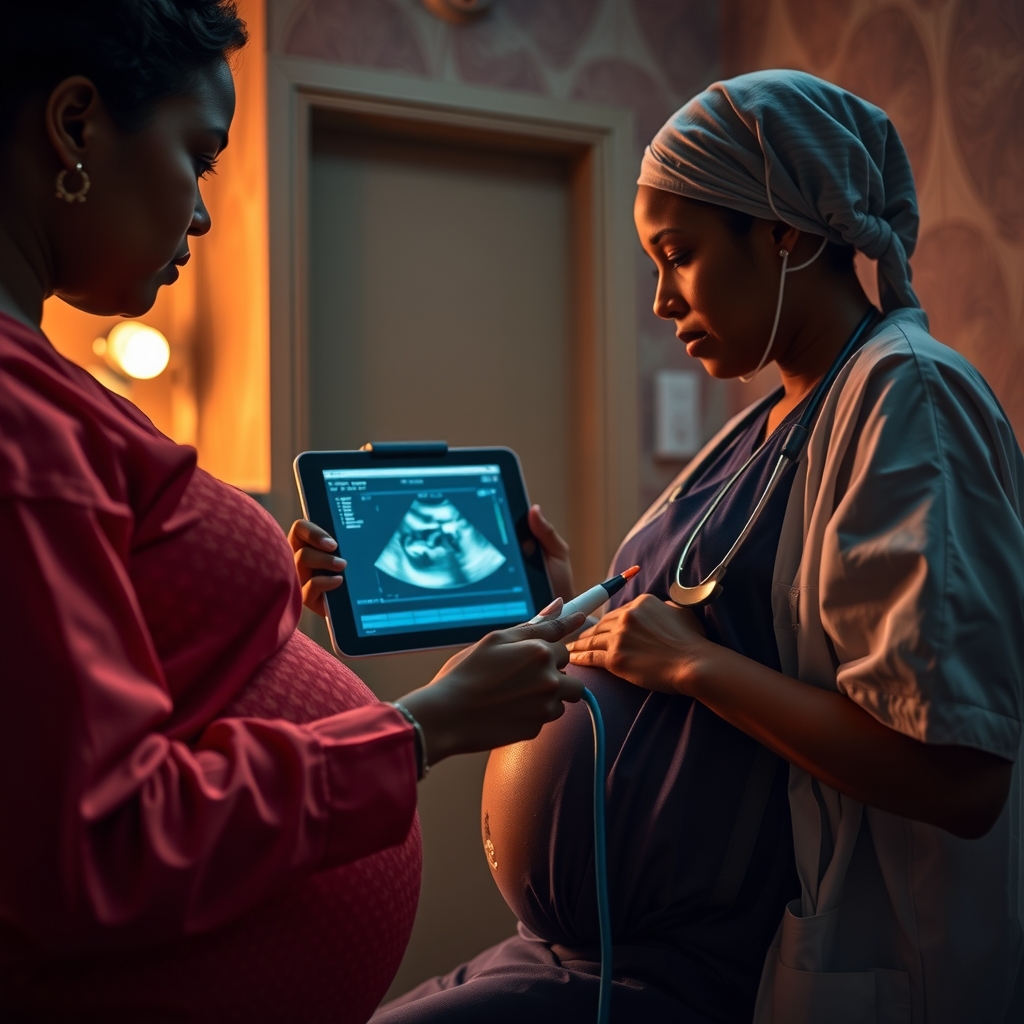
A new prospective study from Google researchers and clinical collaborators reports that an artificial-intelligence model estimated gestational age from “blind-sweep” ultrasound scans with about four days of mean absolute error in Chicago and Nairobi. The result is notable because the scans were collected by novice operators using a handheld probe, but it is narrower than a claim that AI can perform pregnancy diagnosis or make prenatal care broadly available.
What the study tested
The paper, published in JAMA Network Open, is a prospective, multicenter observational diagnostic study conducted at Northwestern Medicine in Chicago and Jacaranda Health in Nairobi. Its primary evaluation included 385 pregnant participants whose pregnancies were 16 to 36 weeks along at the blind-sweep examination. The investigators asked whether a previously developed model could estimate gestational age in new clinical environments, with different operators and a different ultrasound device, rather than merely perform well on data resembling its training set. (JAMA Network Open)
A scan without conventional measurements
In a conventional dating examination, a trained sonographer locates particular fetal views and measures structures such as the head, abdomen or femur. A blind sweep changes the operator’s job: the person moves a probe over the abdomen in a prescribed sequence without having to identify those views in real time. The model analyzes ultrasound video rather than asking the operator to calculate biometrics. The study protocol used up to six freehand sweeps—three vertical and three horizontal—and produced predictions on a tablet in real time while hiding the diagnostic result from the operator. (JAMA Network Open)
That distinction matters. The endpoint was gestational age, the estimate of how far a pregnancy has progressed. Gestational age anchors decisions about timing, testing and treatment, so an inaccurate estimate can have clinical consequences. But the model was not being validated here as a general-purpose obstetric examination. The study did not test whether it could reliably identify fetal anomalies, diagnose complications, or replace a clinician’s overall assessment. (JAMA Network Open)
How the model was adapted
The base model had been trained on ultrasound data from 1,968 participants in North Carolina and Zambia. For this evaluation, researchers paired it with a Clarius C3 handheld transabdominal probe that had not appeared in the original training data. They used a Chicago pilot set from 120 participants—180 examinations divided between training and internal validation—to adapt the system to the new probe and extend its tested range beyond 36 weeks. Crucially, no Nairobi data were used for fine-tuning. That design made Nairobi an external test of whether the adapted system could travel to another population and workflow without local optimization. (Google Research; JAMA Network Open)
The operators were not experienced sonographers. Two operators in Chicago received a handout, verbal instructions and a brief demonstration, while three in Nairobi received six hours of hands-on training after lessons from the Chicago pilot. They practiced on phantoms and volunteers and shadowed expert sonographers. This is a meaningful test of the workflow’s operator burden, though it is not the same as proving that any untrained person could obtain a usable scan. (JAMA Network Open)
Results and what noninferiority means
Accuracy across the two sites
The model’s mean absolute error was 4.1 days in Chicago, with a 95% confidence interval of 3.5 to 4.7 days. In Nairobi, the error was 4.3 days, with a 95% confidence interval of 3.8 to 4.8 days. Across the cohorts, the AI estimate had a mean absolute error of 4.2 days, compared with 4.5 days for the clinical-standard estimate. The paper reported that the AI approach met its prespecified noninferiority test, with P less than .001. (JAMA Network Open)
Mean absolute error is the average size of the difference between an estimate and the reference gestational age; it does not say that every prediction was within four days, nor does it tell a clinician how a particular scan will perform. The comparison was against a standard-procedure estimate based on expert-performed ultrasound and formula-based biometry, while the reference gestational age came from the best obstetric estimate, including early dating scans where available. In Nairobi, 74 participants—about 38%—presented after 14 weeks, so later fetal biometry was used when an early scan was not available. (JAMA Network Open)
A statistical result, not a deployment verdict
Noninferiority means the investigators set out to show that the new approach was not unacceptably worse than the comparator within a predefined margin. Here, the margin was one day. It does not mean that AI outperformed expert care in every clinical sense, nor does it establish that the model improves maternal or newborn outcomes. The narrow difference in average error should therefore be read as evidence about this study’s diagnostic endpoint, not as a blanket endorsement of replacing sonographers.
The result matters because a model that needs a specialist to acquire every image can be difficult to scale where sonographers and ultrasound machines are scarce. A protocolized sweep, portable probe and on-device inference could shift some work toward frontline staff. Google presents that possibility as a route to broader prenatal assessment, while the paper more cautiously describes potential for scalable cross-setting deployment. Those are opportunities, not evidence that the tool is already routine care. (Google Research; JAMA Network Open)
Deployment, access and unresolved questions
The operational details are part of the result
The study tested more than an algorithm in isolation. Software on mobile devices accepted video from the handheld probe and returned a prediction during the examination. Its workflow included a confidence estimate intended to reject poor-quality sweeps, although that flag is not a substitute for clinical review. Researchers also reported practical lessons such as the value of swappable batteries for consecutive patients. Implementation therefore depends on power, maintenance, supervision and training as much as model accuracy. (Google Research; JAMA Network Open)
Access is not automatic: a low-cost probe still requires consent, privacy, referral and clinical oversight. The study also leaves open performance across rural settings, body types, twins, gestational-age distributions, staffing models and local standards of care. Those questions require prospective testing rather than extrapolation from a favorable two-site result.
Why the study’s boundaries matter
The evidence comes from two urban clinical settings and one primary cohort. Chicago contributed adaptation data, so the strongest test of no local fine-tuning was Nairobi—not every possible deployment environment. Operators followed a defined protocol and received study support. Those facts do not invalidate the result; they define what was demonstrated.
The study included follow-up through delivery, but its reported finding is an accuracy and noninferiority result. It did not demonstrate fewer complications, better birth outcomes or safer decisions compared with usual care. Future work must test how clinicians use the prediction, how often scans are rejected, how errors are managed and whether care changes without new harms.
What this result does not show
It does not show that ultrasound has become autonomous. Operators followed a prescribed acquisition protocol, the study used expert-derived reference standards, and the model addressed one variable: gestational age. It does not show that an AI scan can rule out fetal abnormalities or determine whether a pregnancy is healthy. Nor does it show that four days is a guaranteed error bound, because the reported number is an average.
It also does not show universal generalization. Nairobi was a valuable external site, and similar errors across the cohorts strengthen the case that the approach can work beyond its original data. Yet two sites cannot represent the range of ultrasound hardware, clinical practice and patient populations. The defensible reading is narrower: in this prospective evaluation, a minimally adapted model used by novice operators on a new handheld probe estimated gestational age about as accurately as the clinical-standard comparator.
FAQs
What is a blind-sweep ultrasound?
It is a set of predefined probe movements over the abdomen. The operator collects ultrasound video without locating and measuring the usual fetal views in real time. An AI system then analyzes the sweeps, in this case to estimate gestational age. (JAMA Network Open)
What did the model estimate?
It estimated gestational age: how far along the pregnancy is. The study did not validate the system as a broad pregnancy-diagnosis tool, fetal anomaly screener or replacement for prenatal clinicians.
Was the AI better than expert sonographers?
Not in the broad sense. Its average error was 4.2 days versus 4.5 days for the study’s clinical-standard estimate, and it met a one-day noninferiority criterion. That supports “not unacceptably worse” for the measured endpoint, not a conclusion that AI replaces expert judgment. (JAMA Network Open)
Can it be used everywhere now?
No. The evidence covers a prospective cohort at two urban sites, with Chicago data used for adaptation and Nairobi held out from fine-tuning. Wider use would require additional validation, regulatory and clinical governance, training, quality controls and follow-up when a scan is uncertain.
Did the study prove better pregnancy outcomes?
No. It demonstrated gestational-age estimation performance. It did not establish that the system reduces complications, improves birth outcomes or is safer than usual care when embedded in real clinical decisions.