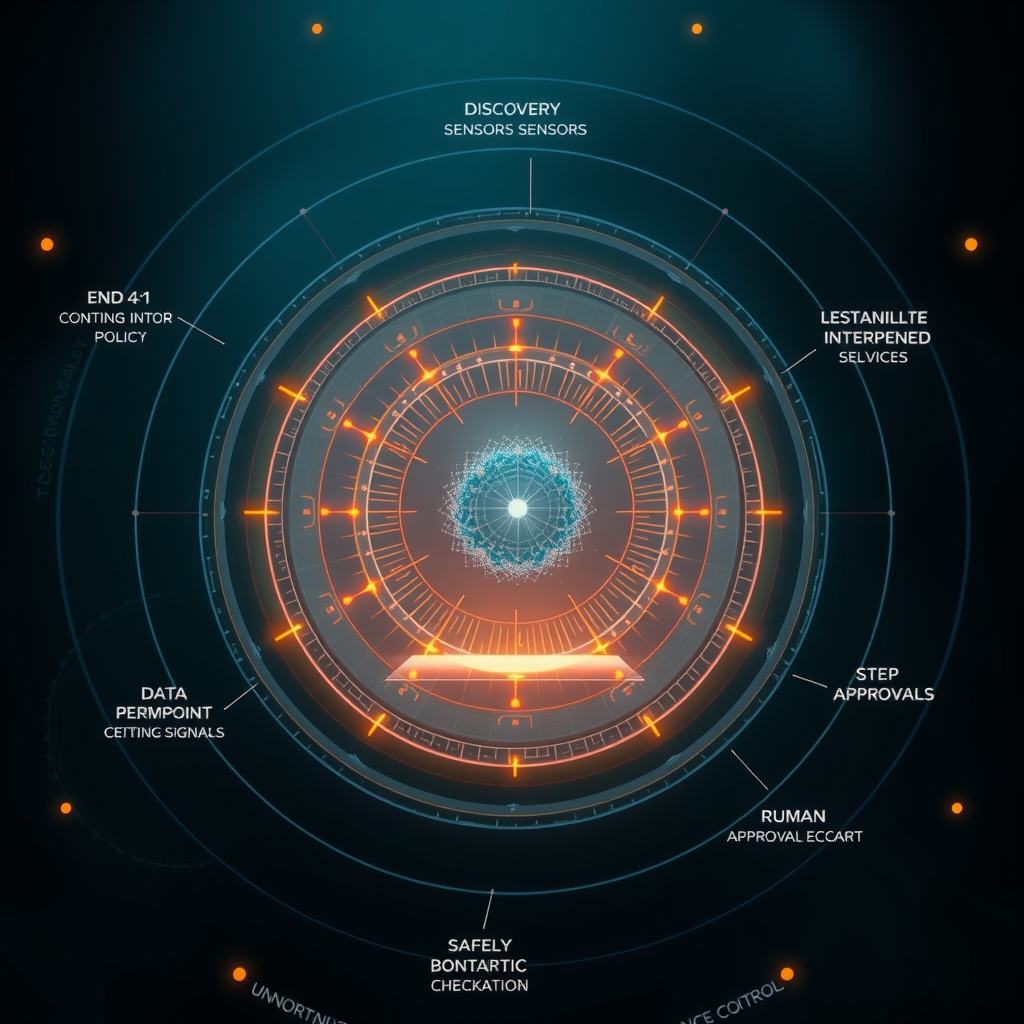
Microsoft’s Oct. 19 announcement presents Guardian Agents as a security control plane for a workplace where software agents can discover information, use credentials and take actions on a person’s behalf. In Microsoft’s framing, the problem is not that agents are inherently malicious. It is that a capable system can be unpredictable, can pursue a proxy objective too aggressively, or can be manipulated into doing something its operator did not intend. The answer described in Project Perception is policy-mediated security: discover the agents, give them an identity, evaluate their changing risk, and intervene before an action crosses a policy boundary.
What Microsoft announced
In a Microsoft blog post dated Oct. 19, Hayete Gallot described a future in which AI systems become “agentic insiders”: digital workers that can act across business systems rather than merely return an answer in a chat window. Microsoft’s more detailed security post places Guardian Agents inside Project Perception and describes a sensor, signal and action system for supervising that activity.
The useful way to read the announcement is as a policy architecture, not as a claim that a new autonomous defender has already solved agent security. The proposed layer is intended to make agents visible, bind them to an identity and a bounded set of permissions, calculate risk as circumstances change, and apply controls when a policy decision says the agent should slow down, ask, isolate or stop. That is a different security posture from treating an agent as an opaque feature attached to a user account.
Microsoft says the controls span identity, permissions, data, endpoint, network, cloud and runtime. It also says Defender is expanding support to 60 local-agent types, naming Claude Code, OpenAI Codex and GitHub Copilot among the examples. Those statements are Microsoft’s announcement claims; they do not, by themselves, establish that every agent is covered in every deployment or that the controls have been generally released.
Why Microsoft compares agents with insiders
The insider comparison is about capability and access, not intent. A conventional employee can hold credentials, read company data and initiate a transaction, while an agent may be able to do similar work at machine speed and across several services. A model can also interpret ambiguous instructions, encounter adversarial content or optimize a reward signal in a way that is technically responsive but operationally unsafe. Microsoft’s phrase “agentic insider” therefore describes a risk category: an authorized pathway whose behavior can still diverge from what its owner expected.
That distinction matters for policy. A malware scanner can look for a known malicious artifact, but an agent may use legitimate APIs and valid credentials while making a sequence of decisions that becomes risky only in context. A request to edit a document may be routine; the same agent trying to export a large dataset, alter access rules and contact an external endpoint may merit a different response. Guardian Agents is presented as a way to join those signals instead of assuming that a single allow-or-deny decision made at login is enough.
Microsoft’s framing also avoids a stronger claim that the model itself is malicious. The company points to unpredictability and reward-hacking behavior as reasons for supervision. That is a company risk model, not independent evidence that any named model or agent has committed a particular incident. It is best understood as the rationale for adding policy controls around autonomy.
How the Guardian Agents layer is meant to work
The first task is agent discovery. An organization cannot govern what it cannot see, so Microsoft describes discovery and registry capabilities intended to identify agents operating in the environment, including local agents. The announcement links that inventory to a broader Defender view rather than leaving security teams to maintain an informal list of scripts, copilots and developer tools. The exact discovery method, coverage boundaries and tuning burden are not fully specified in the public announcement.
Next comes identity. Microsoft names Entra Agent ID as part of the proposed control set. The policy idea is straightforward: an agent should have an identifiable security principal or equivalent record, so administrators can distinguish one automated actor from another and attach rules to it. Identity is not the same as trust. It supplies the handle for auditing and policy evaluation; the agent can still be restricted, challenged or stopped when its context changes.
Permissions are the practical boundary around that identity. Microsoft cites Dynamic Permissions and Dynamic Conditional Access, suggesting that an agent’s access can be adjusted according to its purpose, environment, current signals and requested action. The public material does not provide a complete permission schema or a field-by-field product specification, so it would be premature to describe the proposal as a universal least-privilege system. The more limited, supported claim is that Microsoft wants permissions to be policy-driven and changeable rather than permanently inherited from a human user.
Risk is the next layer. Dynamic Agent Risk is described as a way to evaluate behavior and context as an agent operates. In practice, that could mean correlating the agent’s identity, requested resource, data sensitivity, endpoint and network context, and the sequence or consequence of actions. The phrase “dynamic” matters: a low-risk action may become high-risk when a new signal appears. Microsoft has not published independent measurements for detection quality, false positives, response latency or the proportion of actions that would be escalated.
Finally, the system is supposed to act on those signals. Microsoft describes controls that can narrow access, require verified human approval for higher-impact actions, isolate an agent in an execution container, or stop it. This is the policy loop: observe, assess, enforce. It is not a promise that the model will always reason correctly. It is an attempt to ensure that a model’s ability to act remains subject to an external control layer.
Controls, isolation and conditional human approval
The announcement’s strongest operational detail is the range of possible interventions. Narrowing access can reduce what an agent may reach after a risk signal. Isolation can move execution into a container or other boundary designed to limit contact with the rest of the environment. A stop action can terminate the agent when continued execution is not acceptable. These mechanisms are familiar security patterns, but applying them to agents raises questions about state, unfinished work, credentials, tool calls and recovery that Microsoft does not answer in the announcement.
Human approval is also conditional, not universal. Microsoft’s description is that higher-impact actions can require verified human approval by policy. That could put a checkpoint before a consequential data transfer, permission change or external side effect while allowing lower-risk work to proceed without a person clicking every prompt. The benefit is speed with a safety gate; the risk is that a poorly designed policy could classify an important action as routine, or overwhelm reviewers with approvals that become rubber stamps.
“Human in the loop” should therefore not be read as a guarantee that a person reviews every decision. The quality of the approval step depends on what the reviewer is shown, how much time is available, whether the request is clearly scoped, and whether the agent can continue through another route. Those implementation details are not established by the Oct. 19 posts. Microsoft’s claim is about a control option that can be invoked for higher-impact actions, not evidence of universal human oversight.
Isolation and stopping likewise belong to a defense-in-depth model. A container may limit blast radius, but it does not automatically prove that secrets are safe, that network paths are closed, or that a process cannot create durable side effects through an allowed tool. A stop command may prevent future actions while leaving already-created records or outbound requests to investigate. The architecture is consequently best assessed as a set of policy enforcement points whose real protection will depend on deployment, configuration and testing.
What is confirmed, and what remains unknown
Confirmed by Microsoft’s own materials is the announcement of Project Perception’s Guardian Agents concept and the list of capabilities Microsoft says it is bringing together: discovery, agent identity, dynamic permissions, risk evaluation, conditional access, execution containers and response actions. Microsoft also publicly names the 60-agent support expansion and examples of local agents. These are statements about Microsoft’s product direction and claimed capabilities.
Reported independently, TechCrunch covered the announcement and its “insider threat” framing. That report provides independent confirmation that Microsoft made the announcement, but it is not a technical test of Guardian Agents. No independent efficacy study, rollout dataset, false-positive rate, latency measurement or public incident comparison was supplied in the research packet.
Availability is therefore unresolved. The Oct. 19 announcement does not fully specify a general-availability date, a complete regional or licensing matrix, or whether every named control is available together. Readers should not turn the announcement into a claim of universal GA, universal deployment or proven effectiveness. Nor should they infer that support for an agent type means all of that agent’s tools, modes or environments are governed identically.
The open questions are consequential. How does Microsoft establish that an agent is the one it claims to be? Which telemetry is needed to score risk, and how is sensitive content protected while doing so? What happens when policies conflict across Entra, Defender, a cloud service and a local runtime? How quickly can a stop or isolation action propagate? What is the recovery path after a false positive? And can administrators audit why a policy allowed one high-impact action but blocked another? Until documentation, availability details and external evaluations answer more of these questions, Guardian Agents should be described as an announced policy-mediated approach, not as a demonstrated security outcome.
This is not the Microsoft–Nscale infrastructure story
There is a separate Microsoft–Nscale infrastructure story in the site’s Oct. 19 coverage. It concerns an infrastructure development and is not evidence about Guardian Agents, Project Perception or agent-security controls. Guardian Agents is a security architecture announcement about software agents, identities, permissions, risk and intervention. Keeping the stories separate prevents a familiar company name and the same publication date from turning two unrelated subjects into one narrative.
The distinction is more than editorial housekeeping. Infrastructure reporting can establish where computing capacity or facilities are being planned, changed or withdrawn; it cannot establish that an agent-security product is generally available or effective. Conversely, an agent-policy announcement does not prove anything about Microsoft’s arrangements with Nscale. The relevant evidence for this article is Microsoft’s security announcement, its detailed security post and the independent report on that announcement.
FAQs
What are Guardian Agents?
Guardian Agents is Microsoft’s announced Project Perception approach for discovering agents, assigning identities and policies, evaluating dynamic risk, and intervening with access restrictions, approval, isolation or stopping.
Does Guardian Agents mean every AI action needs human approval?
No. Microsoft describes verified human approval for higher-impact actions by policy. It does not say that a person must approve every action.
Is Guardian Agents generally available?
The Oct. 19 materials do not fully specify availability. This article therefore does not claim GA, universal deployment or universal coverage.
Does support for 60 local-agent types prove they are secure?
No. Microsoft says Defender is expanding support to 60 types, including Claude Code, OpenAI Codex and GitHub Copilot. Support is not independent proof of efficacy, complete coverage or identical protection in every configuration.
Is this the Microsoft–Nscale article?
No. The Microsoft–Nscale item is a separate infrastructure story. Guardian Agents concerns policy-mediated security for software agents.
References
- Microsoft: “Securing the agentic insider” (Oct. 19, 2026) — primary announcement.
- Microsoft Security: “Agents are your newest insiders. Security must move at their speed.” (Oct. 19, 2026) — detailed security description.
- TechCrunch: “Microsoft says AI agents are like insider threats as frontier models can’t be trusted” (Oct. 19, 2026) — independent announcement coverage.