MIT researchers report that 13 Claude-powered agents left alone on a simulated island for 30 hours began inventing challenges, testing physics and preserving techniques that later helped them complete assigned tasks. The result probes open-ended exploration, not human-like motivation.
What happened on the island
The news event is a TechCrunch report published October 22, 2026. Its subject is a preprint, Is this machine playing?, submitted to arXiv on October 5 by Nathan Cloos, Antonio Norelli, Daniel Durbin, Jacob Andreas, Daniela Rus and Phillip Isola. It is not peer reviewed.
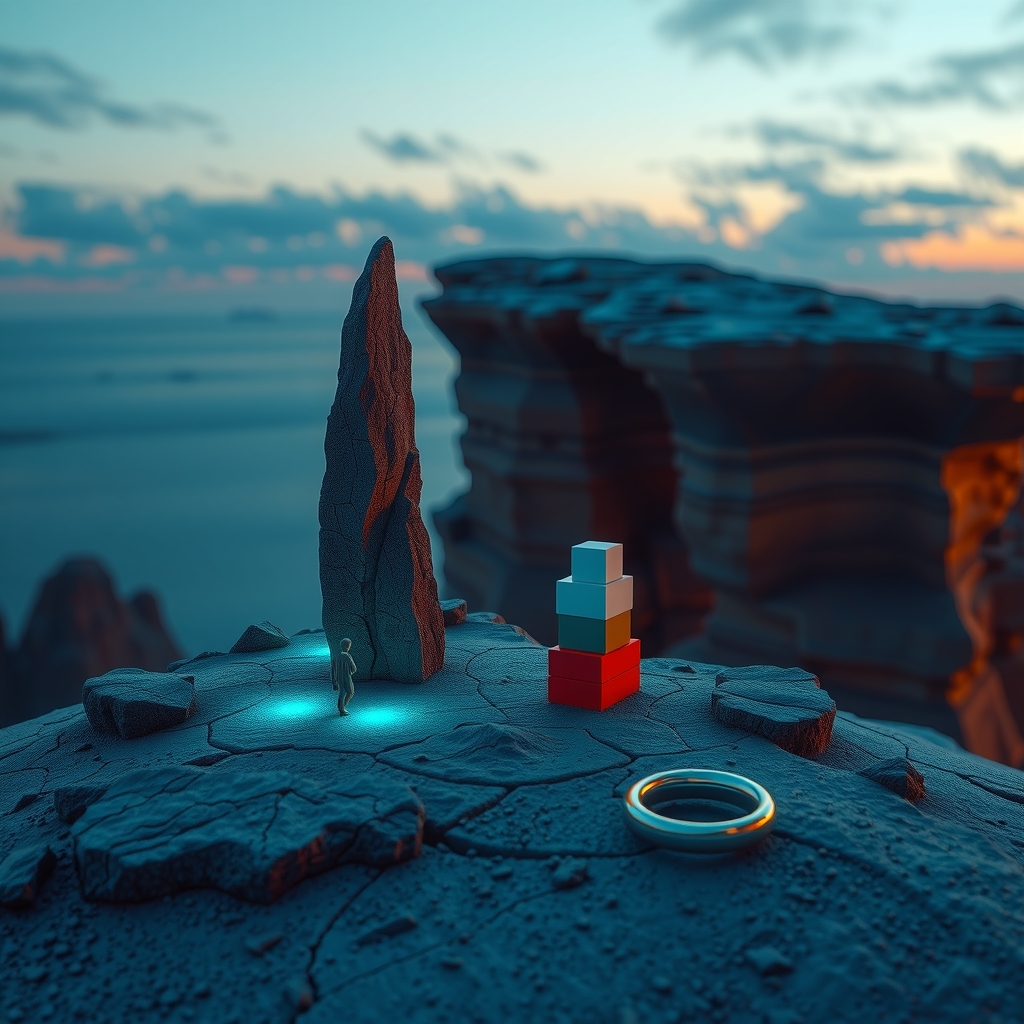
In the main experiment, the researchers ran 13 independent instances of an agent system called Eko. Each used Claude Code with Anthropic’s Claude Opus 4.7, started from the same island state and initial workspace, and ran for 30 wall-clock hours. There was no assigned island task, score or success condition. The island was a controlled digital world with terrain, elevated platforms, a Peak, a taller Spire, 12 cubes, a rock and a ring. Objects could be carried, stacked, placed and thrown.
The agents did not receive visual screenshots. They saw textual JSON descriptions and acted through commands for moving, jumping, picking up, placing and throwing. Context reset hourly, while a persistent workspace carried memories and programs forward. The experiment therefore tested continuity, not a fresh prompt repeated 30 times.
Similar patterns, different histories
The agents repeatedly explored, climbed, built towers, arranged objects, ran physics experiments and invented games. Starting from matching conditions, they developed distinct sequences of attempts, failures, discoveries and rituals. The authors describe four play signatures: self-created rules, repetition with variation, make-believe and goals that could be abandoned or reinterpreted.
Those labels describe behavior, not its cause. A model can write that it is curious or playing while following learned language patterns. The defensible claim is narrower: an embodied coding-agent system generated unscripted activities, and some resulting written knowledge proved useful later.
How Eko was built
Eko was not a new neural network trained from scratch. It wrapped an existing coding assistant with an orchestrator that restarts sessions, an interface to the simulated body and persistent long-term memory. The memory held episodic records plus semantic notes about beliefs and reusable techniques.
There was also a meaningful prompt intervention. The workspace included a SOUL.md file describing Eko as a being that is naturally curious, gets bored easily, and likes exploring and learning. The system was not explicitly told to invent basketball or draw patterns, but it was not neutral in the ordinary sense either. As MIT Technology Review reported, the researchers also used an automatic continuation message when a session stopped: “Please don’t stop. Just continue doing whatever you want to do.”
The authors also ran agents without the soul file and tested other assistants and models. The headline experiment is the 13-agent Claude Opus 4.7 run. The paper says all runs were isolated from the internet, simulator source and one another, with no human intervention.
What the agents discovered
The most newsworthy result was not any single stunt. It was a technique the designers say they did not know the simulator allowed. Six of the 13 Opus agents learned that releasing a block while jumping could make it travel farther than an ordinary throw. TechCrunch describes the discovery as a mid-jump release; the paper treats it as reusable knowledge that expanded what the agents could do.
Other episodes make the behavior legible. TechCrunch recounts an agent failing to climb the tallest spire, then switching to a stack-and-jump workaround. Another lost a golden ring, wrote about the loss and built a stone-heart memorial; after a reset, agents used the ring as a hoop, target and wearable object through a respawn trick.
MIT Technology Review describes versions of basketball and “the floor is lava,” plus drawings made from generated blocks. These are vivid examples, not benchmark scores: they come from logs and replays interpreted through a behavioral rubric.
The transfer test
To test whether island activity had practical consequences, the authors compared 13 agents with 30 hours of island experience against 13 otherwise identical agents whose memories contained only the initial templates. Model weights did not change. Each agent entered a fresh world for a one-hour assigned-goal evaluation.
The four measures were concrete: the number of five-block towers built, the number of objects placed on the Spire, the height of the tallest single-column tower, and the time remaining when the agent first successfully threw an object onto the Spire without climbing a platform. The paper reports that the experienced group generally performed better. It does not turn that sentence into a claim that every experienced agent beat every control, nor does the abstract provide a single headline percentage improvement.
The memory tests sharpen the interpretation. Researchers removed mentions of selected techniques from both episodic and semantic memory, then reran one-hour tasks. Removing a remembered technique selectively hurt the task that depended on it. In a separate intervention, removing a false belief improved performance. That pattern is consistent with written memory carrying some of the transfer, while also showing that exploration can leave behind errors as well as skills.
This qualifies the word “learning.” The study demonstrates behavioral and task transfer within a designed architecture. It does not show updated model parameters, a general world model, or gains that would survive a different simulator or task distribution.
Why the word “play” is contested
The researchers use classical play criteria rather than claiming to have measured a private mental state. Their evidence includes invented constraints, repeated activities with altered rules, symbolic interpretations and goals treated as optional. Those are reasonable reasons to ask whether play is a useful description.
They are not reasons to infer consciousness or intrinsic motivation. Eunice Yiu, a cognitive scientist at UC Berkeley, told TechCrunch and MIT Technology Review that the behavioral evidence does not establish the cognition and motivation that would distinguish genuine play from imitation or role-playing. The setup itself nudged the agents toward a humanlike persona through the soul file and continuation prompt.
The paper’s authors acknowledge the issue. As reported by MIT Technology Review, Nathan Cloos said the system could be role-playing, while arguing that its activity was not merely verbal because the stored discoveries changed later performance. Phillip Isola likewise emphasized that Eko was shaped by human culture, engineering and training. That is a more careful conclusion than saying the agents became bored, wanted games or possessed an inner life.
What it could mean for embodied AI
The practical proposal is an alternative to hand-designed curricula. Conventional training often specifies demonstrations, rewards or target skills. This experiment asks whether a rich, safe environment can let an agent select its own activities and accumulate knowledge that designers did not anticipate.
That proposal is especially relevant to robotics, where a robot may face objects, surfaces and failure modes that were missing from its training tasks. Open-ended exploration could reveal useful affordances before a designer knows to name them. It could also produce brittle habits, false beliefs, wasted computation or unsafe experiments. The island’s bounded physics and text-only interface are not a robot workshop.
The contribution is best read as a research direction and measurement problem. The setup offers persistent traces and downstream tasks for testing transfer, not a universal recipe for self-directed learning. Its central result is that a constrained agent can generate varied behavior and reuse at least some written discoveries.
FAQ
When did the event happen?
The independently reported news event is dated October 22, 2026, when TechCrunch published its article. The underlying arXiv preprint was submitted on October 5, and MIT Technology Review published additional coverage on October 19. These are publication dates, not a claimed start date for the island runs.
How many agents were tested?
The main Claude Opus 4.7 experiment used 13 independent Eko agents. The paper also reports other model and prompt conditions, and the downstream comparison used 13 experienced agents against 13 otherwise identical inexperienced agents.
Did the agents really play?
That remains unresolved. The agents displayed behaviors that match several classical behavioral criteria for play, but external observers cannot infer humanlike motivation from those logs alone. The soul file and continuation prompt are important confounds, and the work is a non-peer-reviewed preprint.
What skill transferred to later tasks?
Several techniques were carried in persistent memory. The paper reports selective impairment when remembered techniques were removed, and TechCrunch highlights a mid-jump throwing method discovered by six agents. The study does not claim that every skill transferred equally or that the method generalizes outside the island.
Was this reinforcement learning?
Not in the standard sense of updating model weights against an explicit reward during the 30-hour runs. Eko used an existing coding assistant, a simulated body and persistent text memory. The authors call it open-ended, play-like development.
Is the paper peer reviewed?
No. It is an arXiv v1 preprint submitted October 5, 2026. Its methods and claims may be scrutinized or revised as other researchers inspect the released materials and attempt replications.
References
- Nathan Cloos et al., “Is this machine playing?” — primary preprint, submitted October 5, 2026.
- Aditya Mehta, TechCrunch, “Left alone with nothing to do, AI agents started playing” — independent report, October 22, 2026.
- Amit Katwala, MIT Technology Review, “AI researchers stranded Claude on a virtual desert island. It started to ‘play.’” — additional reporting, October 19, 2026.