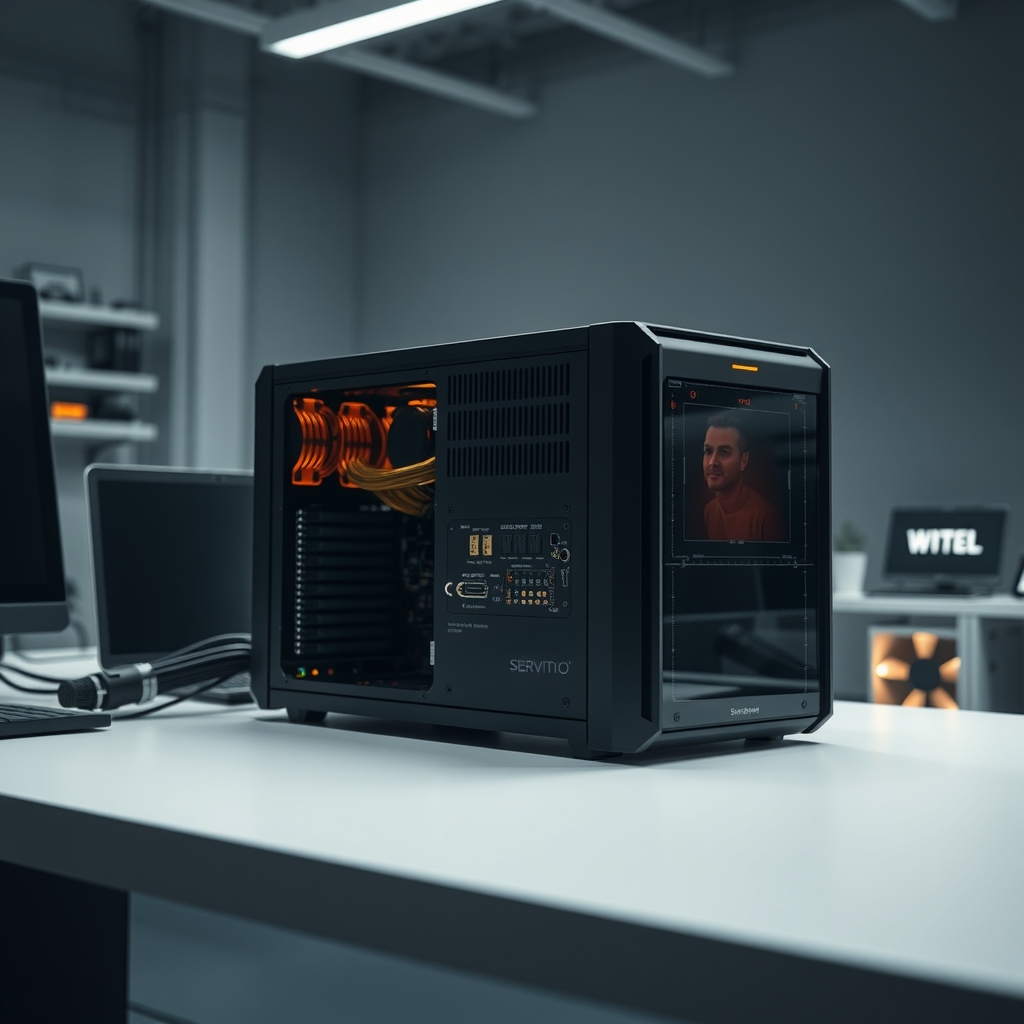
Nvidia announced a 64GB configuration of its DGX Spark personal AI supercomputer on Friday, October 2, 2026, establishing a $4,999 entry point for engineers and researchers seeking to run frontier-grade local AI models on physical hardware. Built in partnership with system makers Acer, ASUS, Dell, Gigabyte, HP, and MSI, the compact desk-side machine begins shipping on Friday, October 23, 2026. The launch directly addresses mounting cloud inference costs and severe memory shortages by packaging Nvidia's GB10 Grace Blackwell Superchip into an accessible physical chassis capable of running 100-billion-parameter open models and always-on autonomous agents entirely on premises.
Table of contents
Hardware architecture and unified memory design
The DGX Spark 64GB retains the fundamental processing core found in Nvidia's earlier 128GB workstation. At the center of the motherboard sits the GB10 Grace Blackwell Superchip, an integrated processor pairing a 20-core Arm Neoverse CPU with a Blackwell-generation GPU graphics processing complex across a high-speed coherent interconnect. The system provides 64 GB of unified LPDDR5X system memory, providing a uniform pool shared dynamically between operating system routines, CPU execution threads, and GPU tensor pipelines.
Unified memory bandwidth measures 273 GB/s, matching the memory throughput specification of the original 128GB version. This architecture enables developers to load model weights directly into unified RAM without paying the data transfer penalties typical of traditional PCIe bus interfaces. For local machine learning engineers, that memory capacity supports running models up to 100 billion parameters at standard quantization levels entirely within a single compact box.
Every retail unit includes an integrated ConnectX-7 network interface card as standard equipment. The network card brings 200 GbE network capabilities directly to the rear I/O panel, giving the compact machine high-throughput connectivity tailored for distributed computing rather than conventional consumer networking.
Scaling beyond a single desk with hardware clustering
Rather than requiring teams to discard hardware when computational requirements increase, Nvidia built hardware clustering directly into the physical chassis. Two DGX Spark 64GB units can connect back-to-back using a standard QSFP direct-attach copper cable plugged into their respective ConnectX-7 ports.
Network orchestration relies on Nvidia Sync Cluster Assistant, an automated utility inside DGX OS that handles link negotiation, fabric addressing, and hardware validation without requiring manual network configuration. Once paired, the two physical machines pool their unified memory into a shared 128 GB memory pool. The pooled configuration expands model execution capacity up to 200 billion parameters, while doubling effective memory bandwidth across the joined nodes.
In benchmark tests released by Nvidia using the open Qwen 3.8 27B model, a clustered pair of 64GB DGX Spark systems achieved up to 1.7x the inferencing throughput of an isolated single system. By late October 2026, Nvidia plans to distribute its Sync Model Launcher tool, which will let users deploy models across multiple desktop nodes through a browser-based management interface.
The pre-installed software ecosystem and agent runtimes
Local AI hardware requires a functional software layer to avoid prolonged setup cycles. The 64GB DGX Spark arrives pre-configured with DGX OS, a specialized Linux distribution packaged with Nvidia CUDA-X runtime libraries, the Nvidia Agent Toolkit, and verified container images for open weights including the Nemotron family.
Third-party inference frameworks work out of the box. Developers can launch workflows using Ollama, vLLM, LM Studio, or PyTorch with native CUDA acceleration within minutes of initial setup. For creative professionals, 3D modeling application Blender is preparing a prebuilt native installer optimized for the Grace Blackwell architecture.
The hardware launch also expands Nvidia's push into on-device agent supervision. The system integrates with recently unveiled silicon-level safety guardrails, connecting directly to frameworks like Nvidia OpenShell and Sentry to monitor agent behaviors outside the host operating system. This native support allows teams to run continuous software engineering bots, local documentation reviewers, and private document processing pipelines without risk of unexpected external code execution.
Local hardware economics versus cloud token bills
The timing of the 64GB release reflects intense pricing pressure across the AI infrastructure sector. While major platform providers like OpenAI expand their cloud footprint with always-on autonomous cloud agents, developers face compounding recurring operational charges. Simultaneously, cloud providers such as DigitalOcean have rolled out managed runtime platforms for agents, competing directly for developer workloads.
For independent developers and enterprise security divisions, offloading proprietary data to remote servers introduces regulatory and financial headaches. Running dedicated agents around the clock on hosted cloud instances quickly accumulates thousands of dollars in monthly token and compute fees. A physical unit sitting on an engineer's desk eliminates external API charges and keeps proprietary corporate code within local firewalls.
Component inflation has also impacted local workstations. Due to acute global memory supply constraints, the retail price of the earlier 128GB DGX Spark configuration climbed nearly 75 percent over recent months, reaching approximately $6,950 at major retailers. By introducing the 64GB SKU at $4,999, Nvidia creates an entry point nearly $2,000 below its existing desktop hardware, opening local supercomputing to smaller studios and university labs.
What is confirmed and what remains unclear
The announcement establishes clear product timelines and technical boundaries. Confirmed details include the $4,999 starting price, the October 23, 2026 commercial release date, and official manufacturing partnerships with Acer, ASUS, Dell, Gigabyte, HP, and MSI. The technical core is confirmed as the GB10 Grace Blackwell Superchip with 64 GB of unified LPDDR5X memory, 273 GB/s throughput, and integrated ConnectX-7 200 GbE networking.
However, several key operational details remain unannounced by Nvidia and its manufacturing partners:
- Total power consumption: Neither Nvidia nor its OEM partners have published exact thermal design power figures or idle power draw for the combined GB10 chip and board assembly.
- OEM customization options: While all six manufacturers will offer the core 64GB specification, partners have not disclosed whether chassis dimensions, external port layouts, or active acoustic profiles will differ between brands.
- International availability: The $4,999 baseline reflects United States retail guidance. Specific pricing, value-added tax adjustments, and regional shipping dates for European and Asian markets have not yet been finalized.
- Memory expansion limits: The unified memory chips remain integrated directly with the processor package, meaning physical RAM cannot be expanded internally without clustering a second machine over QSFP.
Frequently asked questions
What is the starting price and release date of the DGX Spark 64GB?
The system starts at $4,999 and will be commercially available through authorized manufacturing partners on Friday, October 23, 2026.
Which manufacturers are selling the 64GB system?
Nvidia has partnered exclusively with six hardware vendors for this release: Acer, ASUS, Dell, Gigabyte, HP, and MSI. Units will ship with DGX OS pre-installed.
Can two 64GB DGX Spark systems be linked together?
Yes. Two systems can be linked via their built-in ConnectX-7 ports using a QSFP direct-attach cable. Using Nvidia Sync Cluster Assistant, the combined systems pool their memory into a 128 GB space capable of running models up to 200 billion parameters.
How does the 64GB model differ from the 128GB version?
Both models use the same GB10 Grace Blackwell Superchip, ConnectX-7 networking, and 273 GB/s memory bandwidth architecture. The primary distinction is the unified memory capacity, which caps standalone model sizes at 100 billion parameters on the 64GB unit, compared to larger model limits on the 128GB edition.