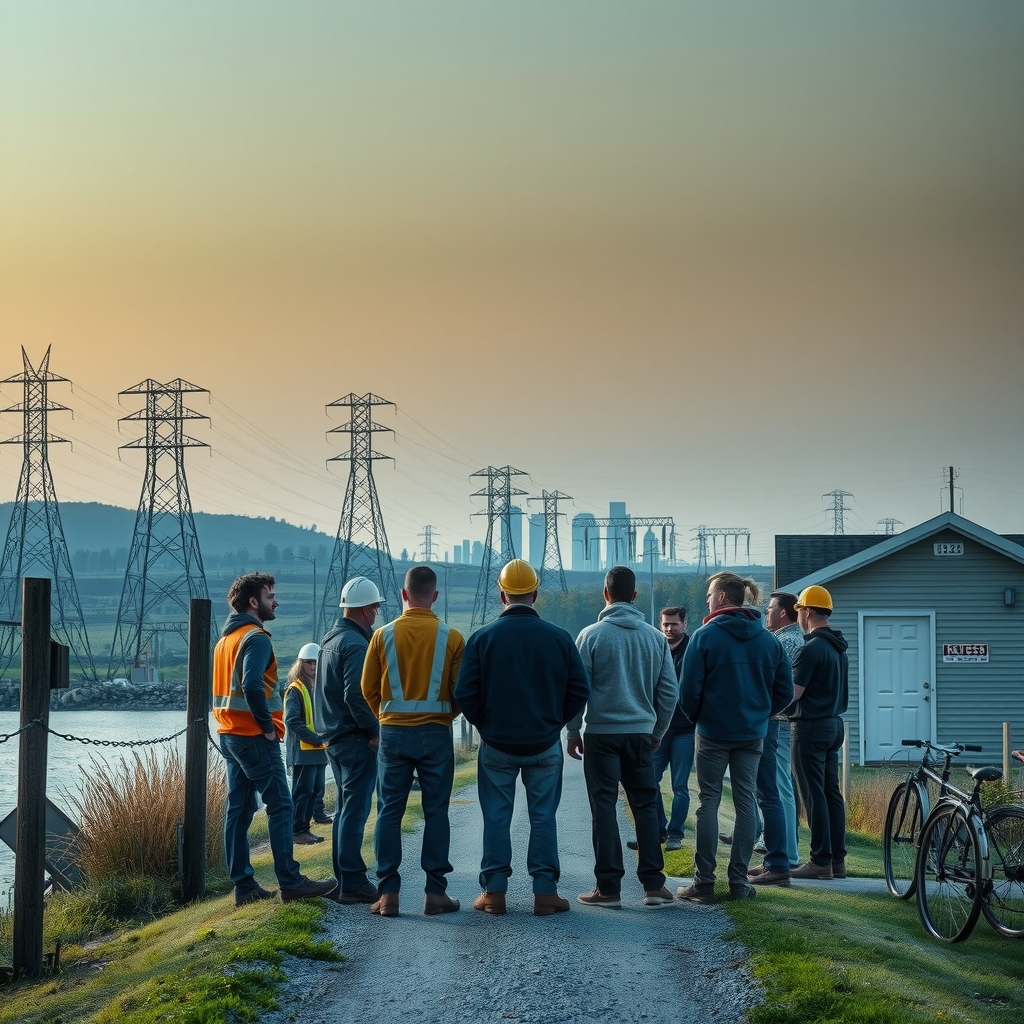
OpenAI announced a National Community Compact on Nov. 5, 2026, promising a common set of safeguards for future U.S. computing campuses it owns and operates, including payment of their full electricity and grid-infrastructure costs, public site-level resource disclosures and recurring reports on local hiring. The company released a separate Compute Campus Policy Blueprint that proposes rules for governments to apply to data-centre developers more broadly; those proposals are not enacted law. The announcement comes amid public and political opposition to expanding data-centre construction, The Hindu reported. [OpenAI] [The Hindu]
What OpenAI promised for future campuses
The Compact is framed as a commitment by OpenAI for future compute campuses that it owns and operates, rather than a claim about every data centre or every project associated with the company. OpenAI says each campus will have a local compact reflecting local priorities and containing a shared baseline of commitments. The package combines early engagement with residents, a local point of contact throughout the campus’s life and annual public reporting on performance. OpenAI’s announcement describes the commitments as the next step in work that began with Stargate community commitments in January and subsequent arrangements in Georgia and Ohio. The Hindu likewise characterizes the announcement as a common set of safeguards for future U.S. campuses the company owns and operates.
That scope matters. The announcement does not establish that independent operators, landlords, utilities or other technology companies have accepted the same terms. Nor does it itself create enforceable standards for the entire sector. The compact is a corporate pledge for a defined category of future OpenAI projects; the accompanying blueprint is a request for public policy action. Treating the two as interchangeable would overstate what was announced.
Energy costs and grid protections
OpenAI says it will pay the full cost of the electricity its campuses use and of the infrastructure needed to serve them. Before major spending starts, it says it will provide financial assurances to protect other customers if a project is delayed, reduced or cancelled. The policy question behind this commitment is how utilities and regulators allocate the cost of new generation, transmission and local grid upgrades when a very large new customer drives demand. OpenAI argues that campuses should not leave other ratepayers responsible for costs attributable to a project that does not proceed as planned. The company’s account sets out this commitment; The Hindu independently reports the same electricity and infrastructure pledge. The Hindu
The wording is a promise, not evidence in itself that all future costs have already been calculated, reviewed by regulators or paid. OpenAI says campus-specific local compacts and public annual reporting will provide an accountability structure. The announcement does not specify a uniform financial-assurance instrument or amount for every campus. The blueprint separately asks state utility commissions to require large electricity customers to cover the additional grid costs they cause and to protect customers if a project falls through. That proposal would need government action to become a generally applicable rule.
OpenAI also points to demand flexibility as one way to connect large facilities while protecting grid reliability. Utilities, it says, should be able to connect campuses that can safely reduce demand when power is scarce. This is distinct from the promise to pay for electricity and infrastructure: paying one’s costs does not eliminate peak-demand constraints, and curtailment concerns when and how much power a site can draw. The two mechanisms address different concerns—cost allocation and system operation.
Resources, disclosures and local accountability
For each campus, OpenAI says it will develop a water plan, prioritize closed-loop or low-water cooling, and publish site-level water and electricity use. It also says construction plans and independent noise studies will be published before operations begin and annually afterward. Those disclosures could give residents and local officials information about resource use and sound impacts that is specific to a site, rather than relying only on general statements about data centres. The commitments do not state a single water or noise threshold applicable across all locations; the company says local compacts will reflect local priorities. OpenAI The Hindu
Transparency also concerns dealings between developers and public authorities. OpenAI says it will not use non-disclosure agreements with public officials, allowing narrow exceptions for legitimate security information, trade secrets, or proprietary or competitively sensitive information. The policy blueprint similarly calls for narrow limits on when developers can require officials to sign NDAs. The pledge is not an absolute promise to publish every piece of information: the company explicitly retains exceptions for specified sensitive matters. Its distinction is that public officials should not routinely be bound to secrecy about campus dealings, while genuinely sensitive information may still receive protection.
The blueprint proposes that incentives offered by state or local governments be disclosed publicly, with measurable commitments and a way to recover benefits when a developer falls short. This is a policy proposal, not a new nationwide clawback rule. The underlying concern is that public subsidies or tax concessions should be tied to outcomes that can be checked. Whether any particular incentive is offered, what conditions it carries and how a recovery mechanism would work remain matters for the relevant government and future policy design.
Jobs, training and community investments
OpenAI also promises to publish expected job creation, work with unions and training providers to prepare residents for employment, and report annually on hiring and apprenticeships. The company says it will make sustained investments in priorities selected with residents. The emphasis is not limited to construction hiring: OpenAI’s blueprint discusses training for trades needed during construction, such as electrical work, as well as roles maintaining power and cooling systems over the longer life of a campus. It also suggests developers share purchasing plans early enough for local suppliers to compete. These are described as approaches in the policy blueprint, not as guaranteed contracts or specified job totals at every future location. OpenAI’s announcement and The Hindu’s report both note union engagement and local hiring and training.
The announcement gives two examples of local priorities shaping investments from earlier work. In Effingham County, Georgia, OpenAI says residents helped shape a $4.8 million grant for free school meals for all 14,000 students in the county. In Pike County, Ohio, families identified childcare as a priority, leading to a joint $6 million commitment from OpenAI and SB Energy. These examples illustrate the company’s stated approach to community-selected investment; they are not universal amounts promised to every future campus, and the company does not say that every community will choose the same kind of program.
A policy blueprint, not a law
The second document, the Compute Campus Policy Blueprint, asks federal, state and local policymakers to establish baseline protections for communities wherever campuses are built. OpenAI says voluntary company commitments are a starting point but argues that laws and regulations are needed for broad, durable expectations. Among its proposals are utility rules assigning large customers the costs they add to the grid, consumer protections if projects are abandoned, public disclosure of water, energy, noise and hiring information, and conditions on tax incentives. It also calls for faster transmission upgrades and restoration or expansion of tax incentives for clean electricity. OpenAI’s blueprint summary presents these as requests to policymakers; The Hindu likewise describes them as proposed measures for governments. The Hindu
As of the announcement, those blueprint provisions are proposals. OpenAI’s publication does not enact them, and neither source reports that they have been adopted as a federal or state-wide legal framework. Existing utility agreements or local rules may address particular projects, but that is different from a general mandate. This distinction also explains why the Compact and blueprint are presented together: one describes what OpenAI says it will do at its own qualifying campuses; the other advocates rules that could apply to developers more broadly if policymakers adopt them.
There is also a practical difference between a public commitment and an enforceable public rule. A company can publish targets and reports voluntarily, while a law or regulatory order can assign oversight, remedies and consequences. The announcement promises annual reporting and local engagement, but its summary does not establish an independent enforcement body or prescribe a uniform penalty for non-compliance. That gap should not be filled by assuming details that the documents do not state. The proposed role for policymakers is one response to that issue, but the blueprint remains advocacy until governments act.
What the Effingham example does—and does not—show
The most striking operational example in the announcement is a planned campus in Effingham County, Georgia. OpenAI says its agreement with Georgia Power allows the utility to reduce electricity delivered to the facility by up to 1,000 megawatts during periods of high demand. The Hindu reports the same figure and describes the arrangement as applying to the planned Effingham campus. This is a project-specific agreement cited to illustrate demand flexibility. It is not a statement that every OpenAI campus will be curtailed by 1,000 megawatts, or that the Compact itself imposes that figure on all future projects. OpenAI The Hindu
The distinction matters because a large maximum curtailment number can be misread as a typical reduction or as a measure of annual consumption. The sources describe the utility’s ability to cut delivered power by up to that amount during high-demand periods; they do not say how often such curtailment will occur, for how long, or what share of the campus’s ordinary load it represents. The arrangement is evidence of one specific demand-management provision, not a complete account of the campus’s energy use or a general operating rule.
OpenAI’s Effingham example also includes a community investment: the company says local residents helped shape a $4.8 million school-meals grant. The energy agreement and grant are separate elements of the project. One concerns grid operations under high demand; the other concerns a locally selected social investment. Both fit the broader theme of local accountability, but neither should be treated as a substitute for the more general commitments OpenAI says it will include in future local compacts.
Why the announcement matters amid opposition
The Hindu placed the Nov. 5 announcement against growing U.S. political and public opposition to data-centre expansion, noting that the issue featured in the Nov. 3, 2026 midterm elections. It reported that OpenAI chief global affairs officer Chris Lehane told Reuters the policy measures had been under development since August, before the elections. That attribution offers the company’s account of the timing; it does not establish that opposition played no role in the announcement or determine how the policies will be received. The article also describes local resistance to proposed infrastructure in the United States and India, underscoring that concerns about electricity, water, noise and local effects are not confined to one project. The Hindu
The Compact’s focus is therefore distinct from a routine company earnings, product or semiconductor story. It is about who pays for the physical infrastructure behind AI, what local people can learn about a campus, whether project plans can respond to community input and what happens if promised benefits are not delivered. These questions can affect whether a site receives public support and how energy and water systems accommodate new demand. The announcement does not resolve those debates, but it sets out commitments OpenAI says it will accept for its own future campuses and a policy agenda it wants governments to consider.
For communities, the significance will depend on implementation at individual sites: when residents are engaged, which information is published, how financial assurances are structured and whether annual reports show outcomes against commitments. For policymakers, the central question is whether to translate some proposed safeguards into rules that bind developers generally. The two documents make different kinds of promises, and their effect should be assessed on those separate tracks rather than as a single new regulatory regime.
Frequently asked questions
When did OpenAI announce the National Community Compact?
OpenAI published the Compact and Compute Campus Policy Blueprint on Nov. 5, 2026. The Hindu’s article is dated Nov. 5, 2026 and independently reports the announcement.
Which campuses are covered by the Compact?
OpenAI says the commitments apply to future computing campuses it owns and operates. It does not describe the Compact as a binding standard for all data-centre operators or every project associated with OpenAI.
Are the blueprint’s proposals already law?
No. The blueprint proposes actions for federal, state and local policymakers. The announcement does not report that those proposals have been enacted as law.
Does every campus have to cut power by 1,000 megawatts?
No. Up to 1,000 megawatts is the maximum reduction in power Georgia Power may deliver under the cited agreement for OpenAI’s planned Effingham County campus during periods of high demand. It is a specific example, not a general Compact commitment.
What environmental information does OpenAI say it will publish?
OpenAI says it will publish site-level water and electricity use, construction plans, and independent noise studies before operations begin and annually afterward. It also says each campus will have a water plan and prioritize closed-loop or low-water cooling.
What local employment commitments did the company describe?
OpenAI says it will publish expected jobs, work with unions and training providers, and report annually on hiring and apprenticeships. The announcement does not provide a universal job count for future campuses.