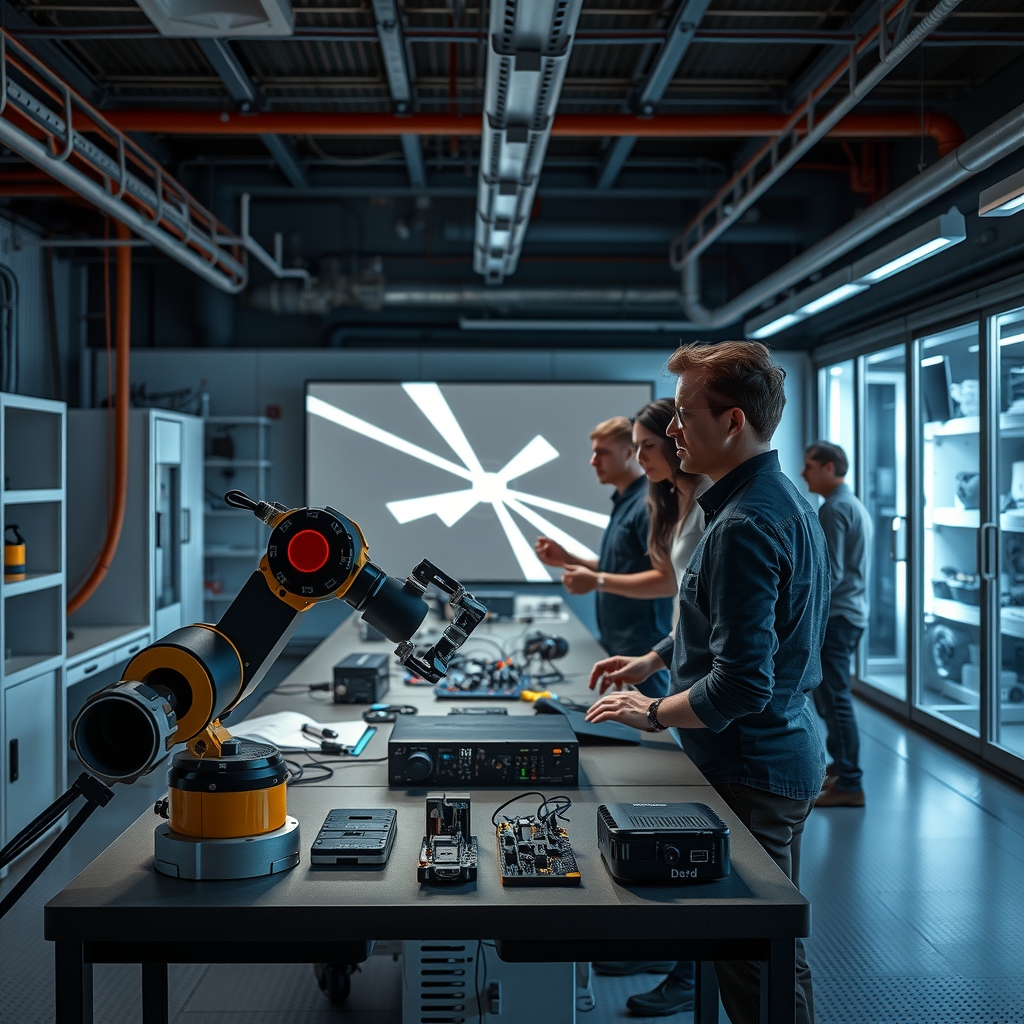
Europe’s physical-AI startup race gained a new institutional bet on October 22, 2026, when UnternehmerTUM Accelerator, Microsoft, Infineon Technologies and NVIDIA announced an equity-free program designed to move robotics and industrial-AI companies from working prototypes toward customers, capital and production.
A four-part launch with a defined first cohort
The Microsoft EMEA announcement, dated October 22 in Munich, describes the Physical AI Growth Lab as a four-month accelerator running from January through April 2027. The lead organization is UnternehmerTUM Accelerator; Microsoft, Infineon and NVIDIA are technology and ecosystem partners. An independent Startbase report, published the same day, independently confirms the launch, its four-month length and its focus on physical AI, robotics and industrial artificial intelligence.
The plan is to select 10 to 15 teams. The program will be hybrid, with online work supplemented by in-person sessions in Munich. Applications are open through November 13, 2026, according to both announcements. The official program page, published October 22, adds a more specific calendar: a January 18–20 kickoff, a February 24 physical showcase and customer-matchmaking event, and an April 15 Demo Day. Those dates describe the advertised schedule, not completed events.
“Equity-free” is central to the offer. The program page says participation has zero cost or equity, so accepted founders retain 100% of their ownership. That is a statement about the terms of this accelerator, not a promise that the companies will avoid future dilution when they raise outside funding.
Who can apply and what the lab offers
Eligibility is aimed at companies beyond the idea stage
The partners are seeking startups based in Europe, the Middle East and Africa, or companies actively building for EMEA markets. The published criteria call for a working prototype or minimum viable product, at least one technical co-founder, a team of no more than 20 people and a founding date less than three years before application. The official page describes an ideal applicant as having early customers, pilots or signed letters of intent, while the Microsoft and Startbase versions more generally state a working prototype or MVP. That difference matters: early commercial traction is presented as desirable on the program page, but it is not clearly stated there as an absolute threshold.
Resources cover cloud, chips, models and market access
Accepted teams are promised up to $350,000 in Microsoft Azure credits in the Microsoft and Infineon releases; the program page displays the amount as up to €350,000, without explaining the currency discrepancy. This article therefore treats the credit value as an advertised “up to 350,000” benefit whose currency should be confirmed with the organizers before a company relies on it for planning.
The package also includes access to NVIDIA physical-AI software development kits and open models, NVIDIA Inception benefits, and Infineon’s hardware foundation: semiconductors, power semiconductors, microcontrollers, sensors and connectivity components. UnternehmerTUM contributes access to more than 170 deep-tech mentors and more than 200 investors, along with introductions to enterprise customers. The program page additionally advertises technical training, NVIDIA Deep Learning Institute courses, customer exposure and a Demo Day. These are access and support commitments; they are not guaranteed investment, a customer contract or a performance benchmark.
Why the partners are combining their stacks
Physical AI sits at the intersection of bottlenecks. A robot or autonomous industrial system needs models, but it also needs data from sensors, simulation and control software, reliable compute, power electronics and a route into an operating customer’s environment. A startup can have a promising demo and still lack hardware, cloud budget, safety work or procurement relationships needed to turn that demo into a repeatable product.
That division of labor is the partners’ rationale, not independent proof that the model will work. The UnternehmerTUM announcement says the program will include technical workshops, 1:1 guidance, enterprise introductions, investor access and a Demo Day. Whether those interactions produce pilots, revenue or funding will only become observable after the first cohort starts and reports results.
What is confirmed—and what is still a projection
The launch and terms are well corroborated
Three official sources align on the core event. Microsoft’s EMEA release, Infineon’s press release and UnternehmerTUM’s own announcement all date the launch October 22, 2026, name the same four organizations and describe a January–April 2027, equity-free accelerator. Startbase independently confirms the date, partners, no-equity structure, application deadline, regional scope and 10–15-team target. That convergence is enough to verify the central news claim.
The program page is also the clearest source for the advertised schedule and no-equity language. It says accepted startups can leave with 100% of their equity and lists the Munich sessions and Demo Day. None of these sources, however, says that a cohort has already been selected. As of the announcement, applications were open and the program was future-facing.
Market-size numbers should not be treated as measured facts
Microsoft and Infineon repeat a claim that Europe will hold approximately 22.5% of the global physical-AI market in 2026. The cited market-research link is a forecast, and Startbase notes that the announcement does not explain the market definition or calculation method. It is therefore best read as a promotional projection, not as a verified baseline for European share. The same caution applies to UnternehmerTUM’s claim that startups from its accelerator have raised nearly €4 billion: Startbase clarifies that this is cumulative funding raised by companies in the ecosystem, not money committed to the new lab.
There is no evidence yet that the lab has created jobs, generated sales or improved a selected startup’s competitiveness. Those outcomes are unknown; the event creates a trackable intervention, not proof that Europe has solved physical-AI commercialization.
The commercialization problem behind the program
Robotics startups often face a long transition from a controlled demonstration to a system that works repeatedly around people, machines and changing environments. That transition can require more than model quality. Teams may need to integrate sensors and motor control, test edge inference, meet industrial safety expectations, secure pilot sites and persuade customers to alter an existing workflow. Each step consumes cash and specialized time.
An equity-free structure addresses one narrow part of that problem: it lets selected companies access infrastructure and advice without surrendering ownership to the accelerator. It does not remove the need to raise capital, nor does it guarantee that the partners’ platforms will be the cheapest or best fit for every product. Founders may still face hardware lead times, integration costs, customer procurement cycles and the technical risk of deploying systems outside the lab.
A pipeline, not yet an outcome
For now, the Physical AI Growth Lab is best understood as an ecosystem intervention. It places a startup accelerator, a cloud provider, a chipmaker and a GPU-and-models company behind a narrowly defined cohort of physical-AI builders. That is distinct from a chatbot release or a data-center announcement: the central product is a commercialization pipeline for machines and industrial systems.
The promise is substantial access without an equity charge. The uncertainty is equally clear. No cohort has begun, no results have been demonstrated and the market-share figure is a forecast with an unclear methodology. Reporting the launch accurately means holding both facts at once: Europe now has a concrete new lab to watch, but its impact remains a future claim.
FAQ
What was announced on October 22, 2026?
UnternehmerTUM Accelerator, Microsoft, Infineon Technologies and NVIDIA announced the Physical AI Growth Lab, a four-month accelerator for physical-AI, robotics and industrial-AI startups. The first program is scheduled for January through April 2027.
Is the Physical AI Growth Lab really equity-free?
The organizers describe it as free and equity-free. The official program page says accepted companies retain 100% of their equity. That applies to participation in the lab; it does not prevent later dilution through external fundraising.
Who is eligible to apply?
Startups must be based in EMEA or building for EMEA markets, have a working prototype or MVP, be less than three years old and have a team of up to 20 people. The published criteria also call for at least one technical co-founder. The program page favors teams with early customers, pilots or signed letters of intent.
What do selected startups receive?
The advertised package includes up to 350,000 in Azure credits, NVIDIA SDKs and open models, NVIDIA Inception benefits, Infineon hardware and semiconductor expertise, technical training, more than 170 mentors, access to more than 200 investors, enterprise introductions and a Demo Day. The Azure-credit currency is inconsistent across official pages, which applicants should clarify directly.
When is the application deadline and where is the program held?
Applications are listed as due November 13, 2026. The program is hybrid, with required in-person sessions in Munich. The official roadmap lists a January 18–20 kickoff, a February 24 showcase and an April 15 Demo Day.
Has the accelerator already produced results?
No. The first cohort has not started. Claims about future market impact, customer wins, investment or job creation remain unverified. The 22.5% European market-share figure cited by the organizers is a forecast whose methodology is not explained in the announcement.