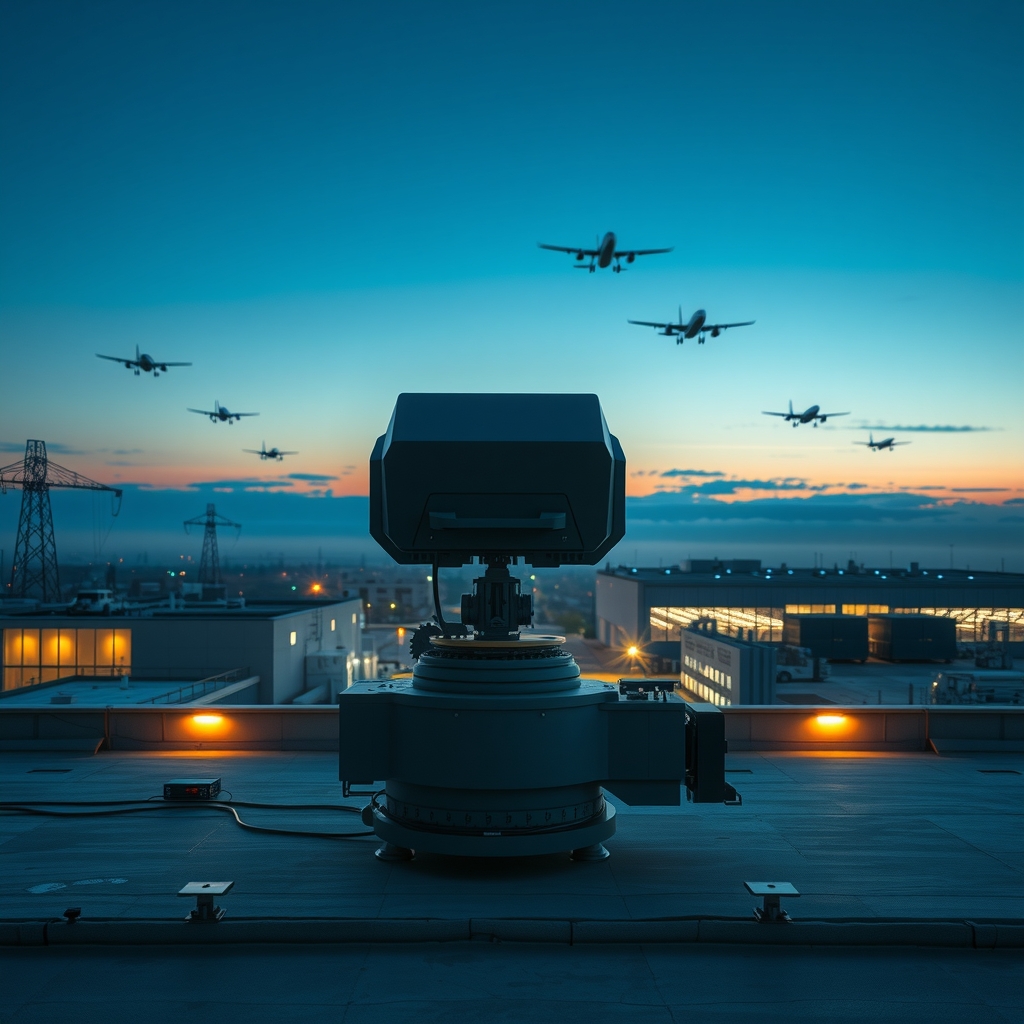
Shield AI says it has signed a definitive agreement to acquire radar maker Echodyne in a transaction valued at $5.3 billion and is raising $2.5 billion to support the deal. The November 5 announcement combines an acquisition, a new equity round, structured equity financing and debt—but none of those figures should be mistaken for a completed transaction. The companies expect the acquisition to close in early 2027, subject to regulatory approvals and other customary conditions.
The disclosed terms specify $4.8 billion to be paid and issued at closing, with up to another $500 million contingent on Echodyne meeting agreed performance targets. Shield says the financing package includes a $1 billion Series H at a $28.8 billion post-money valuation, $1 billion of structured equity from funds managed by Blackstone and $500 million of debt led by JPMorgan Chase. Bloomberg independently reported the same headline financing breakdown and contingent consideration; GeekWire also described the deal as pending and conditional.
What the announced deal actually says
Shield AI’s November 5 press release calls the transaction a definitive agreement to acquire Echodyne Corp. and values it at $5.3 billion. The number describes the announced transaction value, not cash already transferred or a completed purchase. Of that headline amount, $4.8 billion will be “paid and issued at closing,” in the company’s formulation, and as much as $500 million more depends on Echodyne reaching agreed performance targets.
The difference matters. The initial $4.8 billion combines payment and issuance, so the public announcement does not describe the entire amount as cash. It does not publicly break down how much is cash versus equity, identify every security or recipient, or spell out the performance metrics governing the contingent payment. Those details should not be inferred from the round valuation or from the shorthand phrase “$5.3 billion deal.” Bloomberg’s November 5 report likewise says the $4.8 billion is in cash and equity, with an additional $500 million conditional on milestones, attributing those terms to Shield.
Thus, “up to $5.3 billion” is the careful way to summarize total value: $4.8 billion at closing plus a contingent maximum of $500 million. The top-line value is not equivalent to a guaranteed amount. Because the contingent sum depends on later performance, its eventual payment cannot be treated as certain. The announcement gives no probability estimate, accounting treatment, payout schedule or target definitions. Until the agreement closes, even the closing payment remains prospective.
How the $2.5 billion financing is composed
Shield says it is raising $2.5 billion “to support the transaction.” Its stated sources add up: $1 billion in Series H funding, $1 billion in structured equity investment from funds managed by Blackstone, and $500 million in debt financing led by JPMorgan Chase Bank, N.A. as sole arranger. The company identifies the Series H as co-led by Disruptive and Innovation X Capital, with participation from Advent, JPMorganChase’s Security and Resiliency Initiative, Snowpoint Ventures, Apandion, Center15 Capital and others.
Bloomberg separately reported the same three-part financing structure, describing the Blackstone component as structured equity and the JPMorgan component as debt. This corroboration is useful, but the terms remain based on company-provided deal information and public reporting; it is not evidence that all proceeds have already been funded. Shield says Series H proceeds will be used principally to fund the acquisition. Its release does not provide a full sources-and-uses statement, loan covenants, interest rate, equity rights, drawdown schedule or closing mechanics for each financing tranche.
The Series H is priced at a $28.8 billion post-money valuation, a valuation of Shield after that round under its stated terms. It is not Echodyne’s purchase price, nor does it independently establish the combined company’s future market value. Bloomberg compared that figure with Shield’s reported $12.7 billion valuation after a $2 billion financing in March 2026. That comparison illustrates the rapid valuation step-up reported for Shield, but private-company valuations from separate financings can reflect different instruments, rights, dilution and market conditions. The press release does not provide enough detail to calculate comparable per-share economics or a precise valuation multiple.
Likewise, the $2.5 billion financing total should not be confused with the $5.3 billion maximum transaction value. The announcement does not explain in detail how the difference between those amounts is funded, nor does the financing headline itself disclose all sources of consideration. The known facts are the three financing amounts and the stated acquisition consideration structure. Beyond those, a complete capitalization or purchase-price bridge would require information not included in the public release or the accessible independent report.
Why Shield wants a radar business
Shield presents Echodyne as an expansion of its Mission Systems business and a move into radar and counter-drone markets. The strategic logic is sensor-to-action integration: software and autonomous vehicles rely on sensors to detect objects and establish a picture of the environment, while radar can supply detection and tracking inputs in conditions where operators need to monitor aerial threats. In Shield’s account, owning or controlling a radar platform would bring sensing closer to its autonomy software, aircraft and mission systems portfolio.
The company says Echodyne radars are incorporated in hundreds of counter-drone and security systems used by defense, government and commercial customers in more than 40 countries. Those are company claims in its release, not independently audited market-share statistics. Shield says radar can support systems that detect, track and defeat unmanned aircraft, including remote weapon stations, high-energy lasers and high-power microwave systems, and can cue interceptors. Detection and tracking are not the same as defeating a drone: a radar may provide information to a larger system, while the decision and action depend on other sensors, command systems, effectors, operators and rules.
For Shield, the acquisition would also broaden the kinds of customers served. GeekWire reported that Shield chief executive Gary Steele described Echodyne as Shield’s first step into hardware serving civilian as well as military uses. The same radar technology, the companies say, can help venues and airports identify unauthorized drones and help public-safety agencies operate drones in shared airspace. Such use cases are not identical in their legal authorities, risk thresholds or operating procedures. The announcement does not establish how particular customers will deploy the systems or what safeguards will govern each context.
Shield’s stated broader business architecture comprises autonomy software, autonomous systems and mission systems. Its release names Hivemind autonomy software, V-BAT and X-BAT aircraft, and Aechelon simulation. Echodyne would add a sensor and manufacturing capability to that portfolio. The potential advantage is a more integrated offering to defense customers; the countervailing challenge is that integrating businesses and products does not by itself prove improved performance, lower cost, or faster deployment. Those outcomes will require evidence after closing.
What Echodyne brings—and what remains unproven
Echodyne designs compact solid-state radar using a proprietary Metamaterials Electronically Scanned Array architecture, known as MESA, according to the company materials cited by Shield. The press release describes its systems as software-defined and says the business brings engineering expertise and production capacity. The strategic importance is not simply that radar is another product line: it is that sensors can shape what autonomous and human-operated systems perceive, and a radar supplier may have established relationships with system integrators and end users.
The announcement says Echodyne’s team will remain in place after closing, MESA radars will continue to be available as standalone products, and CEO Eben Frankenberg will report to Shield CEO Gary Steele while retaining responsibility for Echodyne’s products, manufacturing operations and partner and customer engagement. This is the companies’ stated plan, not a guarantee that every product, staffing or commercial arrangement will remain unchanged indefinitely. The public release does not outline post-close governance, product road maps, integration milestones or any customer-specific commitments.
Shield also points to a $250 million ceiling contract Echodyne received in September from Joint Interagency Task Force 401 for counter-UAS radar. A contract ceiling is not necessarily a guaranteed order or revenue amount. The acquisition announcement does not say how much of that ceiling has been obligated or delivered. That distinction is especially important when considering management’s claim that both businesses expect triple-digit revenue growth in the current fiscal year. The release gives no revenue base, time series, audited financials or definition of the forecast period, so the growth statement should be understood as company guidance rather than an independently verified result.
GeekWire adds context from the Seattle-area business ecosystem, reporting that Echodyne had about 400 employees and had recently opened a manufacturing facility in Woodinville. It says the company raised roughly $200 million historically and cites a PitchBook estimate of a $485 million valuation after its 2022 priced round. These are reported background figures, not the terms of this acquisition, and a past venture-round valuation is not directly comparable to current transaction consideration. GeekWire also attributes to a Shield spokesperson that no layoffs were planned and employees would not be required to relocate; those are forward-looking assurances reported by the outlet, not binding terms detailed in the press release.
Integration, customers and Seattle-area operations
The companies’ public rationale combines product breadth with industrial scale. Echodyne’s Kirkland headquarters and Woodinville production footprint add a substantial Washington presence to Shield, which announced in September that Washington would be a production home for X-BAT. Shield’s release says Echodyne’s recently opened 86,350-square-foot facility represented a $40 million investment and could produce about 30,000 radars annually. A facility’s stated capacity is not actual output, utilization, or evidence of booked demand; the release does not publish current production volumes.
Combining a radar manufacturer with an autonomy and aircraft developer can create opportunities to test sensors and software together, coordinate product planning, and offer customers a broader system. It can also introduce integration costs, competing priorities and execution risk. Shield has made prior acquisitions, as GeekWire notes, but a history of acquisitions alone cannot predict the result of this one. Customers that currently buy Echodyne radars as standalone equipment may care about continued availability, support, pricing, export approvals and product independence. The promise that MESA products will remain available after closing addresses one immediate concern, although no duration or contractual guarantee is specified publicly.
There are also distinct responsibilities in defense and commercial markets. Systems that detect drones at an airport, secure a border, or support a military mission may share technology, but differ in applicable regulation, authorization, procurement, data retention and acceptable error rates. The announcement describes applications; it does not disclose performance benchmarks, false-alarm rates, certification status across jurisdictions or deployment rules. Those are material questions for buyers and affected communities, rather than details that can be settled by the transaction headline.
Closing conditions and the open questions
Shield expects the acquisition to close in early 2027, subject to applicable regulatory approvals and satisfaction of other customary closing conditions. As of the November 5 announcement, this is a pending transaction—not an acquisition already completed. Neither the company release nor accessible independent coverage establishes that regulators have approved it, that financing has fully funded, or that the parties have satisfied all conditions. Any later report should update status against direct company or regulatory disclosures rather than repeat the original expected timetable as fact.
The term “regulatory approvals” is broad. The release does not identify each reviewing authority, describe any national-security review, or state whether any special conditions are anticipated. Given the companies’ defense and government customer base, regulatory scrutiny is a relevant consideration, but it would be speculative to predict a particular review outcome or timetable from the public material available here. The conditions must therefore be described as unresolved rather than assumed routine in outcome.
Several transaction details remain undisclosed in the cited material: the precise cash-versus-equity composition of the $4.8 billion closing consideration; the performance targets attached to the contingent $500 million; the detailed rights and cost of structured equity and debt; the complete sources and uses; and any customer or regulatory approvals beyond the general condition language. The valuation basis and dilution associated with the Series H are also not fully explained in the announcement. None of those gaps undermines the core disclosed figures, but they limit what can responsibly be said about economics and execution.
For readers evaluating the figures, there are three separate measures to keep straight: up to $5.3 billion in total transaction value, $2.5 billion in announced financing, and $28.8 billion as Shield’s Series H post-money valuation. They refer to different things. The transaction amount includes a contingent component; the financing comprises three announced instruments; and the valuation applies to Shield after the Series H, not to Echodyne alone or to a completed combined company. Treating the three as interchangeable would overstate what the announcement establishes.
What to watch next
The most consequential next update is whether and when the transaction closes. Company and regulatory notices can establish the status of approvals and conditions; closing documentation may clarify consideration and financing. Investors and customers will also want detail about how the contingent payment is measured, whether the financing is fully funded, and how product and customer commitments are handled during integration.
Operationally, useful evidence will include radar production and delivery data, contract awards and actual obligations rather than ceilings, customer adoption, and financial results after closing. The companies’ claim of triple-digit growth is a forecast; it should not be reported as achieved growth without subsequent figures. Similarly, the planned retention of Echodyne’s team and standalone products is relevant, but implementation should be assessed over time.
For now, the strongest verified account is a carefully bounded one. Shield announced a definitive agreement on November 5, 2026, to acquire Echodyne for a transaction value of up to $5.3 billion, with $4.8 billion payable and issued at closing and up to $500 million contingent on performance. It also announced a $2.5 billion financing package, including a $1 billion Series H at a stated $28.8 billion post-money valuation. Bloomberg independently reported those key terms, and GeekWire supplied regional and operational context. The companies still have to meet the stated closing conditions, and important details remain undisclosed.
Frequently asked questions
Has Shield AI completed the Echodyne acquisition?
No. Shield announced a definitive agreement on November 5, 2026. The companies expected closing in early 2027, subject to regulatory approvals and customary closing conditions. The announcement is not evidence that closing has occurred.
Is the acquisition price $5.3 billion in cash?
No such conclusion is supported. Shield says $4.8 billion will be paid and issued at closing and up to $500 million more is contingent on agreed performance targets. The release does not fully specify the cash-versus-equity breakdown; Bloomberg characterizes the closing consideration as cash and equity.
What is included in Shield’s $2.5 billion financing?
The announced composition is $1 billion in Series H funding, $1 billion in structured equity investment from funds managed by Blackstone, and $500 million of debt financing led by JPMorgan Chase Bank, N.A. The company did not publish full financing terms or a complete sources-and-uses statement in the announcement.
What does the $28.8 billion valuation mean?
It is the stated post-money valuation for Shield AI’s $1 billion Series H round. It is not Echodyne’s standalone valuation, the acquisition price, or a guaranteed value for the combined company.
How much of the $5.3 billion is guaranteed?
The companies say $4.8 billion is to be paid and issued at closing. Up to $500 million is contingent on Echodyne meeting agreed performance targets. The public materials cited here do not spell out those targets or the eventual payout.
References
- Shield AI, “Shield to acquire Echodyne in a transaction valued at $5.3 billion and raise $2.5 billion at a $28.8 billion valuation,” November 5, 2026.
- Bloomberg, “Shield AI To Hit $28.8 Billion Value With $5.3 Billion Radar Acquisition,” November 5, 2026 (updated November 5).
- GeekWire, “Shield AI to buy Bill Gates-backed radar maker Echodyne in $5.3B deal, doubling down on Seattle area,” November 5, 2026.
- Echodyne, “Echodyne Awarded $250 Million JIATF 401 Counter-UAS Contract,” September 2026.