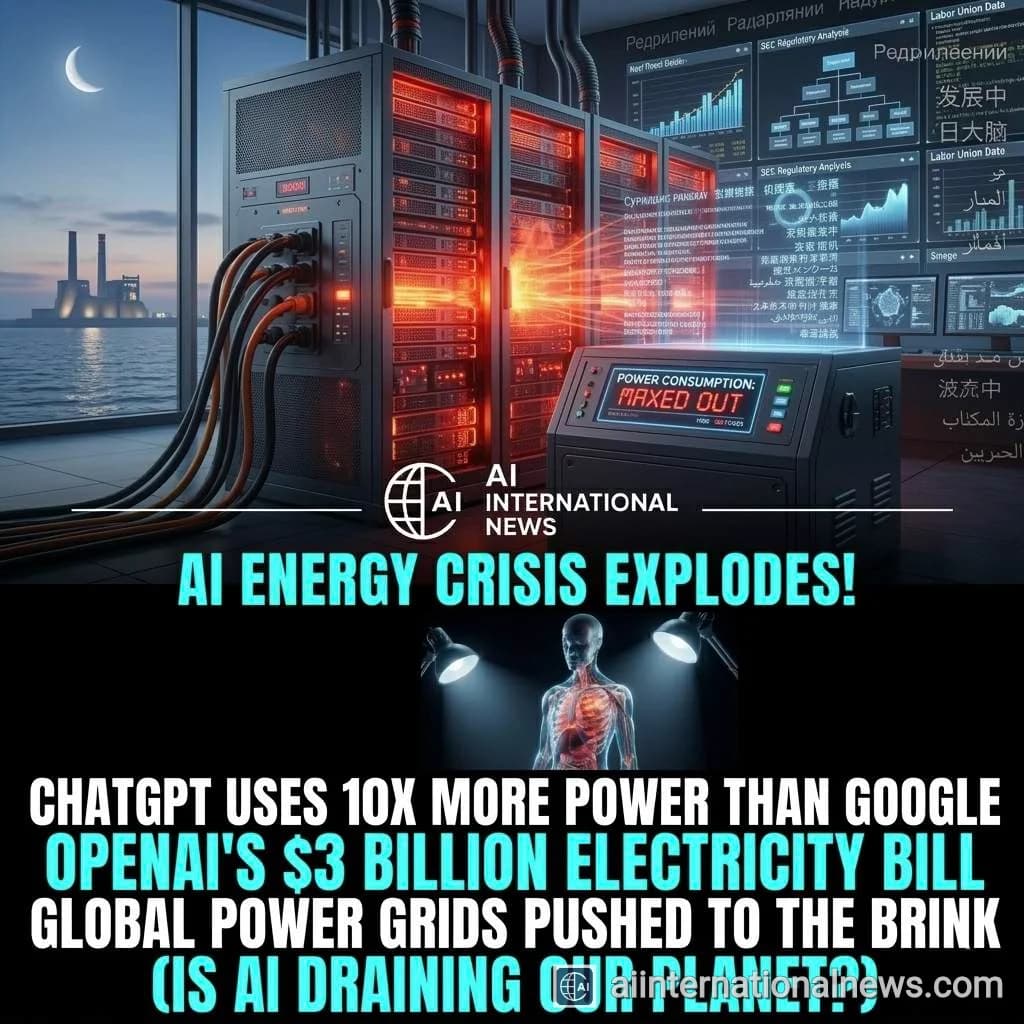
SHOCKING REPORT: The artificial intelligence revolution is moving at lightspeed, but it is leaving a massive carbon footprint in its wake. A groundbreaking new environmental tech study published this week reveals a startling statistic: a single query on ChatGPT consumes nearly 10 times more electricity than a standard Google search. As AI usage scales globally, we are officially entering the 'AI Energy Crisis'.
For years, tech giants have promised that AI will help solve the climate crisis by optimizing grids and discovering new materials. However, the short-term reality is much darker. Training large language models (LLMs) requires tens of thousands of specialized GPUs running at maximum capacity for months. Now, with hundreds of millions of daily active users chatting with AI agents, the inference cost—the energy used to actually generate the responses—is skyrocketing. Reports indicate OpenAI's annual energy bill has recently surpassed the $3 Billion mark.
Data Centers Pushed to the Brink
The physical infrastructure of the internet was not built for the constant, heavy computational load of generative AI. Traditional data centers are facing severe overheating issues, requiring massive amounts of water and industrial cooling systems. In regions heavily populated by tech infrastructure, such as Northern Virginia and parts of Europe, local power grids are experiencing unprecedented strain, leading to warnings of potential brownouts during peak usage hours.
Abhijeet's Take: This is the dirty little secret of the AI boom that Silicon Valley doesn't want to talk about. We are treating AI like magic, but it runs on coal, gas, and massive amounts of electricity. If we don't figure out how to make these models fundamentally more efficient, or rapidly transition data centers to 100% nuclear or renewable energy, the AI revolution is going to hit a hard physical wall. As a user, it really makes you think twice before asking an AI a useless question.
The Push for 'Small Tech'
In response to this crisis, a new hardware race has begun. Companies are desperately trying to develop specialized 'Low-Power AI Chips' and heavily optimized Small Language Models (SLMs) that can run directly on your smartphone without pinging a massive, energy-hungry cloud server. Until these localized solutions become the norm, the environmental cost of our digital assistants will continue to grow.