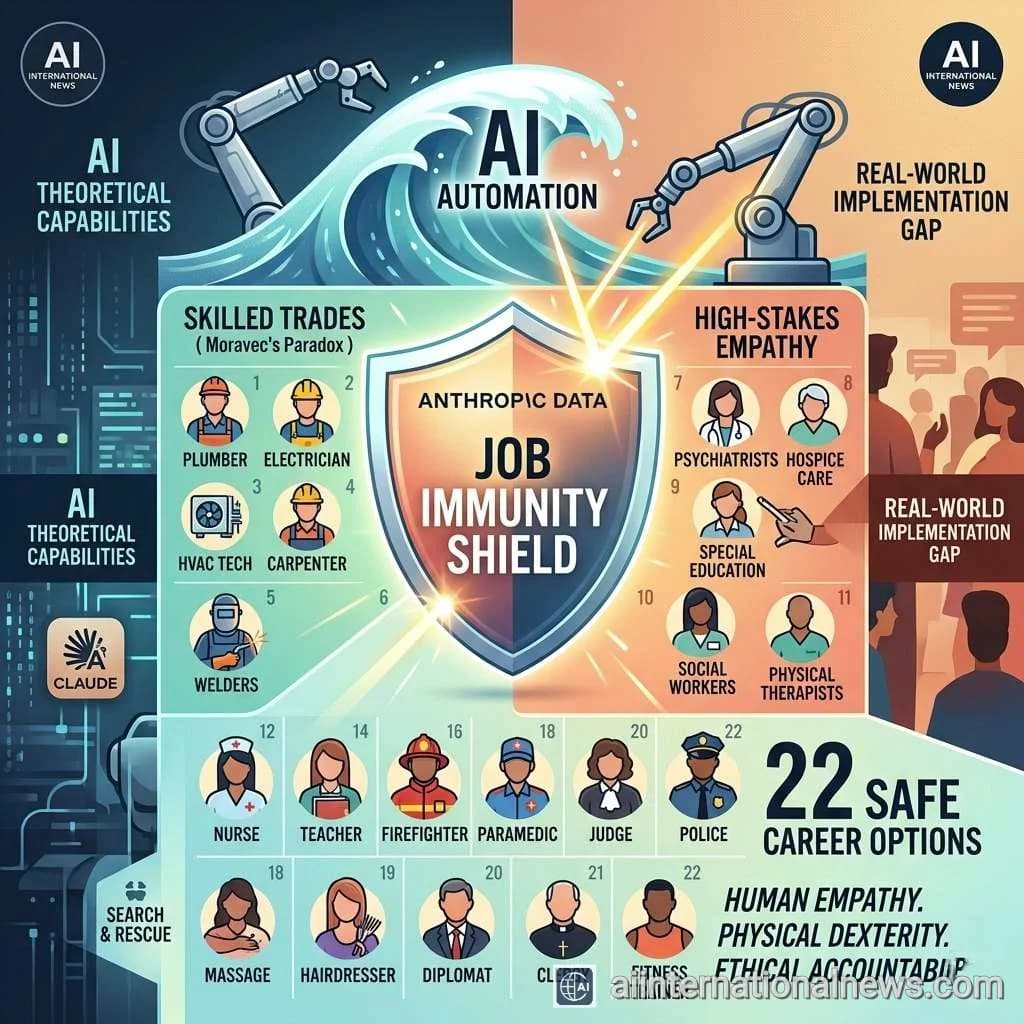
BREAKING: A comprehensive new study released by Anthropic, utilizing massive datasets of real-world usage from its Claude AI models, has shattered the prevailing narrative of universal job displacement. The research definitively identifies 22 distinct career paths that remain completely insulated from artificial intelligence, highlighting a massive 'implementation gap' between what AI can theoretically process and what it can practically execute in the modern workforce.
For the past three years, the dominant narrative emanating from Silicon Valley has been one of inevitable, sweeping automation. As large language models (LLMs) like Anthropic's Claude and OpenAI's GPT systems evolved to pass the bar exam, write production-level code, and generate photorealistic media, a profound anxiety gripped the global workforce. The assumption was simple: if a machine can think faster than a human, every job is at risk. However, as we move deeper into 2026, empirical data is finally replacing speculative panic. A groundbreaking internal study published by Anthropic has provided a vital reality check, revealing that while AI is spreading rapidly across digital workflows, a vast swath of the economy remains entirely out of its reach.
By analyzing anonymized telemetry data, API usage logs, and enterprise deployment metrics from millions of Claude interactions, Anthropic's researchers sought to map the exact boundaries of AI utility. They weren't looking for what Claude *could* do in a controlled laboratory setting; they were looking for what users and corporations were *actually* trusting the AI to do in real-world, high-stakes environments. The results were illuminating. The data revealed a stark line of demarcation, identifying 22 specific professions that exhibit virtually zero vulnerability to AI automation. These careers share common foundational traits that current—and likely near-future—algorithms simply cannot replicate: complex physical manipulation in unstructured environments, profound human empathy, and high-stakes ethical accountability.
The Implementation Gap: Theory vs. Reality
To understand the significance of Anthropic's findings, one must grasp the concept of the 'implementation gap.' In a research paper, an AI might demonstrate the theoretical knowledge to diagnose a rare disease or calculate the structural load of a bridge. But in the real world, liability, physical execution, and the nuances of human interaction create impenetrable moats around certain jobs.
Anthropic's data scientists noted that while Claude is heavily utilized by software developers, digital marketers, paralegals, and financial analysts—often executing up to 60% of their daily routine tasks—its usage drops to absolute zero when physical presence, spontaneous physical problem-solving, or deep emotional intelligence is required. The researchers categorized the 22 safe professions into three primary domains: The Unstructured Physical Economy, The High-Stakes Empathy Economy, and The Dynamic Crisis Responders.
Domain 1: The Unstructured Physical Economy
The most absolute barrier to AI adoption remains Moravec's paradox: the observation that high-level reasoning requires very little computation, but low-level sensorimotor skills require enormous computational resources. It is currently much easier to train an AI to write a corporate merger agreement than to train a robot to climb a ladder and fix a leaking pipe. As a result, skilled trades remain the ultimate safe haven from the AI revolution.
According to the Anthropic data, careers such as Plumbers, Electricians, HVAC Technicians, Carpenters, and specialized Welders have zero exposure to AI displacement. An electrician does not just 'know' how to wire a house; they must physically navigate cramped crawlspaces, identify degraded wires by touch and sight, adapt to non-standard architectural quirks, and execute precise physical manipulations. While an AI can provide a schematic, it cannot turn the wrench. Until we see the mass deployment of highly dextrous, autonomous humanoid robots that are cheaper than human labor—a reality that roboticists admit is still decades away—the skilled trades will command massive premiums in the labor market.
Domain 2: The High-Stakes Empathy Economy
The second category of immune professions revolves around jobs where human connection is not just a soft skill, but the core product itself. While AI chatbots have been deployed for basic customer service and mental health triage, Anthropic's usage data shows that in high-stakes, emotionally charged environments, users overwhelmingly reject algorithmic intervention.
Careers in this sector include Psychiatrists, Hospice Care Workers, Special Education Teachers, Social Workers, and specialized Physical Therapists. In these roles, the nuance of a human sigh, the reading of subtle body language, and the authentic sharing of human experience are paramount. A machine can generate a perfectly empathetic-sounding sentence, but it does not *feel* empathy. In moments of profound vulnerability—such as palliative care or specialized trauma therapy—human beings inherently demand the presence of another human being. Furthermore, the ethical and legal liabilities in these fields make total automation practically impossible.
Abhijeet's Take: We have spent the last decade telling kids to 'learn to code' to secure their future. Anthropic's data proves that we were pointing them in the exact wrong direction. Coding is exactly what LLMs excel at. What they cannot do is rewire a 1950s circuit breaker, calm down a panicked patient in an ER, or negotiate a hostage situation. We are about to witness the greatest economic inversion of our lifetime: the 'Blue-Collar Renaissance.' As white-collar cognitive labor becomes infinitely cheap and abundant via APIs, the value of complex physical labor and profound human empathy is going to skyrocket. If you want a job that is 100% safe from Claude and GPT-5, buy a toolbelt or get a degree in clinical psychology. The future belongs to those who work in the physical world and those who heal the human mind.
Domain 3: Dynamic Crisis Responders and Ethical Arbiters
The final domain identified by Anthropic's telemetry data encompasses roles that require real-time decision-making in chaotic, highly unpredictable, and life-threatening environments, as well as roles requiring deep ethical judgment that society refuses to delegate to code.
This includes Firefighters, Paramedics, Search and Rescue Operators, and frontline Law Enforcement. An AI cannot kick down a burning door, carry a victim through smoke, or make a split-second physical tackle. The environment of a disaster zone is the exact opposite of the structured data an AI needs to operate. Additionally, roles like Judges, High-Stakes Negotiators, and Clergy remain deeply insulated. While AI can draft legal briefs or write sermons, the actual dispensation of justice, the nuance of a diplomatic treaty negotiation, and the spiritual guidance of a congregation require a level of philosophical accountability that software cannot provide.
Key Takeaways: The 22 AI-Proof Careers
- Skilled Trades: Plumbers, Electricians, HVAC Technicians, Carpenters, Welders, and specialized Mechanics.
- Healthcare & Empathy: Nurses, Hospice Workers, Social Workers, Psychiatrists, Occupational Therapists, and Special Education Teachers.
- Crisis Response: Firefighters, Paramedics, Search & Rescue, and specialized tactical Law Enforcement.
- Personal Services & Beauty: Hairdressers, Massage Therapists, and highly specialized physical fitness trainers.
- Ethical & Human Arbitration: Judges, Clergy, high-level Diplomats, and complex conflict mediators.
- The Common Thread: All these roles require navigating unpredictable physical environments, providing authentic emotional support, or taking ultimate moral accountability for human lives.
The Future of the Workforce: Augmentation vs. Replacement
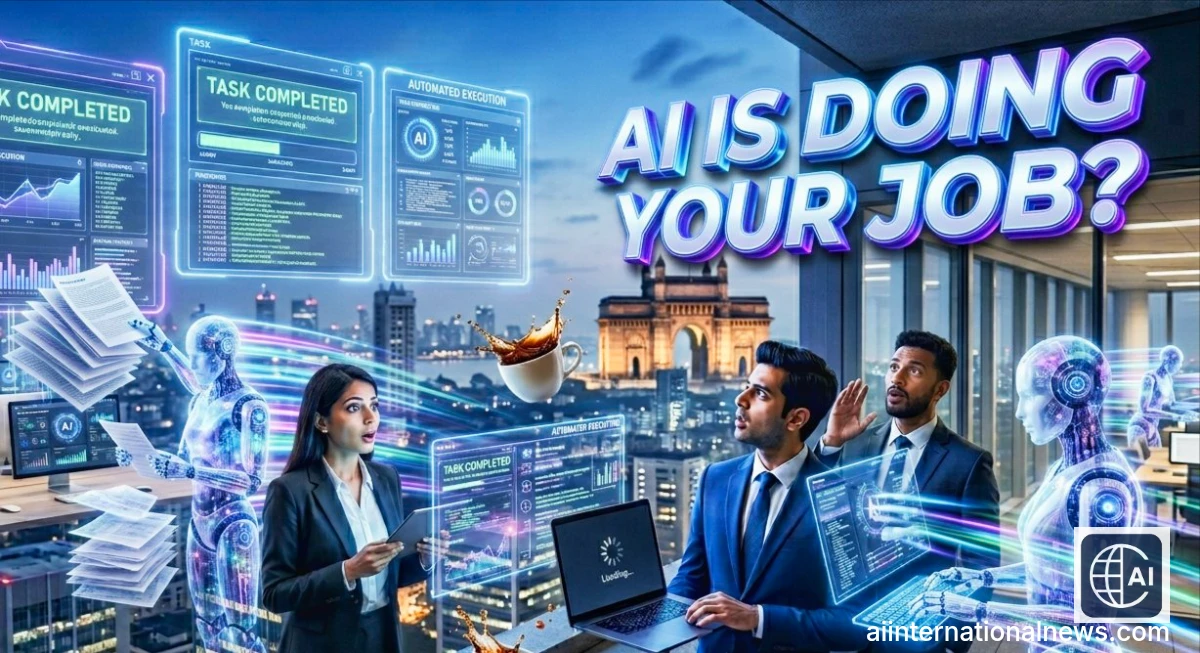
The Anthropic study should not be interpreted as a sign that AI is failing; rather, it is a map of where AI is actually succeeding. The technology is rapidly commoditizing digital, screen-based tasks. The API logs show massive spikes in usage for drafting emails, writing Python scripts, generating legal boilerplate, and summarizing financial reports. In the white-collar world, AI is shifting from an external tool to the core infrastructure of the business.
However, the revelation of these 22 immune careers provides a crucial roadmap for educational institutions, policymakers, and workers. It forces a re-evaluation of how we value different types of intelligence. For decades, society has placed a premium on cognitive, analytical tasks—the very tasks that neural networks have now mastered. Conversely, we have historically undervalued physical dexterity and emotional labor—the exact traits that remain uniquely, stubbornly human.
Conclusion: The End of the Universal Automation Myth
As we navigate the deep integration of AI into the global economy in 2026, the Anthropic data serves as a vital grounding mechanism. The fear that machines will imminently replace all human endeavor is fundamentally flawed. Artificial intelligence is a cognitive engine, not a physical or emotional one. While the landscape of office work will be unrecognizable by the end of the decade, the plumber fixing your sink, the nurse holding your hand, and the firefighter rushing into a burning building are not going anywhere. The ultimate irony of the AI revolution is that by automating our digital lives, it is forcing us to rediscover the irreplaceable value of our physical humanity.
Frequently Asked Questions
Why can't AI replace jobs like plumbing or carpentry?
These jobs operate in what researchers call 'unstructured physical environments.' While AI can analyze a photo of a broken pipe, it lacks the advanced robotics, tactile feedback, and physical adaptability required to squeeze under a sink, turn a wrench, and physically manipulate materials in a messy, real-world setting. This phenomenon is known as Moravec's paradox.
How did Anthropic determine which jobs are safe?
Anthropic, the creator of the Claude AI models, analyzed anonymized usage logs, enterprise API calls, and telemetry data. They looked at where their AI models were being utilized heavily (like coding, writing, and data analysis) versus where they were practically never used or trusted to execute tasks independently, revealing clear boundaries around physical, empathetic, and high-stakes crisis roles.
Are software engineering and coding jobs safe from AI?
According to the broader context of the study and current tech trends, standard software engineering is highly exposed to automation. Anthropic's data shows massive usage of Claude for writing, debugging, and deploying code. While senior architects who design complex systems remain necessary, the routine 'blue-collar' coding tasks are rapidly being automated by AI agents.