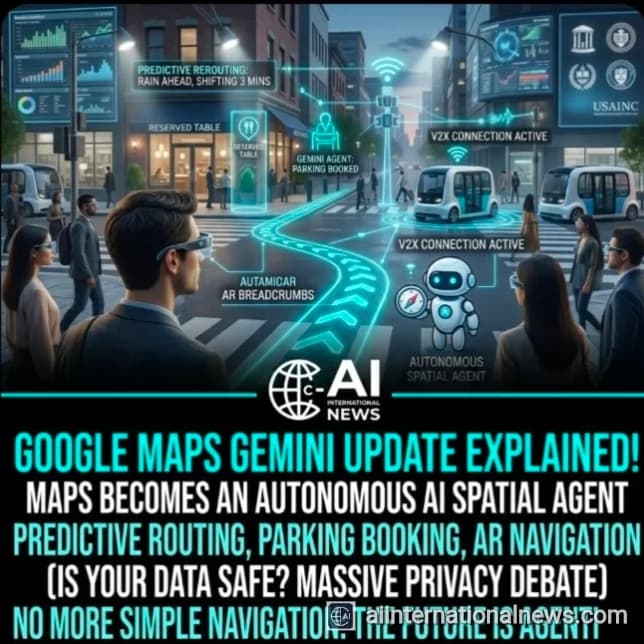
March 21, 2026. The way we navigate the physical world has just undergone its most significant transformation since the invention of GPS. In a surprise keynote, Google announced the complete overhaul of Google Maps, deeply integrating its advanced Gemini multimodal AI directly into the platform's core infrastructure. Moving far beyond the static 'Immersive View' of previous years, Google Maps is now positioned as an autonomous spatial agent capable of actively managing your entire physical journey.
From Turn-by-Turn to Autonomous Commute Management
For years, navigation apps were reactive: you inputted a destination, and they provided a route based on current traffic. The 2026 Gemini update makes Google Maps proactive and agentic. Utilizing what Google calls 'Predictive Spatial Reasoning', the AI now analyzes your calendar, historical preferences, real-time micro-weather patterns, and smart city V2X (Vehicle-to-Everything) infrastructure to orchestrate your commute.
According to the official release on The Keyword (Google's official blog), the new Maps agent can dynamically reroute you to avoid a sudden downpour, automatically negotiate and book a parking spot near your destination before you even arrive, and notify your meeting attendees if the AI predicts an unavoidable delay. It is no longer a map; it is a digital concierge for the physical world.
Deep Integration with AR and Wearables
This update is heavily tied to the anticipated boom in consumer AR (Augmented Reality) hardware. While the smartphone app gets a massive conversational interface upgrade, the true power of this AI is designed for smart glasses. Google has integrated a massive computer vision upgrade, allowing the Maps agent to 'see' what you see through your camera or wearables.
Looking for a specific restaurant in a crowded alley? The Gemini agent will overlay neon-cyan AR breadcrumbs directly into your field of vision and highlight the specific doorway. Leading tech publications like Wired have noted in their spatial computing analysis that this level of real-time rendering requires unprecedented edge-computing power, pushing the limits of modern on-device NPUs.
Abhijeet's Take: We are looking at the death of the traditional 'search bar' in Maps. Why type an address when you can just tell your earbud, 'Find me a quiet coffee shop on the way to the office that has vegan pastries, and book a table'? This is the real-world application of Agentic AI. However, giving an AI autonomous control over your physical movements, your wallet (for parking/tolls), and your exact real-time camera feed is a massive leap of faith. The convenience is god-tier, but the privacy implications are terrifying.
The Privacy Debate: The Cost of Ultimate Convenience
With great spatial power comes a massive privacy debate. For the Gemini agent to effectively manage your life, it requires continuous, background access to your highly precise location, camera feeds, and payment methods. Digital rights organizations, including the Electronic Frontier Foundation (EFF), have immediately raised red flags regarding the potential for mass surveillance and the monetization of hyper-specific physical behavior data.
Google claims that all personal processing happens locally on your device's NPU (Neural Processing Unit), echoing the industry-wide shift towards edge computing. However, skeptics point out that the continuous syncing required for V2X communication and real-time smart city data means your device is constantly pinging the cloud. The success of this Google Maps overhaul will ultimately depend on whether consumers value autonomous convenience more than their physical privacy in the AI era.