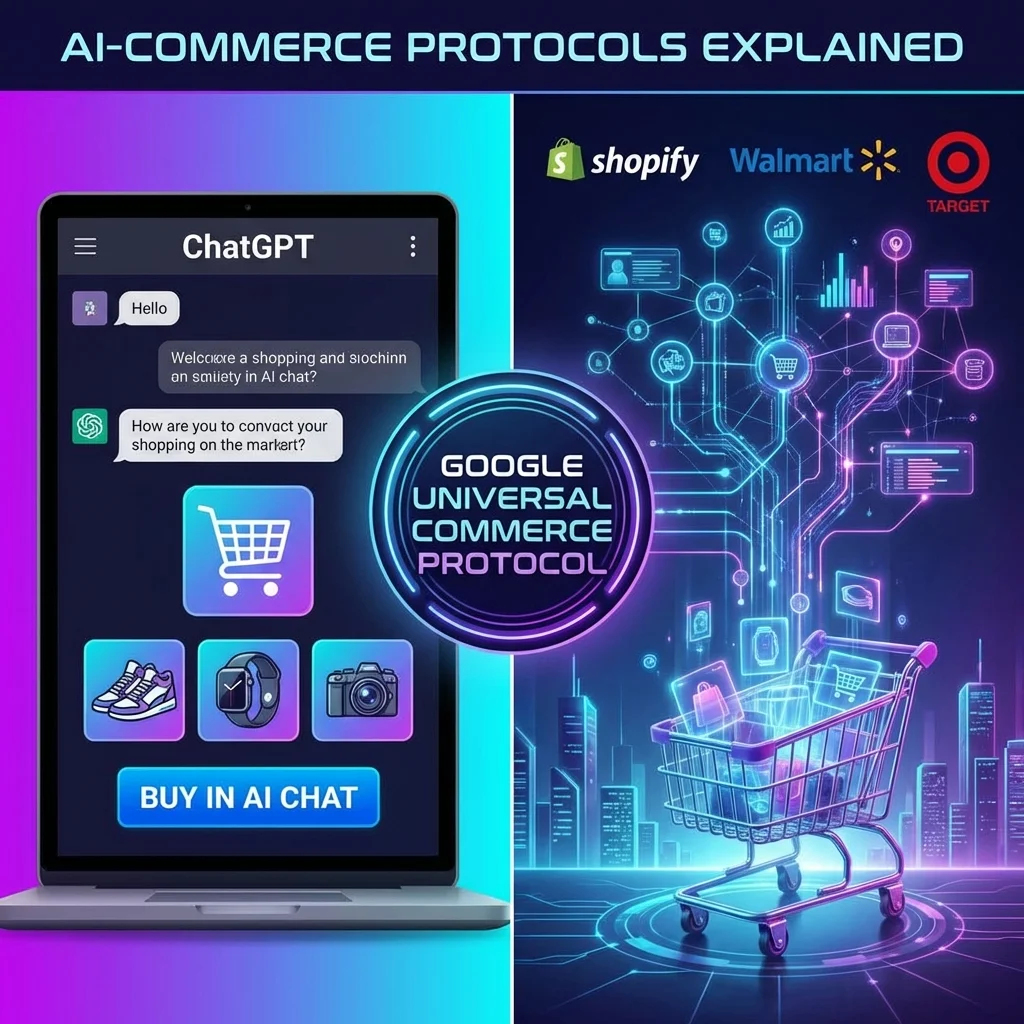
📝 Abhijeet's Take: I just bought shoes in ChatGPT. Didn't open a browser. Didn't visit a website. Just chatted with AI and boom - purchased. This is the death of traditional e-commerce as we know it. Amazon should be terrified.
What is Universal Commerce Protocol?
Google's Universal Commerce Protocol (UCP) is an open protocol that enables AI agents to execute purchases across any retailer without custom integrations.
How It Works:
- ✅ Chat with AI (ChatGPT, Perplexity, Copilot)
- ✅ Ask for product recommendations
- ✅ AI shows options from multiple retailers
- ✅ Purchase directly in chat
- ✅ No website visit needed
Launch Partners (January 2026)
Major Retailers:
- 🛒 Shopify: Agentic Storefronts
- 🏬 Walmart: Full catalog integration
- 🎯 Target: Direct AI shopping
- 🎨 Etsy: Handmade goods in AI chat
- 🏠 Wayfair: Furniture via AI agents
Shopify Agentic Storefronts
Shopify introduced Agentic Storefronts - products surface and transactions occur directly within AI conversations.
How Agentic Storefronts Work:
- ✅ Products appear in ChatGPT, Perplexity, Copilot
- ✅ AI recommends based on conversation context
- ✅ One-click purchase in chat
- ✅ No redirect to website
- ✅ Seamless checkout experience
Why This Changes Everything
1. Death of Traditional E-Commerce
| Old Way | New Way (UCP) |
|---|---|
| Open browser ❌ | Chat with AI ✅ |
| Search products ❌ | AI recommends ✅ |
| Compare sites ❌ | AI compares ✅ |
| Multiple clicks ❌ | One-click buy ✅ |
2. Amazon's Worst Nightmare
Amazon built a moat with convenience. UCP makes EVERY retailer as convenient as Amazon.
3. SEO Becomes Irrelevant
Why rank on Google when AI agents recommend products directly?
💭 Reality Check: E-commerce companies spent billions on SEO, websites, and user experience. UCP makes all of that obsolete. The future of shopping isn't websites - it's conversations with AI.
Real-World Use Cases
Example 1: Buying Shoes
You: "I need running shoes for marathon training"
AI: "Based on your needs, here are 3 options from Nike, Adidas, and New Balance. Nike Pegasus 40 is $130 on Shopify. Want to buy?"
You: "Yes"
AI: "Purchased! Arriving Tuesday."
Example 2: Furniture Shopping
You: "I need a desk for my home office, budget $500"
AI: "Found 5 desks on Wayfair and Target. This standing desk is $449, 4.8 stars, free shipping. Purchase?"
You: "Show me reviews first"
AI: [Shows reviews] "Still interested?"
You: "Buy it"
Impact on Different Players
Winners ✅
- ✅ Small Retailers: Compete with Amazon
- ✅ Shopify Merchants: Direct AI access
- ✅ Consumers: Easier shopping
- ✅ AI Platforms: New revenue stream
Losers ❌
- ❌ Amazon: Loses convenience moat
- ❌ Google Shopping: Bypassed entirely
- ❌ SEO Agencies: Less relevant
- ❌ Traditional E-Commerce: Outdated model
Technical Implementation
For Retailers:
- ✅ Integrate with UCP API
- ✅ Provide product catalog
- ✅ Enable AI agent access
- ✅ Handle transactions via protocol
Privacy and Security
Concerns:
- ⚠️ AI agents accessing payment info
- ⚠️ Purchase history tracking
- ⚠️ Data sharing between platforms
- ⚠️ Impulse buying via AI persuasion
The Future of Shopping (2026-2030)
Predictions:
- 🛒 2026: 10% of e-commerce via AI chat
- 📈 2027: 30% of online shopping in AI platforms
- 🚀 2028: 50% of purchases via AI agents
- 🌍 2030: Traditional e-commerce websites obsolete
💭 Final Thoughts: Google just changed the game. Shopping in AI chat isn't the future - it's now. If you're an e-commerce business and you're not integrating with UCP, you're already behind. The question isn't "Will this replace websites?" It's "How fast will it happen?" My bet: 3 years max.