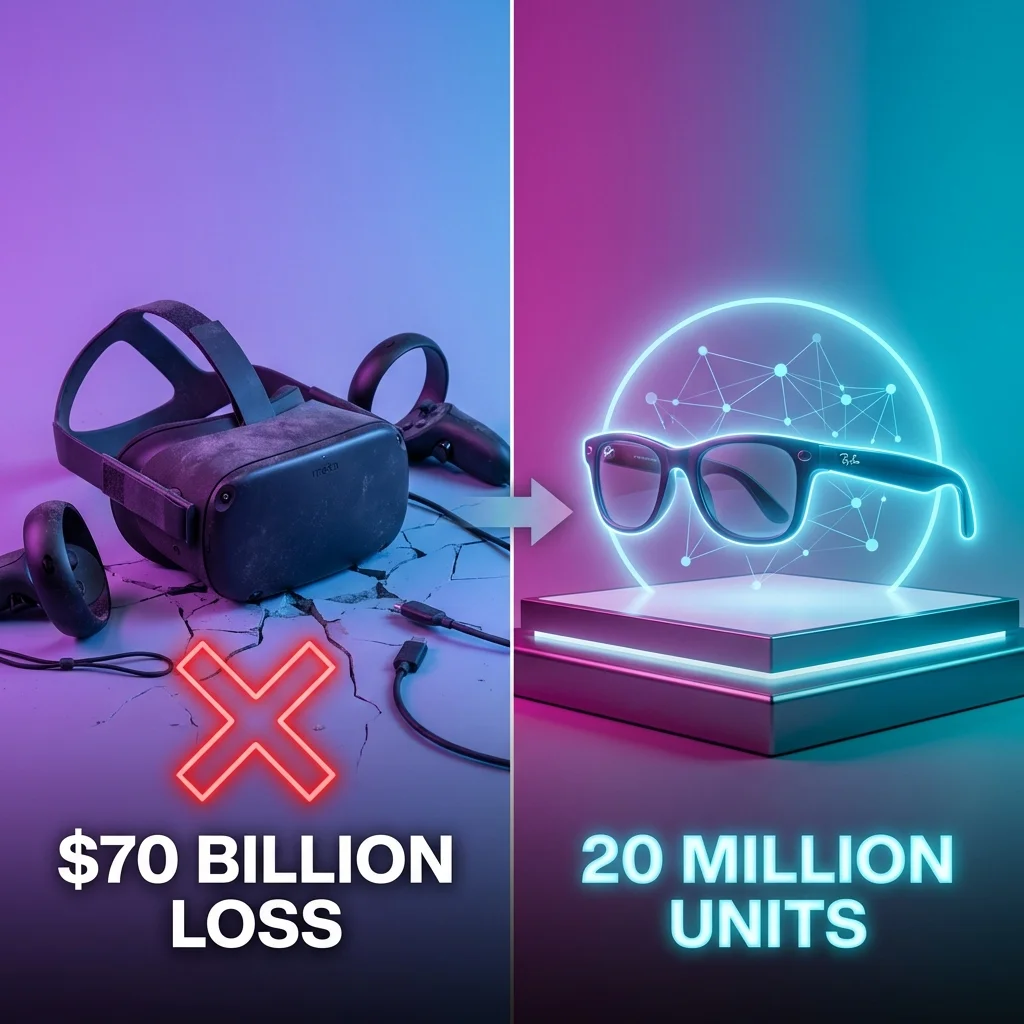
📝 Abhijeet's Take: I called this 2 years ago. VR was always a solution looking for a problem. AI wearables? That's the real future. Meta just burned $70 billion to learn what we already knew: people want tech that fits into their lives, not tech that replaces their lives.
The $70 Billion Metaverse Failure
Meta's Reality Labs division has accumulated over $70 billion in operating losses since 2020, making it one of the most expensive corporate failures in tech history.
Reality Labs Losses (2020-2026):
- 2020: $10.2B loss
- 2021: $10.1B loss
- 2022: $13.7B loss
- 2023: $16.1B loss
- 2024: $14.5B loss
- 2025: $12.8B loss (estimated)
- Total: $70B+ burned
What Went Wrong?
- ❌ VR headsets too expensive ($500-$3,500)
- ❌ Limited use cases (gaming only)
- ❌ Motion sickness issues
- ❌ Social isolation concerns
- ❌ No killer app emerged
- ❌ Market adoption remained under 5%
The Mass Layoffs Begin
In January 2026, Meta announced massive restructuring of Reality Labs:
Layoffs & Closures:
- 1,000+ employees laid off from Reality Labs
- Armature Studio - Closed
- Twisted Pixel - Closed
- Sanzaru - Closed
- Multiple VR projects - Cancelled
- Metaverse initiatives - Defunded
Official Statement:
Meta stated Reality Labs will operate with a "leaner organization and a more focused roadmap to maximize long-term sustainability."
Translation: VR is dead. We're cutting our losses.
The AI Wearables Pivot
While VR burned billions, Meta found unexpected success with Ray-Ban Meta smart glasses.
Ray-Ban Meta Glasses Success:
- ✅ 20 million units target for 2026
- ✅ 30 million if demand stays strong
- ✅ Doubling production capacity
- ✅ AI-powered real-time assistance
- ✅ $299 price point (affordable!)
- ✅ Actual daily use (not just gaming)
Why AI Glasses Work (VR Didn't):
| Feature | VR Headsets | AI Glasses |
|---|---|---|
| Price | $500-$3,500 ❌ | $299 ✅ |
| Daily Use | 30 mins max ❌ | All day ✅ |
| Social | Isolating ❌ | Enhancing ✅ |
| Use Cases | Gaming only ❌ | Everything ✅ |
| Adoption | 5% market ❌ | Growing fast ✅ |
Full AI Acceleration Mode
Meta is now in "full AI-acceleration mode," reorienting from social media company to AI infrastructure giant.
Meta's AI Investments (2025-2026):
- 💰 Tens of billions into data centers
- 🔧 Custom AI chips development
- ⚡ Large-scale computing infrastructure
- 👥 Top AI talent hiring spree
- 🏢 Meta Compute division created
- 🤖 Alexandr Wang leads AI strategy
What Meta is Building:
- ✅ AI-powered smart glasses (Ray-Ban Meta)
- ✅ Real-time AI assistants
- ✅ Computer vision wearables
- ✅ Voice-activated AI services
- ✅ Everyday AI integration
💭 Reality Check: Meta spent $70B trying to convince people to live in virtual worlds. Now they're making glasses that help you live better in the real world. That's the difference between vision and delusion.
What This Means for the Industry
1. Metaverse is Dead
If Meta - the company that literally renamed itself for the metaverse - is abandoning it, it's over.
2. AI Wearables are the Future
Smart glasses, AI earbuds, health wearables - these are the next computing platform.
3. Practical AI Wins
AI that solves real problems (navigation, translation, information) beats AI that creates new problems (isolation, motion sickness).
4. Apple Was Right
Apple skipped the metaverse hype, went straight to Vision Pro (mixed reality), and is now working on AI glasses. They saw this coming.
Winners & Losers:
| Winners ✅ | Losers ❌ |
|---|---|
| Ray-Ban (Meta partner) | VR headset makers |
| AI chip makers | VR game studios |
| Wearable tech companies | Metaverse platforms |
| Practical AI startups | VR content creators |
The Numbers Don't Lie
Meta's Strategic Shift:
- VR Investment (2020-2026): $70B+ ❌
- VR Market Share: 5% ❌
- VR Revenue: Minimal ❌
- AI Glasses Sales (2026): 20M units ✅
- AI Infrastructure Investment: Tens of billions ✅
- Market Response: Positive ✅
What Happens to VR Now?
VR Isn't Completely Dead, But:
- ✅ Gaming niche will survive
- ✅ Enterprise training use cases
- ✅ Specialized applications (medical, military)
- ❌ Mass consumer adoption - not happening
- ❌ Metaverse social platforms - dead
- ❌ VR as next computing platform - failed
Lessons Learned
🎯 Key Takeaways
- ✅ Don't force technology on people - solve real problems
- ✅ Wearables > Headsets for daily use
- ✅ AI that enhances reality > AI that replaces reality
- ✅ Price matters - $299 glasses beat $3,500 headsets
- ✅ Social integration > Social isolation
- ✅ Practical AI > Visionary AI
- ✅ Listen to market signals, not your vision
💭 Final Thoughts: Meta's $70B lesson: The future isn't about escaping reality - it's about enhancing it. AI glasses that help you navigate Mumbai traffic? That's useful. VR worlds where you pretend to be someone else? That's escapism. The market has spoken.
What's Next for Meta?
2026 Roadmap:
- ✅ Ray-Ban Meta 2.0 (improved AI features)
- ✅ 20-30M smart glasses sold
- ✅ AI infrastructure expansion
- ✅ New AI wearable categories
- ✅ Focus on practical AI applications