Abhijeet's Take: I built my first AI agent last month. It researches topics, writes summaries, and emails me daily. Runs while I sleep. This tutorial teaches you how to build the same. Let's dive in.
What is Agentic AI?
Agentic AI = Autonomous AI systems that independently plan, execute, and refine workflows.
Simple Comparison:
- ChatGPT: You ask, it answers. One-shot interaction.
- Agentic AI: You set a goal, it figures out how to achieve it. Multi-step execution.
Real Example:
Task: "Research AI trends and write a weekly report"
ChatGPT Approach:
- You: "What are AI trends?"
- ChatGPT: Gives answer
- You: "Write a report"
- ChatGPT: Writes report
- Result: You do the planning
Agentic AI Approach:
- Agent: Searches web for AI news
- Agent: Reads top 20 articles
- Agent: Summarizes key trends
- Agent: Writes formatted report
- Agent: Emails you the report
- Result: Agent does everything
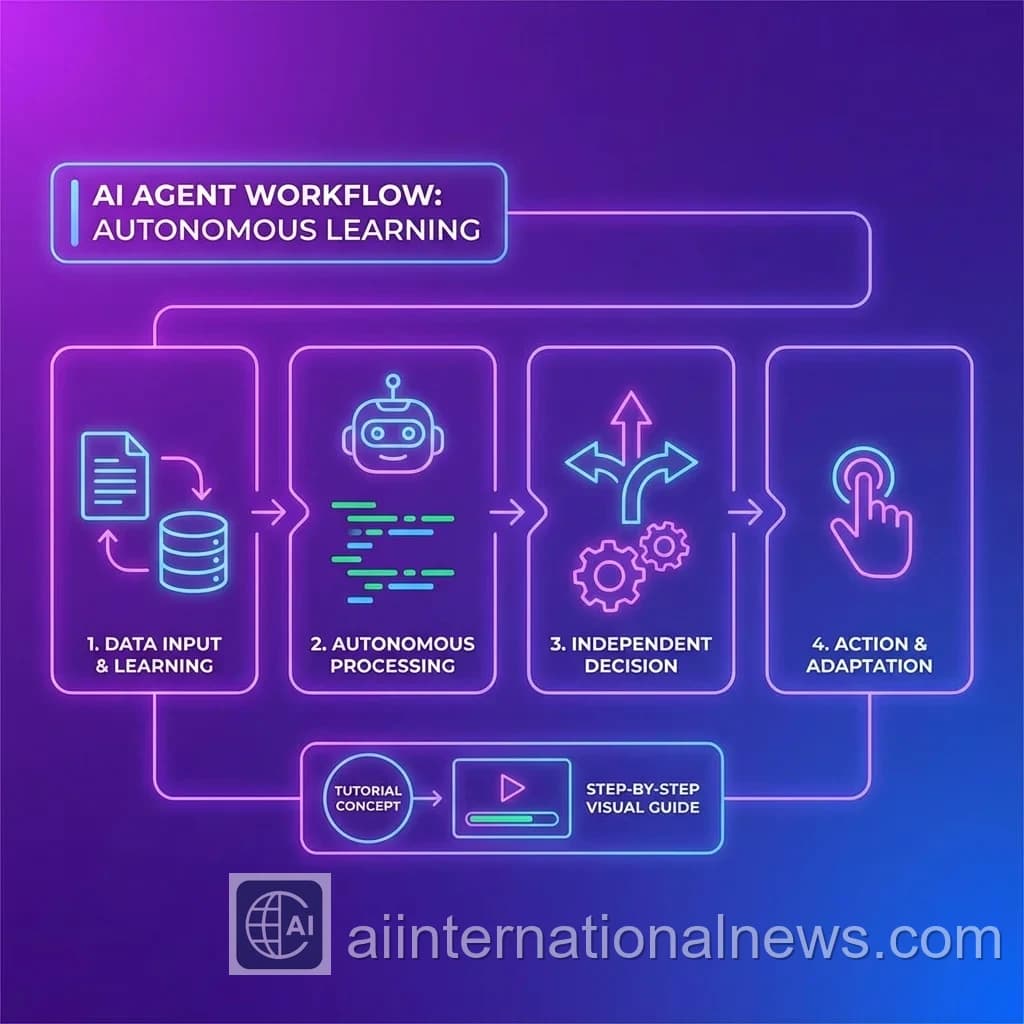
Core Concepts
1. Autonomy
Agents make decisions without constant human input.
2. Planning
Agents break down complex goals into actionable steps.
3. Execution
Agents perform tasks using tools (web search, code execution, APIs).
4. Iteration
Agents learn from results and refine their approach.
Key Insight: Agentic AI is about giving AI goals, not instructions. You define the "what," the agent figures out the "how."
Building Your First AI Agent
Step 1: Choose Your Framework
Popular Frameworks (2026):
- LangChain: Most popular, great documentation
- AutoGPT: User-friendly, good for beginners
- CrewAI: Best for multi-agent systems
- Microsoft Semantic Kernel: Enterprise-ready
Step 2: Define Your Agent's Goal
Start simple. Example: "Monitor Hacker News and summarize top AI posts daily."
Step 3: Give Your Agent Tools
Common Tools:
- Web Search: Google, Bing APIs
- Web Scraping: BeautifulSoup, Playwright
- Code Execution: Python interpreter
- File Operations: Read/write files
- Email: Send notifications
Step 4: Implement the Agent Loop
1. Receive goal 2. Plan steps to achieve goal 3. Execute first step using tools 4. Evaluate result 5. If goal achieved → Done 6. If not → Refine plan and repeat from step 3
Practical Example: News Summarizer Agent
Goal:
"Every morning at 8 AM, send me a summary of top 5 AI news articles."
Agent Workflow:
- Search: Query "AI news today" on Google
- Filter: Get top 5 results from reputable sources
- Scrape: Extract article content
- Summarize: Use LLM to create 2-sentence summaries
- Format: Create email-friendly HTML
- Send: Email the summary
Tools Needed:
| Tool | Purpose |
|---|---|
| Google Search API | Find news articles |
| BeautifulSoup | Extract article text |
| OpenAI API | Summarize content |
| SMTP | Send email |
Multi-Agent Systems
Multiple specialized agents working together. More powerful than single agents.
Example: Content Creation Team
- Researcher Agent: Finds trending topics
- Writer Agent: Creates article drafts
- Editor Agent: Improves quality, checks facts
- SEO Agent: Optimizes for search engines
- Publisher Agent: Posts to website
Agent Communication:
Agents pass information to each other. Researcher → Writer → Editor → SEO → Publisher.
Best Practices
1. Start Simple
Build single-task agents first. Master basics before multi-agent systems.
2. Clear Goals
Vague goals = poor results. "Research AI" is bad. "Find 5 AI news articles from last 24 hours" is good.
3. Tool Selection
Give agents only necessary tools. Too many tools = confusion and errors.
4. Error Handling
Agents will fail. Build retry logic and fallbacks.
5. Monitoring
Log everything. You need to know what agents are doing.
My Mistake: I once gave an agent 20 different tools. It spent 10 minutes deciding which tool to use for simple tasks. Less is more.
Common Use Cases
Personal Productivity:
- Email management and prioritization
- Calendar scheduling
- Research and summarization
- Content creation
Business:
- Customer support automation
- Data analysis and reporting
- Lead generation
- Social media management
Development:
- Code review and testing
- Bug fixing
- Documentation generation
- Deployment automation
Tools & Resources (2026)
Frameworks:
- LangChain: langchain.com
- AutoGPT: github.com/Significant-Gravitas/AutoGPT
- CrewAI: crewai.com
- Semantic Kernel: microsoft.com/semantic-kernel
LLM Providers:
- OpenAI: GPT-4, GPT-4 Turbo
- Anthropic: Claude 3
- Google: Gemini Pro
- Open Source: Llama 3, Mistral
Challenges & Solutions
| Challenge | Solution |
|---|---|
| Infinite loops | Set max iterations (e.g., 10 steps) |
| High costs | Use cheaper models for simple tasks |
| Hallucinations | Fact-checking layer, human review |
| Tool failures | Retry logic, fallback options |
Future of Agentic AI
2026-2027 Trends:
- More autonomous, less human intervention
- Better multi-agent coordination
- Specialized agents for specific industries
- Improved reasoning and planning
- Lower costs, higher accessibility
Key Takeaways
Summary
- Agentic AI = Autonomous systems that plan and execute
- Different from ChatGPT: goals vs prompts
- Core concepts: autonomy, planning, execution, iteration
- Start with LangChain or AutoGPT
- Give agents clear goals and necessary tools
- Multi-agent systems for complex tasks
- Monitor, log, and handle errors
Final Thoughts: Agentic AI is the future of work. Not replacing humans - augmenting them. Build your first agent this week. Start simple. Iterate. In 6 months, you'll have digital workers handling tasks while you sleep. The future is autonomous.