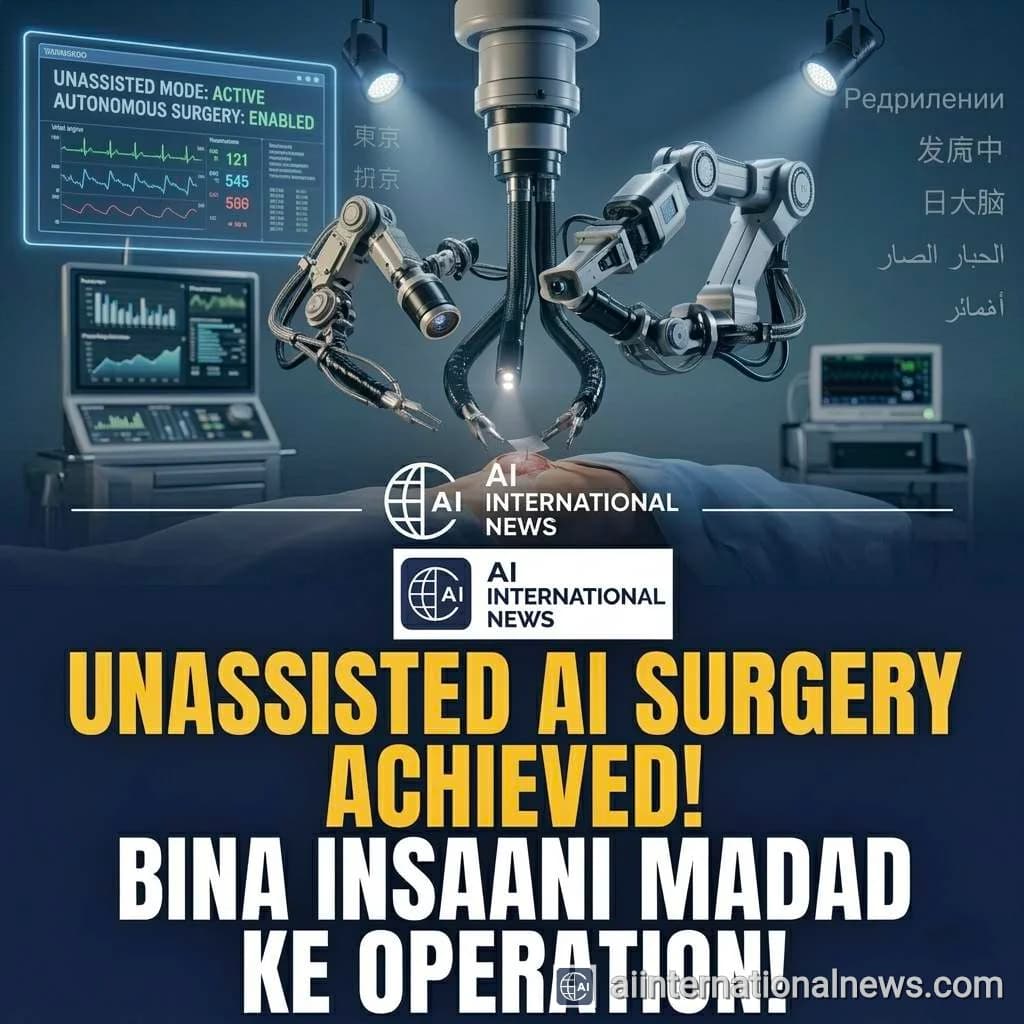
BREAKING: The medical field has officially crossed the ultimate frontier. Early this morning, a fully autonomous AI-driven robotic surgeon, operating under the project name 'MedBot X', successfully completed a complex 10-hour cardiovascular procedure on a human patient. For the first time in medical history, no human doctor touched the surgical instruments, and no human guided the robot's decisions during the operation.
Since the introduction of robotic-assisted surgery systems like the Da Vinci machine decades ago, robots have been highly precise tools controlled directly by human hands. However, the MedBot X represents a monumental leap from 'assisted' to 'autonomous'. Powered by a massive neural network trained on over 5 million hours of surgical video data and real-time biometric feedback, the AI was able to analyze the patient's anatomy, make microscopic incisions, and dynamically adjust its strategy when unexpected bleeding occurred—reacting 400 times faster than a human doctor's reflexes.
Superhuman Precision: Removing the 'Shaky Hand'
The core advantage of the MedBot X is its absolute lack of physical fatigue and emotional stress. During a 10-hour operation, human surgeons naturally experience micro-tremors in their hands and cognitive fatigue. The AI, equipped with sub-millimeter optical sensors and haptic feedback arms, maintained 100% perfect precision from the first minute to the last. The patient, a 54-year-old male, is reportedly in stable condition and recovering 30% faster than the traditional surgical baseline due to the ultra-minimally invasive nature of the AI's incisions.
Abhijeet's Take: We always thought AI would replace copywriters and coders first, leaving physical blue-collar and highly specialized medical jobs for last. We were wrong. The success of MedBot X proves that high-stakes physical manipulation is now within AI's grasp. While human doctors won't disappear tomorrow—they are still needed for empathy, diagnosis, and ethical oversight—the actual physical act of cutting into a human body will soon be viewed as too dangerous to be left to a human. Within the next decade, demanding a 'human surgeon' might sound as reckless as demanding a car without airbags.
The Regulatory Nightmare
While the technological achievement is undisputed, the legal and ethical implications are causing chaos. The FDA granted a highly restricted, one-time emergency waiver for this trial. But who is legally responsible if an autonomous AI makes a fatal mistake? The hospital? The software developer? The hardware manufacturer? As we move deeper into 2026, lawmakers are rushing to draft new 'Algorithmic Malpractice' laws to handle a future where our most critical care is delivered by machines.