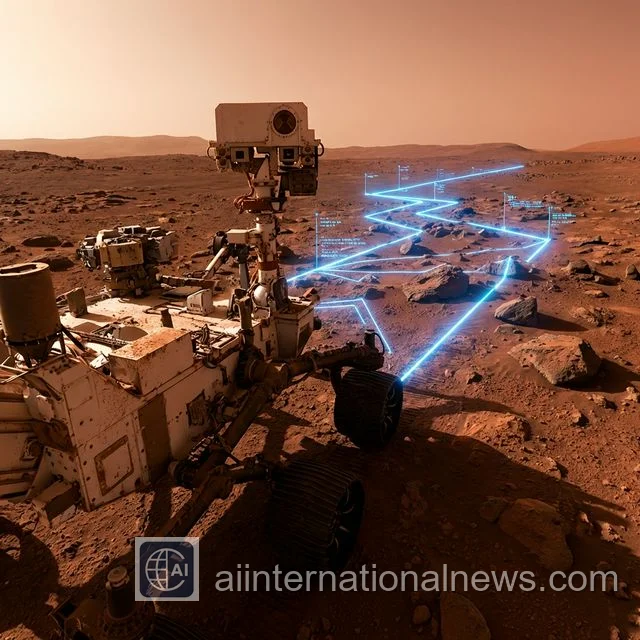
📝 Abhijeet's Take: This is the moment "Science Fiction" became "Science Fact." We aren't just using AI to write emails anymore; we are trusting it to drive a $2.7 billion nuclear robot 140 million miles away.
The Problem: The 20-Minute Delay ⏱️
Driving on Mars is a nightmare. It takes about 20 minutes for a signal to travel from Earth to Mars. That means if a rover sees a cliff edge, human drivers on Earth won't know about it until 20 minutes *after* the rover has already fallen off.
Until now, NASA engineers (the "Rover Drivers") had to painstakingly map out every single meter of the path days in advance. The rover would drive a few feet, stop, wait for instructions, and drive again. It was slow. Painfully slow.
The Solution: Enter Claude 🧠
NASA's JPL (Jet Propulsion Laboratory) partnered with Anthropic to integrate a specialized version of Claude into the rover's navigation stack. Unlike previous "AutoNav" systems which followed simple rules, Claude can *reason* regarding the terrain.
How Claude Pilots Perseverance:
- Visual Analysis: Analyzes images from the Navcams in real-time.
- Risk Assessment: Identifies loose sand (death trap) vs solid bedrock.
- Path Planning: Plots a continuous curve around obstacles.
- Speed: Increased effective drive speed by 300% vs human control.
The Results: 400 Meters in One Sol Mars Day
In a test run last week, Perseverance was given a simple command: "Go to that rock formation." The rover engaged its AI pilot and drove 400 meters in a single Martian day (Sol), dodging sharp rocks and sand traps that human drivers hadn't even mapped yet.
💭 Reality Check: Before you panic about "Skynet in Space," remember this: Claude isn't deciding *where* to go (mission goals). It's only deciding *how* to get there safely. The leash is longer, but humans still hold it.
Why This Changes Everything
This isn't just about Mars. NASA's upcoming missions to Europa (Jupiter's moon) and Titan (Saturn's moon) are too far for any meaningful human control. Communication delays can be over an hour.
If we want to explore the subsurface oceans of Europa for life, we *need* AI that can think for itself. Perseverance is just the training ground.
Comparison: Old AutoNav vs Claude
| Feature | Classic AutoNav | Claude AI Pilot |
|---|---|---|
| Reasoning | Rule-based (If-Then) | Generative Vision |
| Speed | Stop-and-go | Continuous Drive |
| Adaptability | Low (Stuck often) | High (Re-routes instantly) |
The Bottom Line
Space exploration just got a massive upgrade. By putting a "brain" on the rover, NASA has effectively put a driver in the seat, eliminating the millions of miles of lag. Mars is about to feel a lot closer.
What's Next? Would you trust an AI to land a spacecraft with astronauts on board? That might be the next step.