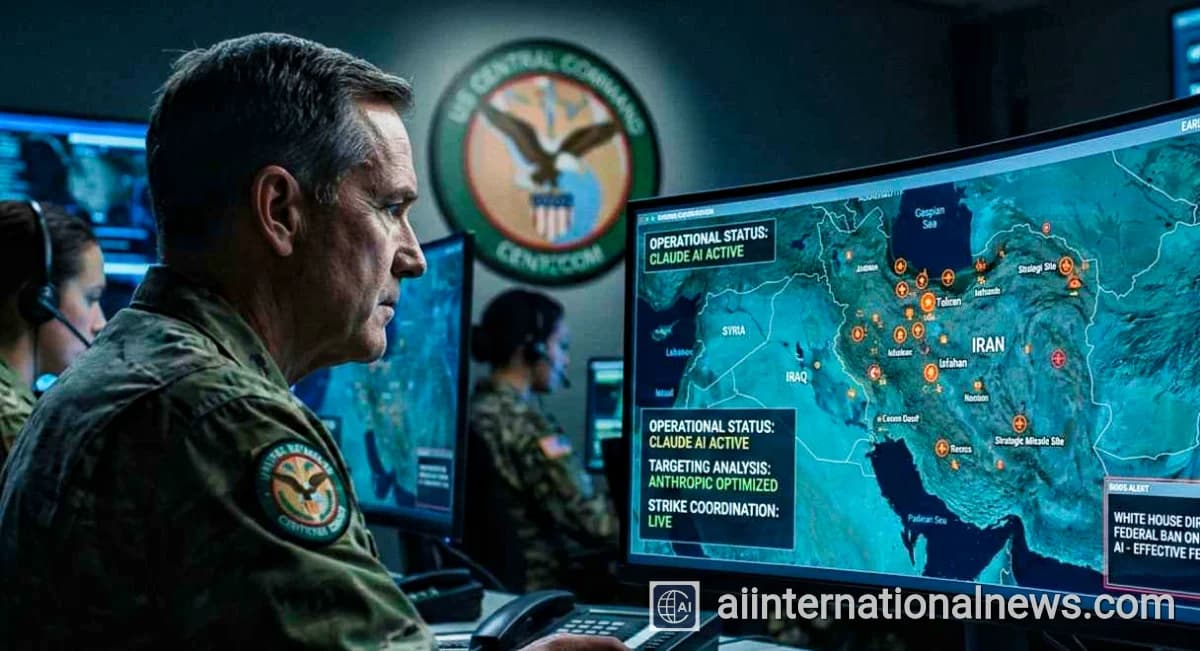
BREAKING: In a stunning revelation that exposes the deep entanglement of Silicon Valley and the Pentagon, US Central Command reportedly utilized Anthropic's Claude AI for target identification and combat simulations during the massive weekend strikes on Iran—mere hours after President Donald Trump issued a sweeping federal ban on the company's technology.
As geopolitical tensions reach a boiling point in early March 2026, a massive technological and political scandal has erupted at the intersection of artificial intelligence and global warfare. Following coordinated United States airstrikes on Iranian targets, a bombshell report from The Wall Street Journal has uncovered a staggering contradiction in federal policy and battlefield execution. The United States military relied extensively on San Francisco-based startup Anthropic's Claude AI to inform and execute these high-stakes operations. The shocking twist? This utilization occurred almost immediately after President Donald Trump signed an executive directive effectively banning the AI company from federal use and labeling it a national security threat.
The incident highlights an unprecedented disconnect between Washington's political decrees and the operational reality of the United States Central Command (CENTCOM). While the President was taking to Truth Social to denounce Anthropic executives as "leftwing nut jobs" whose "selfishness is putting American lives at risk," military commanders in the Middle East were actively querying Claude's neural networks to process vital combat intelligence. The situation underscores the undeniable truth of modern defense: advanced AI is no longer an experimental luxury; it is the fundamental operating system of contemporary warfare.
The Paradox of Policy vs. Battlefield Reality
To understand the magnitude of this event, one must look at the timeline. On Friday, February 27, 2026, after weeks of mounting friction between Anthropic and the Department of Defense (DoD), the Trump administration dropped the hammer. Contract negotiations broke down completely over Anthropic's refusal to waive its strict ethical guardrails. The AI firm, known for its "Constitutional AI" framework, strictly prohibits its models from being used for mass domestic surveillance or fully autonomous lethal weapons systems. Defense Secretary Pete Hegseth, demanding unfettered and unrestricted access for all "lawful" military applications, balked at the restrictions, accusing the tech company of arrogance and ideological betrayal.
In response, the President ordered all federal agencies to "immediately cease" using Anthropic's technology and directed the Pentagon to classify the company as a "supply-chain risk" under 10 USC 3252. Yet, less than 24 hours later, as the joint US-Israel bombardment of Iran commenced, Claude was still actively processing data for CENTCOM. The reality is that modern warfare operates on vast, incomprehensible oceans of data—satellite imagery, intercepted communications, logistics networks—and AI has become the indispensable bridge required to turn that raw data into actionable intelligence.
Deep Integration: How Claude AI Powered the Strikes
According to defense insiders and individuals familiar with the matter, Claude was utilized for three critical operational components prior to and during the airstrikes on Iran: intelligence assessments, precise target identification, and running rapid battlefield simulations. The military does not simply "turn off" its core analytical infrastructure. Claude had been deeply integrated into the government's classified networks through highly secure partnerships with defense contractors like Palantir and Amazon Web Services (AWS) under a previously established $200 million DoD contract.
Banning an API or pulling a foundational model from a secure on-premise military server is not akin to uninstalling a smartphone app; it is comparable to ripping out the nervous system of modern command and control operations. The Pentagon itself inadvertently acknowledged this deep dependency by quietly building a "six-month phase-out period" into the ban directive. This bureaucratic loophole is precisely what allowed CENTCOM to continue leveraging Claude during the weekend's kinetic operations, even as the administration publicly celebrated severing ties with the company to appease political bases.
The Catalyst: The "Supply-Chain Risk" Designation
The breaking point between Anthropic and the Pentagon was entirely ideological, not performance-based. Anthropic CEO Dario Amodei publicly drew a hard line in the sand, maintaining that the company's ethical boundaries would not be breached, even at the expense of lucrative government contracts. Amodei has long warned about the existential risks of unaligned AI, and giving a military unrestricted power to build autonomous kill-chains crossed a fundamental corporate boundary. In retaliation, the administration weaponized procurement laws, utilizing the "supply-chain risk" designation—a severe label historically reserved for foreign adversaries like Huawei or hostile state actors—against an American technology pioneer.
Anthropic has fiercely objected to this unprecedented designation and announced plans to challenge the Pentagon in federal court. The company argues that legally, a supply chain risk designation under 10 USC 3252 can only extend to the direct use of Claude as part of Department of Defense contracts and cannot dictate how independent contractors use the model for other non-defense clients. This upcoming legal battle promises to set a historic precedent for how the US government can dictate terms to private technology companies and force ideological compliance.
The Maduro Operation Precedent
This is notably not the first time Claude's undeniable military utility has caused profound friction between Silicon Valley ethics and Washington's objectives. In January 2026, Claude was reportedly leveraged heavily during the highly classified and controversial operation to capture Venezuelan President Nicolas Maduro. Anthropic raised internal alarms at the time, pointing to its terms of service which explicitly forbid Claude from being applied for violent ends or developing weaponry. The Maduro operation was the initial spark that ignited the current inferno, proving to military leadership that Claude was highly capable, while simultaneously proving to Anthropic that the military would push its models to the absolute ethical brink if left unchecked.
Silicon Valley Split: OpenAI Steps Into the Breach
The military-industrial complex abhors a vacuum. Within mere hours of the Anthropic ban being formalized, rival AI giant OpenAI stepped into the breach to claim the abandoned territory. OpenAI CEO Sam Altman swiftly announced a sweeping new agreement to deploy ChatGPT and other proprietary OpenAI models into the Pentagon's classified networks. While OpenAI claims it will maintain safety guardrails, the rapid timing of the deal signals a profound schism in Silicon Valley's approach to national security.
While Anthropic is holding the line on its strict safety frameworks and suffering the wrath of the federal government as a result, OpenAI is moving aggressively to corner the highly lucrative defense sector. The implications for the future of artificial intelligence development are staggering: will the most powerful frontier models of the next decade be shaped by civilian safety ethics, or will they be molded by the unyielding, pragmatic demands of global warfare and infinite defense budgets?
Abhijeet's Take: What we are witnessing is the messy, inevitable collision between frontier AI safety frameworks and raw geopolitical necessity. The fact that the US military used Claude to run combat simulations in Iran just hours after the President banned the software exposes a profound vulnerability: the Department of Defense is irreversibly addicted to commercial AI. You cannot mandate a transition to 'more patriotic software' overnight when your current targeting systems rely on the neural networks you just banned. Anthropic's refusal to yield on autonomous weapons is commendable, but it highlights a terrifying reality—if ethical companies step away from defense contracts, the militaries of the world will simply buy from companies willing to remove the guardrails. We are officially entering the era of the AI-powered arms race, and the line between Silicon Valley servers and active warzones has been completely erased. The 6-month phase-out period is just a band-aid over a bullet wound; the military simply cannot function without the intelligence density these LLMs provide.
Key Points: The Anthropic-Pentagon Fallout
- Operational Reliance: US Central Command utilized Anthropic's Claude AI for complex intelligence analysis, battle simulations, and precise targeting during the March 2026 airstrikes on Iran.
- Timing of the Ban: The battlefield usage occurred just hours after President Donald Trump signed an executive order banning federal agencies from using Anthropic's tools, calling the firm "leftwing nut jobs."
- Ideological Clash: The ban was triggered by Anthropic's refusal to allow its AI to be used for mass domestic surveillance or fully autonomous lethal weapons, leading Defense Secretary Pete Hegseth to accuse the firm of ideological betrayal.
- Supply-Chain Risk: The Pentagon uniquely labeled the San Francisco-based startup a "supply-chain risk," a designation Anthropic is currently preparing to fight in federal court.
- The Loophole: The military was able to continue using Claude due to a six-month "phase-out" window quietly granted by the administration, acknowledging the deep, structural integration of the tech in modern warfare.
- OpenAI's Move: Capitalizing on the fallout, OpenAI signed a new agreement to deploy its tools into the Pentagon's classified networks, effectively replacing Anthropic and claiming the massive defense budget.
The Ethical Divide in the Modern Defense Industrial Base
The events of late February and early March 2026 will undoubtedly be studied by military historians and tech ethicists for decades to come. The core issue transcends the immediate political drama of the Trump administration's public feud with Silicon Valley; it strikes at the absolute heart of how democratic nations wage war in the 21st century. When a frontier AI model is capable of parsing thousands of intercepted communications in seconds to recommend a missile strike, who bears the moral responsibility? The developers who trained the neural network, or the commander who pulled the trigger based on its algorithmic recommendation?
Anthropic's leadership has consistently argued that the developers must maintain a degree of control to prevent catastrophic misuse. By enforcing their terms of service against the most powerful military apparatus on earth, they have attempted to prove that AI safety is not just a corporate buzzword, but an actionable, enforceable standard. However, critics within the defense establishment argue that "Big Tech" cannot be allowed to dictate national security policy, override the decisions of the Commander-in-Chief, or hamstring American soldiers on the battlefield while adversaries like China rapidly develop unrestricted AI capabilities.
The Six-Month "Phase-Out" Reality
The reality of the aforementioned six-month phase-out period exposes the stark vulnerability of the modern military. You cannot mandate a seamless transition to alternative platforms without sacrificing immediate operational capability. As the US unwinds its reliance on Claude, the transition period will be a high-wire act of integrating untested OpenAI infrastructure while simultaneously managing active, volatile combat scenarios in the Middle East and elsewhere. The military's reliance on Claude during the Iran strikes proves that when lives are on the line and immediate tactical advantages are required, political decrees take a back seat to raw computational power.
Conclusion: A New Era of AI Warfare
The revelation that Anthropic's Claude AI was instrumental in the recent strikes against Iran, despite an active federal ban, shatters any remaining illusions about the separation between civilian technology and military application. Artificial intelligence is no longer a backend support tool; it is the tip of the spear. As Anthropic heads to court to fight its national security designation, and as OpenAI integrates further into the Pentagon's classified networks, the rules of engagement are being rewritten in real-time. The code compiled in San Francisco today will undoubtedly direct the munitions of tomorrow, fundamentally altering the calculus of global conflict forever.
Frequently Asked Questions
Why did the US military use Claude AI immediately after it was banned?
Despite President Trump's executive order banning Anthropic, the military's advanced command systems were already deeply integrated with Claude AI for operations. Because "unplugging" the AI abruptly would cripple ongoing intelligence workflows and put soldiers at risk, the Pentagon included a six-month phase-out period. This loophole allowed US Central Command to continue using Claude during the critical, time-sensitive strikes on Iran.
What was Claude AI specifically used for in the Iran strikes?
According to reports from The Wall Street Journal and various defense insiders, US Central Command utilized Claude AI for processing complex intelligence assessments, identifying specific high-value targets, and running rapid battlefield simulations to predict the outcomes and collateral damage of the strikes before they were physically executed.
How has Anthropic responded to the federal ban?
Anthropic has firmly refused to compromise its ethical guardrails, which explicitly prohibit its AI from being used for mass domestic surveillance or fully autonomous lethal weapons. The company strongly criticized the Trump administration's decision to weaponize the "supply-chain risk" designation—a term usually reserved for foreign adversaries—and announced it will actively challenge the Pentagon's directive in federal court.