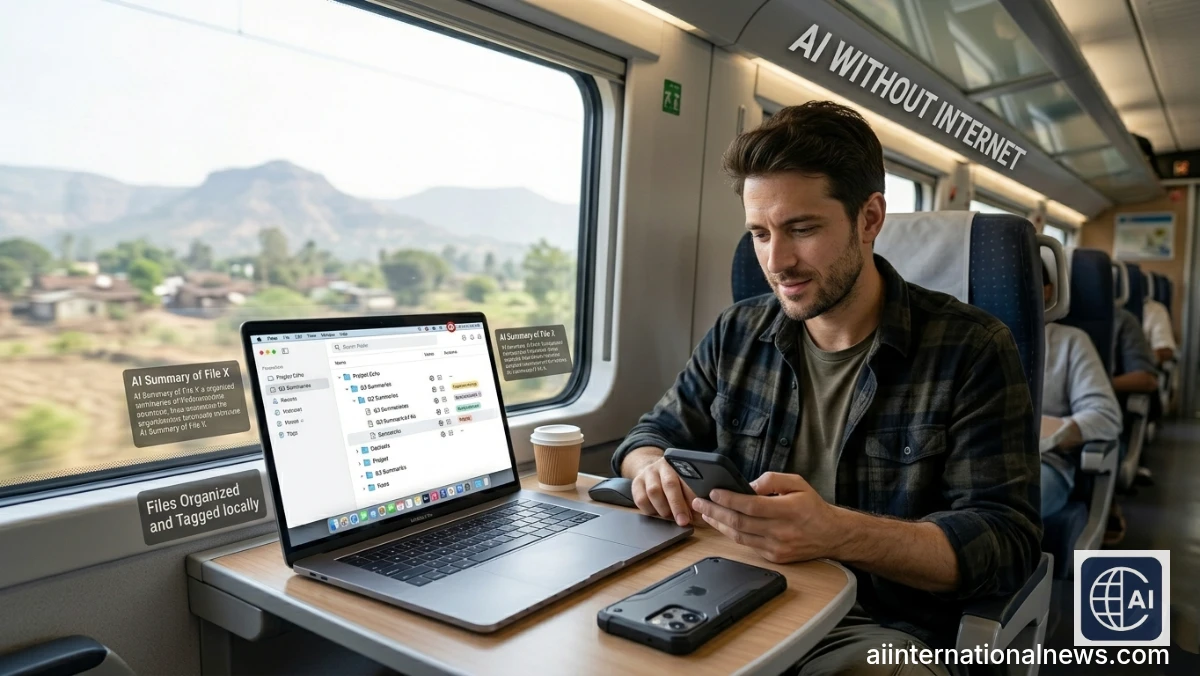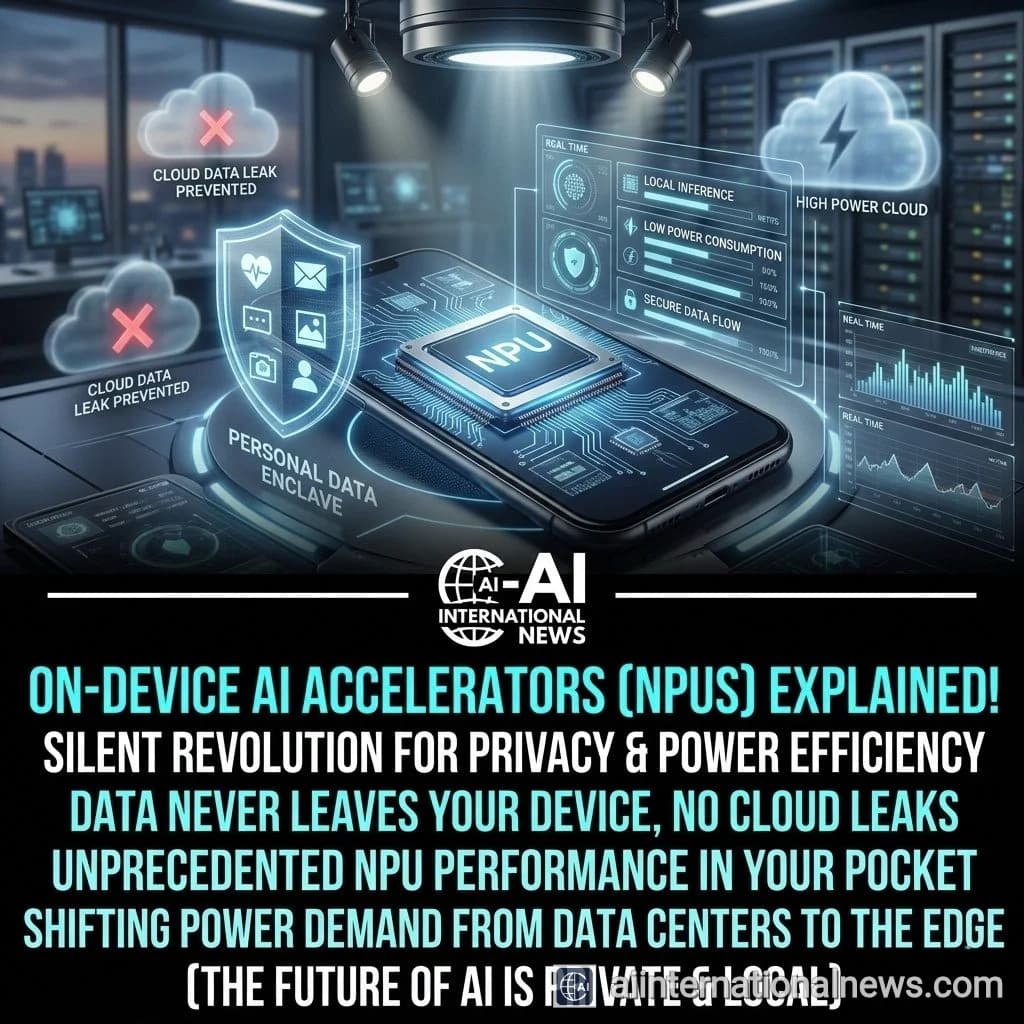
March 19, 2026. The defining battle of the AI era is no longer about which model has the most parameters. It is about where those parameters execute. As large language models (LLMs) and diffusion models explode in capability, the massive energy cost and data vulnerability of centralized cloud processing are pushing the industry toward a critical inflection point: the integration of powerful **On-Device AI Accelerators**, commonly known as Neural Processing Units (NPUs). This shift is not merely a technical upgrade; it is a fundamental realignment of the global privacy landscape and energy grid demands. shows the core concept.
The Privacy Paradox: Cloud vs. Local
For decades, the cloud has been the dominant force in computing, offering scalable power. But for AI, it presents a significant privacy paradox. Processing sensitive data—personal health metrics, financial records, real-time video streams, private conversations—in centralized servers, regardless of encryption, creates single points of catastrophic failure. The emerging standard for 2026 is data minimization through local processing. This means that inference—the active decision-making of an AI—must happen on the edge, on the device itself.
Governments are taking note. The European Commission's AI Act, initially focusing on high-risk applications, is being updated to reflect the necessity of local inference for personal data protection. Recent privacy scandals involving data leakage from major cloud providers (e.g., data breach reports in major financial times) have accelerated this legislative push. Organizations like the Electronic Frontier Foundation (EFF) argue that true privacy in the AI age can only be achieved through local execution. Source: Multiple policy and advocacy reports from early 2026.
The Rise of the Dedicated NPU
The solution to this paradox is hardware. CPU (Central Processing Unit) architecture is too sequential for AI's massive parallel matrix multiplications. GPUs (Graphics Processing Units) are parallel but extremely power-hungry. The NPU is a purpose-built accelerator, specifically designed for AI inference. These dedicated chips are highly efficient at managing data flow, minimizing data movement (the biggest bottleneck in AI energy consumption), and optimizing model weights.
By 2026, integrated NPUs are ubiquitous, found in everything from entry-level smartphones to smart city infrastructure. Apple Silicon's Neural Engine, Qualcomm's Hexagon NPU in Snapdragon, and Google's Tensor units have all reached unprecedented performance levels. Tech analyst reports confirm that NPU efficiency (TOPS per watt) is now the primary hardware metric for consumer tech. [Image comparing CPU, GPU, and NPU architectures] illustrates why NPUs dominate this space. Source: Manufacturer technical papers and independent reviews.
Energy Grids on the Brink
Perhaps the most significant impact of the local AI shift is environmental. Centralized AI data centers are massive energy drains. Studies by research institutions like the MIT Technology Review suggest that training and running large cloud models is unsustainable on current energy trajectories. Major news outlets have documented how data centers are pushing regional power grids to their breaking points. By moving inference locally, we shift the energy load from massive data centers to millions of smaller, highly efficient consumer devices.
The NPU's efficiency is key here. While a cloud inference might cost tens of watts per request, a local NPU can perform complex tasks at a fraction of a watt. This localized processing model reduces transmission losses (which can account for 5-10% of total grid energy), utilizes varied local power sources (including renewable microgrids), and leverages the vast, distributed efficiency of the entire consumer hardware ecosystem.
Abhijeet's Take: We are witnessing the decentralization of intelligence. The argument used to be 'Cloud offers scalability.' Today, the argument is 'Local offers security and sustainability.' The integrated NPU is the most significant privacy tool since end-to-end encryption. In 2026, the real innovation isn't a smarter chatbot; it's the hardware in your pocket that can run it without calling home. If you are building AI, and it relies on the cloud for basic inference, you are building an obsolete system. The future is local, private, and efficient.
The Interoperability Challenge
The successful transition to a local AI world faces one final hurdle: interoperability. How do disparate devices, running different OS kernels and NPU architectures, share data and coordinate actions? This is where software frameworks like ONNX (Open Neural Network Exchange) and TensorFlow Lite are critical. They are developing standard execution engines that allow models trained on one framework to run efficiently on any certified NPU, regardless of the underlying hardware or software stack.
Protocols for Secure Multiparty Computation (SMPC) and Federated Learning, managed by organizations like the W3C (World Wide Web Consortium), are essential for multi-device collaboration without exposing raw local data. This complex interplay of hardware, policy, and software standardization is the defining challenge of the next phase of the AI revolution.