March 17, 2026. The world of artificial intelligence has officially moved past the simple text generation models of the early 2020s. We have entered the age of autonomous systems, where AI agents can execute complex, multi-step tasks across diverse software environments. Yet, at the heart of this revolution lies a critical, and often misunderstood, technical hurdle: the orchestration of these agents. This is where the concept of **Universal Neural Controllers (UNCs)** is now emerging as the next critical frontier in AI research and development.
For years, a key limitation of large language models (LLMs) was that they were designed as stateless, reactive systems. They processed an input and generated an output, with no inherent memory, planning ability, or true understanding of causal reasoning beyond text patterns. Moving from this 'brain-in-a-vat' paradigm to true agency requires a new architecture—one that acts more like an operating system's kernel, managing state, tools, and multi-model interactions. This orchestrating layer is the UNC.
What is a Universal Neural Controller (UNC)?
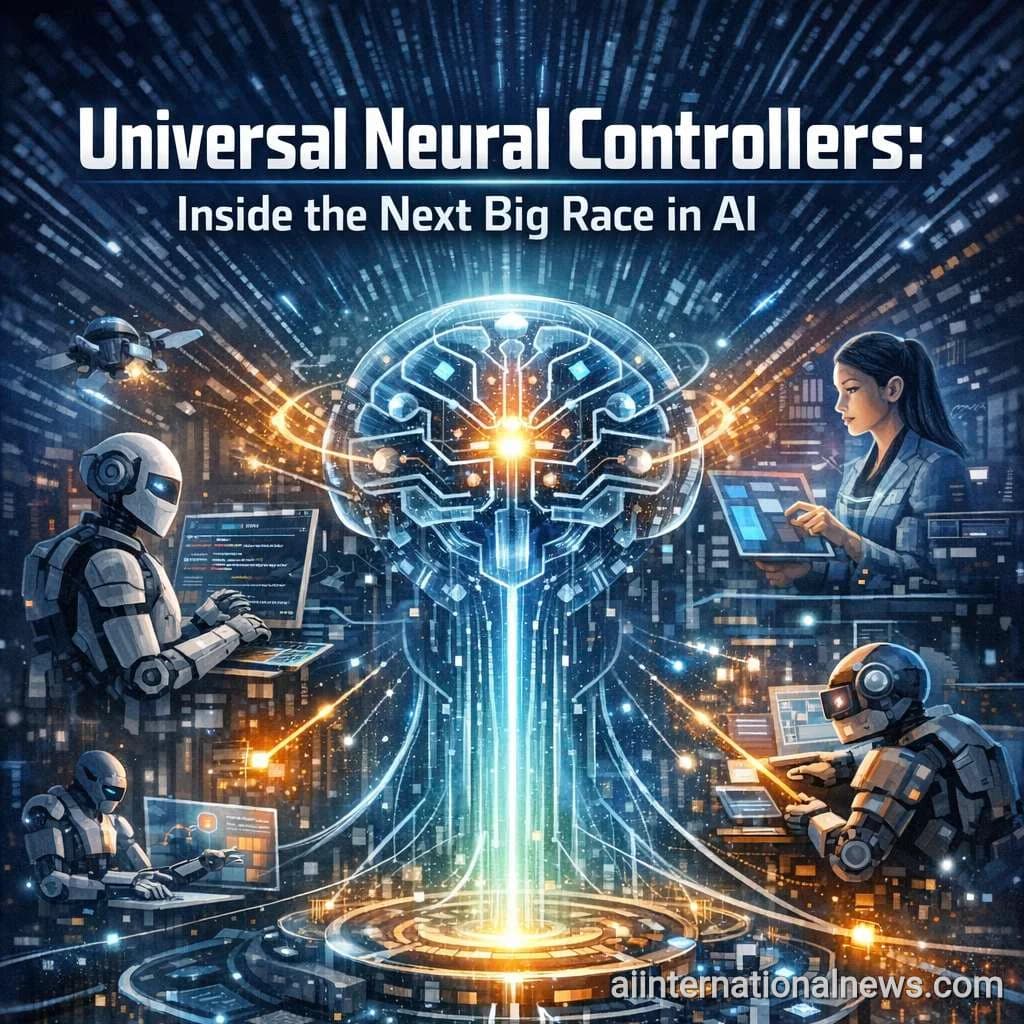
A Universal Neural Controller is not a standalone large model. It is a specialized, lightweight, and incredibly fast component within a cognitive architecture that manages the entire lifecycle of an autonomous AI agent's actions. Its primary function is context orchestration, tool use routing, memory management, and hierarchical planning. shows how a UNC sits at the intersection of various subsystems.
Think of it as the 'neurological system' to the Large Model's 'cognitive brain'. While a base model like Llama 4 might provide raw linguistic reasoning, it is the UNC that determines *when* to use it, *what* tools it needs to access, and *how* to process its output before looping back into the reasoning-action cycle. The emerging consensus among researchers at places like Stanford Human-Centered AI and DeepMind is that this orchestration layer is now the bottleneck in scaling AI agent capabilities. (Source: Multiple recent technical blogs and symposium papers).
The Core Modules of UNCs: Orchestrating Agency
To create a cohesive UNC, several critical modules are tightly integrated. While each large-scale tech company has its internal name, the conceptual modules are consistent across the industry:
- Context and State Manager: The brain of the UNC, maintaining the agent's short-term contextual memory, session state, and current goal hierarchy.
- Model and Tool Router: It decides which foundation model to use (e.g., small, specialized model vs. large multimodal model) and which external software tools (e.g., a web browser, database, or API) are required. A classic challenge it solves is managing dependencies during multi-tool execution.
- Episodic and Long-Term Memory: Crucial for personalization and complex multi-day tasks, this module manages vector databases and relational graphs to store and retrieve past user interactions and generalized knowledge. The challenges are discussed in several seminal papers in 2024-2025.
- Planning and Reasoning Engine: This is where the core loop occurs. It takes a goal, decomposes it into sub-tasks using methods like Tree of Thoughts (ToT) or Chain of Thoughts (CoT), and iteratively refines and executes the plan. A detailed breakdown of this loop is shown in .
The Competitors: Closed vs. Open Source Approaches
The race for UNCs is a complex battleground. On one side are massive corporate players like OpenAI and Google DeepMind, who are integrating these controllers deep within their proprietary model ecosystems to provide perfectly optimized agentic performance. Their advantage is vertical integration.
On the other side is the burgeoning open-source movement, led by Meta and organizations like Hugging Face, who are building modular and transparent UNC standards. This approach allows developers to mix and match foundation models with controllers from different vendors, preventing vendor lock-in but requiring more manual integration. The debate over which paradigm is more efficient and secure is the defining conflict of 2026. This conflict parallels the classic browser wars or operating system competitions of the past.
UNCs and the Path to AGI (Artificial General Intelligence)
Perhaps the most profound implication of Universal Neural Controllers is their role in bridging the gap to truly general-purpose systems. By enabling models to function as unified cognitive systems, UNCs allow for real-time model blending—for instance, using a specialized model for mathematical calculations while a large language model manages natural language communication. The neuro-symbolic approach, combining deep learning with symbolic reasoning managed by the UNC, is a crucial step towards robust AGI, as highlighted in several seminal papers on the limits of pure deep learning.
Abhijeet's Take: For all the focus on bigger models, the real revolution is happening in the orchestration layer. A UNC is basically the operating system for the intelligent software of tomorrow. In 2026, the company that builds the standard neural controller will be as powerful as Microsoft was with Windows. If you are not building on-device, modular, and open UNC standards, you are preparing to be locked into someone else's garden. As developers and users, we must push for transparency in how these cognitive operating systems are managed and secured.
The Next Frontier: Agent-to-Agent Communication and UNC Interoperability
As agents become more pervasive, the final challenge will be interoperability. A UNC manages an individual agent, but how do multiple agents, each controlled by a different UNC, communicate and collaborate? Protocols are currently being proposed to standardize how agents exchange structured knowledge graphs, share state, and resolve resource conflicts. The ultimate goal is to move from siloed personal agents to complex multi-agent simulations capable of solving humanity's largest problems, from scientific discovery to environmental modeling.