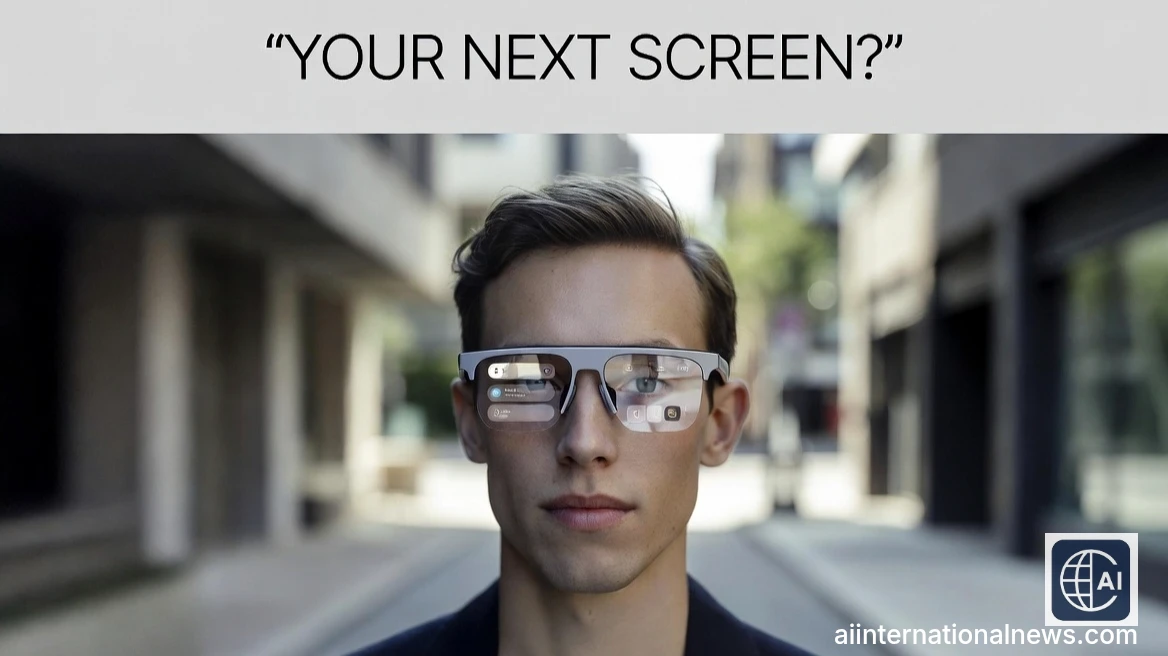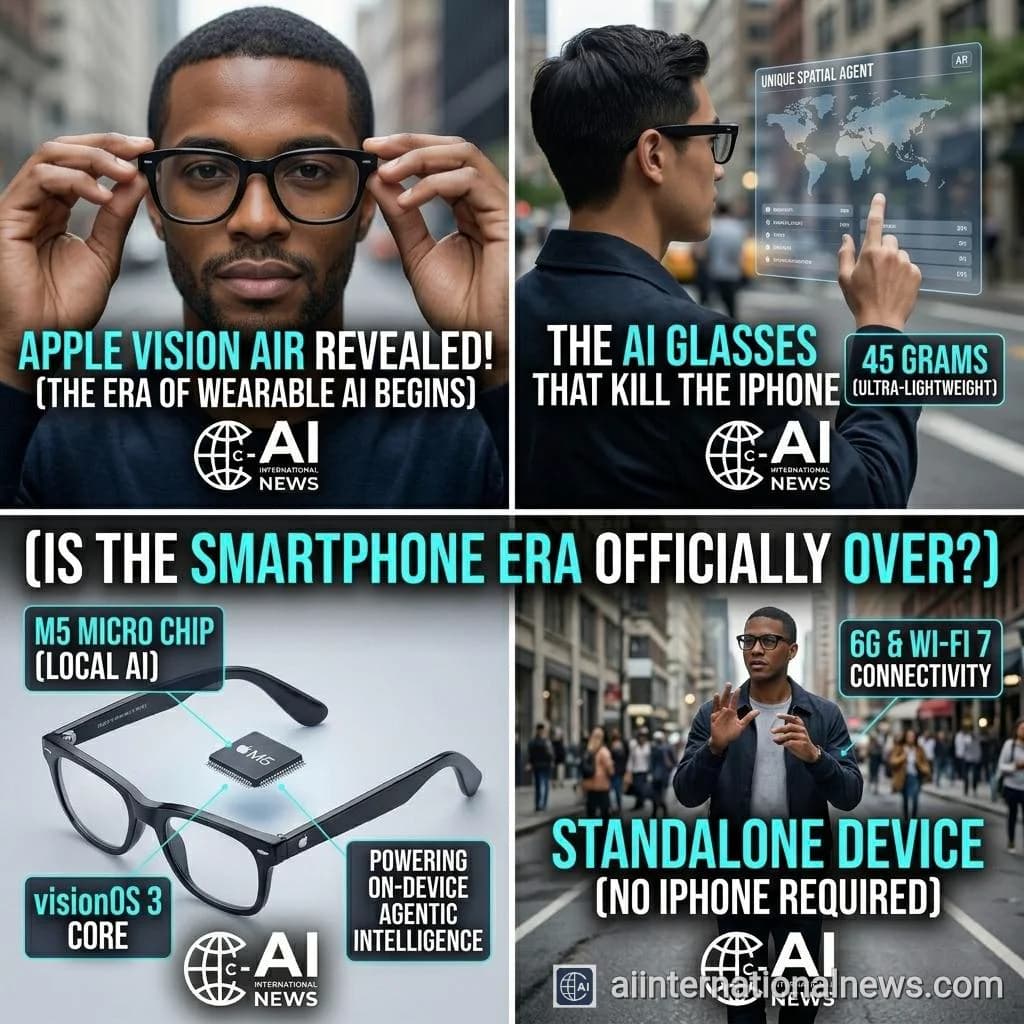
March 25, 2026. The smartphone era is officially on notice. In a surprise morning press release, Apple has finally unveiled its worst-kept secret: the Apple Vision Air. Unlike the bulky Vision Pro of the early 2020s, the Vision Air looks nearly identical to standard Ray-Ban wayfarers, weighs a mere 45 grams, and represents Apple's biggest hardware gamble since the original iPhone in 2007.
Hardware: The M5 Micro and True Standalone Power
The biggest shock of the announcement isn't the form factor, but the independence of the device. Early rumors suggested these glasses would need to be tethered to an iPhone for processing power. Instead, Apple introduced the completely new M5 Micro chip. This ultra-low-power silicon contains a specialized Neural Engine dedicated entirely to running local AI models.
According to initial hands-on reports from The Verge, the Vision Air features micro-OLED holographic projectors built directly into the lenses, providing a massive, high-definition augmented reality (AR) overlay. But the real magic lies in its cameras. The glasses feature continuous outward-facing spatial sensors that map your environment in real-time, feeding visual data directly into Apple's newly revamped AI operating system, visionOS 3.
Software: The 'Siri Spatial Agent'
Apple hasn't just put a screen on your face; they have put an autonomous agent in your eyes. Siri has been completely overhauled into the Siri Spatial Agent. Because the AI processes everything locally on the device (aligning with Apple's strict privacy-first marketing), it can instantly 'see' what you see.
As detailed in the official release on the Apple Newsroom, the use cases are entirely agentic. You can look at a restaurant across the street and whisper, "Book a table for two at 8 PM." The Siri Agent will recognize the restaurant, access their reservation system via the web, and confirm the booking in your field of vision. Look at a menu in a foreign language, and it live-translates the text seamlessly over the original font.
Abhijeet's Take: We have been waiting for the 'iPhone Killer' for a decade, and this is it. Apple realizes that typing on a glass rectangle is an outdated way to interact with artificial intelligence. The future is looking at the world and having an AI assistant perfectly integrated into your reality. By making it completely untethered, Apple has just made the smartwatch and the smartphone secondary accessories. The battle for the ultimate AI wearable just ended before the competitors could even figure out the hardware.
The Privacy Challenge and Pricing
Of course, a device that constantly records your point of view raises massive privacy concerns. Apple has heavily emphasized that the M5 Micro chip processes all visual data on-device, meaning no video feeds are ever sent to the cloud. However, tech analysts like Mark Gurman at Bloomberg point out that governments will likely scrutinize this new era of 'invisible' public recording.
Priced at $899, the Apple Vision Air isn't cheap, but it is priced competitively against high-end iPhones, heavily signaling Apple's intent to transition users away from screens and into spatial computing. Pre-orders begin next Friday, with units shipping in late April 2026.
Frequently Asked Questions (FAQs)
1. Do the Apple Vision Air glasses require an iPhone to work?
No. Thanks to the new M5 Micro chip, the Vision Air is a completely standalone device capable of connecting directly to 6G networks and Wi-Fi 7 without needing an iPhone nearby.
2. How much does the Apple Vision Air cost?
The base model is priced at $899 in the US, positioning it as a direct alternative to purchasing a flagship smartphone.
3. What is the battery life like?
Apple claims the Vision Air provides up to 14 hours of 'mixed-use' battery life, utilizing an innovative smart-sleep mode that powers down the projectors when you are not actively engaging with the AI or AR elements.